
Mérida, Mexico – Possibly the Hottest Place I Have Ever Been
Mérida may well be the hottest place I have ever been.
Now, that is a fairly bold statement coming from an Australian. We tend to think we have a reasonable understanding of heat. We grow up with summers that melt road surfaces, make steering wheels untouchable and convince sensible people that air conditioning was one of humanity’s greatest inventions.
But Mérida…
Mérida took things to another level.
It was the sort of heat that greeted you the moment you opened the front door, wrapped itself around you like a hot, damp blanket and politely informed you that any plans involving physical activity should probably be postponed until sometime in November.
Getting there was our first compromise.
We flew from Oaxaca rather than taking the bus.
I always wrestle with decisions like that because I firmly believe overland travel is the best way to experience a country. Buses, trains and ferries force you to watch landscapes change, notice small towns that never appear in guidebooks and meet people you would otherwise never encounter. Flying, on the other hand, feels a little like cheating. You disappear into an airport and magically emerge somewhere entirely different, having skipped everything in between.
Unfortunately, the bus route from Oaxaca to Mérida was anything but straightforward. It involved multiple changes, took an extraordinarily long time and required the sort of commitment normally associated with polar expeditions.
Eventually common sense won.
I wasn’t entirely happy about it.
But sometimes you simply have to get on the plane.
Oaxaca had been a great introduction to Mexico. We had enjoyed wandering its colourful streets, discovering the local food and getting our bearings in a completely new country. The apartment had been… well… functional rather than memorable, but you cannot win them all.
Besides, one of the joys of long-term travel is knowing that another place is always waiting.
The real reason we were heading to Mérida, however, was a house.
Not just any house.
An amazing house.
The world was still dealing with the aftermath of COVID, tourism had collapsed almost everywhere and Mexico was no exception. Accommodation that would normally have been well beyond our budget was suddenly available for prices that seemed almost too good to be true.
Slow travel has another advantage as well.
Rent somewhere for a month rather than a few nights and owners often become surprisingly generous with discounts.
The result?
We ended up renting a beautiful traditional Mexican house complete with high ceilings, colourful tiled floors, a modern western-style kitchen and bathrooms…
…and a swimming pool.
Normally, a pool is a pleasant luxury.
In Mérida it became essential survival equipment.
Within minutes of arriving we knew we had chosen well. We were going to be perfectly happy calling this place home for the next month.
Well…
Almost perfectly.
There was one tiny complication.
Feral cats.
A few days before we arrived, the owner had sent us a slightly unusual message.
A feral cat, he explained, had decided his garden was the perfect place to have five kittens. He had assumed she would move them somewhere else once they were old enough.
She hadn’t.
Instead, she had apparently decided the garden suited her just fine.
He had started feeding them and wondered if we would mind continuing while we stayed there.
Mind?
Of course not.
How hard could feeding a few cats possibly be?
Famous last words.
So there we were.
Temporary foster parents to one fiercely independent feral mother, her five kittens and another adolescent cat that appeared to have lingered from an earlier litter and clearly hadn’t got the memo about moving out.
To describe them as unfriendly would be generous.
They were tiny furry anarchists.
Touching them was out of the question.
Getting close to them required careful negotiations.
Most of our interactions involved them glaring suspiciously at us from a safe distance while we delivered food.
Eventually, with patience, routine and, I confess, the occasional squirt from a water pistol, I managed to establish some order at feeding time. The particularly bossy black kitten had developed a habit of stealing everyone else’s dinner, so my role gradually evolved into referee, food distributor and crowd controller.
It wasn’t exactly how I had imagined spending my mornings in Mexico.
But somehow it became part of daily life.
Before long we had settled into a comfortable routine.
Each morning we wandered to our favourite café for coffee before picking up fresh supplies from a nearby supermarket on the way home.
The produce was excellent. Fresh fruit, vegetables, bread and local ingredients made eating at home both easy and enjoyable.
Most afternoons followed a remarkably similar pattern.
Pool.
Read.
Cool down.
Repeat.
There simply wasn’t much alternative.
By late morning the temperature was already climbing enthusiastically towards ridiculous.
The locals, sensibly, slowed down.
We followed their lead.
Every now and then we ventured into the historic centre to explore.
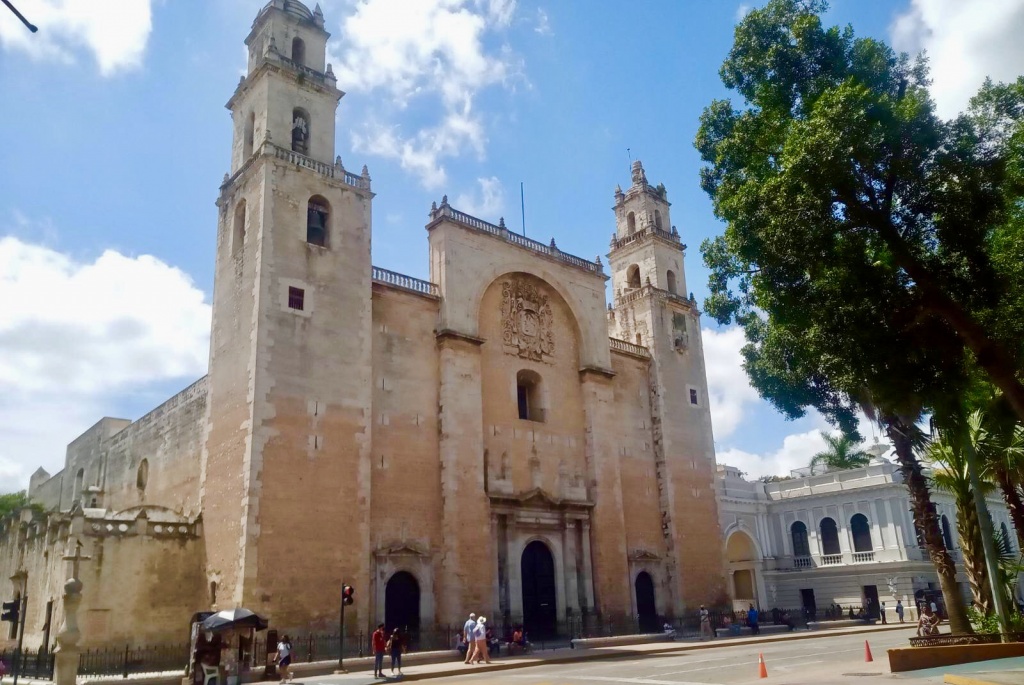
Mérida is one of the oldest colonial cities in Mexico, founded in 1542 on the site of the ancient Maya city of T’hó. The heart of the city centres around the impressive Plaza Grande, where locals gather beneath shady trees while visitors admire the elegant colonial architecture. The enormous Mérida Cathedral, one of the oldest cathedrals in the Americas, dominates the square, while nearby grand government buildings and museums tell the story of the region.
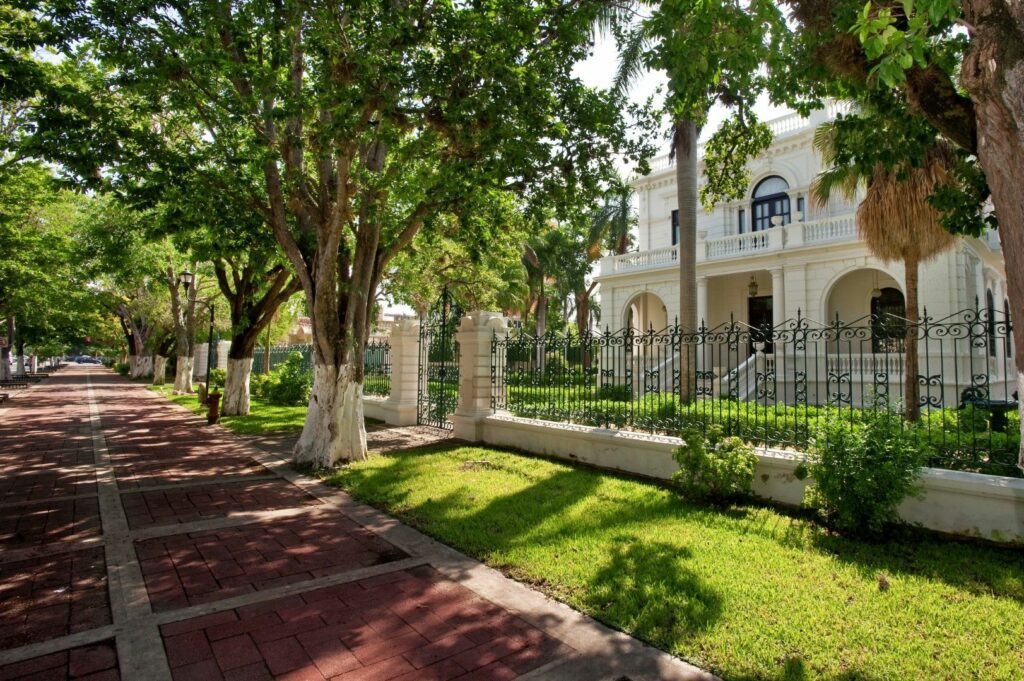
One of our favourite walks was along Paseo de Montejo, the city’s broad tree-lined boulevard.
The avenue is lined with magnificent mansions that wouldn’t have looked out of place in Paris.
Their existence tells the story of Mérida’s extraordinary wealth during the late nineteenth and early twentieth centuries, when the Yucatán became immensely prosperous through the production of henequén — a tough fibre extracted from agave plants and used around the world to make rope, twine and sacks.
For a while, henequén was known as green gold.
The fortunes it created were staggering.
Many of those elegant mansions remain today as reminders of just how wealthy Mérida once became.
One day we decided it was time to escape the city and hired a driver to take us to Uxmal.
Everyone has heard of Chichén Itzá.
Uxmal, not so much.
Which is rather a shame.
In many ways, I actually preferred it.
Yes, Uxmal is a magnificent ancient Maya city and one of the finest archaeological sites in Mexico. Arriving early meant we had several glorious hours wandering through the ruins almost entirely on our own before the inevitable convoy of tour buses arrived.
The architecture is extraordinary.
Unlike many Maya sites, Uxmal is famous for its intricate stone mosaics, elaborate carvings and graceful proportions. The magnificent Pyramid of the Magician, rising steeply above the complex with its unusual rounded shape, immediately draws your attention, while the vast Governor’s Palace is regarded as one of the masterpieces of ancient Maya architecture. Everywhere you look there are beautifully decorated facades, courtyards and ceremonial spaces that somehow still manage to inspire awe more than a thousand years after they were built.
It is one of those places that quietly exceeds expectations.
If Chichén Itzá gets the headlines, Uxmal deserves far more attention than it receives.
The rest of the month passed quietly.
And that was exactly what we wanted.
Long-term travel is not about rushing from one attraction to the next every single day. If you are travelling for months at a time, life has to become… well… life.
You develop routines.
You discover favourite cafés.
You cook.
You do the washing.
You answer emails.
You buy groceries.
You occasionally do absolutely nothing.
Partly because you want to.
Mostly because it was too bloody hot to contemplate anything more ambitious.
Then, almost before we realised it, the month had come to an end.
It was time to pack our bags once again, say goodbye to our wonderful house, our indispensable swimming pool and, of course, our still extremely feral feline family.
The kittens had grown.
The mother still regarded us with deep suspicion.
The black troublemaker remained convinced everyone else’s dinner belonged to him.
Some things never change.
With one last look around our little oasis, we climbed aboard a bus and headed south towards the cool mountains of Chiapas and the beautiful colonial town of San Cristóbal de las Casas.
What could possibly go wrong?