


Santorini & Samos
Two Greek islands, one stomach bug and a very slow ferry through the Aegean
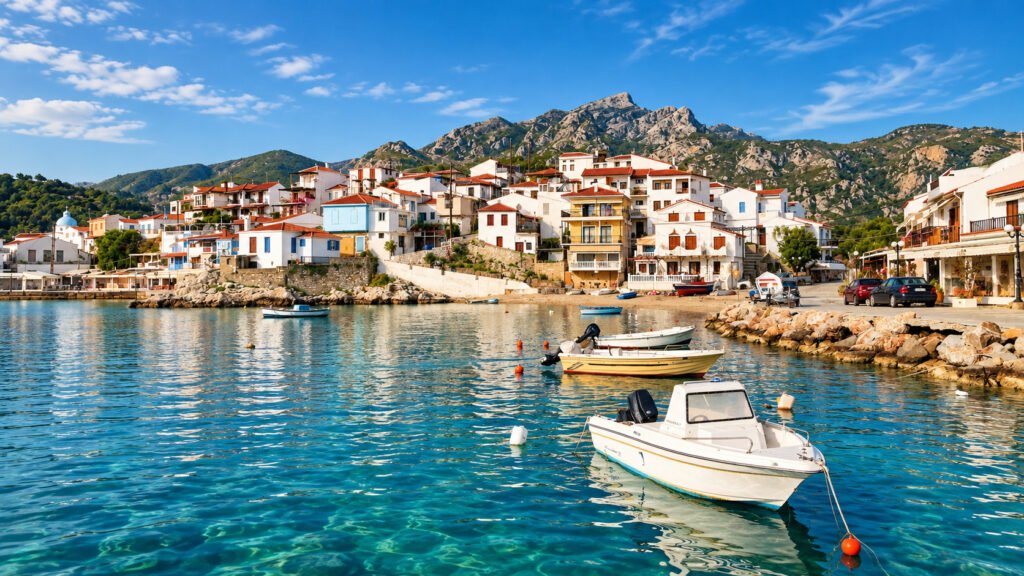
Our next Greek island was Samos. We arrived by ferry into a very pretty harbour town and made our way up the hill to an apartment overlooking the water. The apartment itself was lovely, with a balcony and a fabulous view across the harbour, so things were looking promising.
Unfortunately, Samos never really worked for us.
Perhaps we were unlucky, perhaps we were staying in the wrong part of the island, or perhaps it simply suffered by comparison with some of the other Greek islands we had already visited. Whatever the reason, it felt much more geared towards tourists and we never really settled into it.
The restaurants were expensive for what they were serving and much of the food was surprisingly ordinary. This was particularly disappointing because Greece had been feeding us extremely well up until then and we had become accustomed to sitting down almost anywhere and being given something simple, fresh and delicious.
Samos seemed determined to interrupt that run.
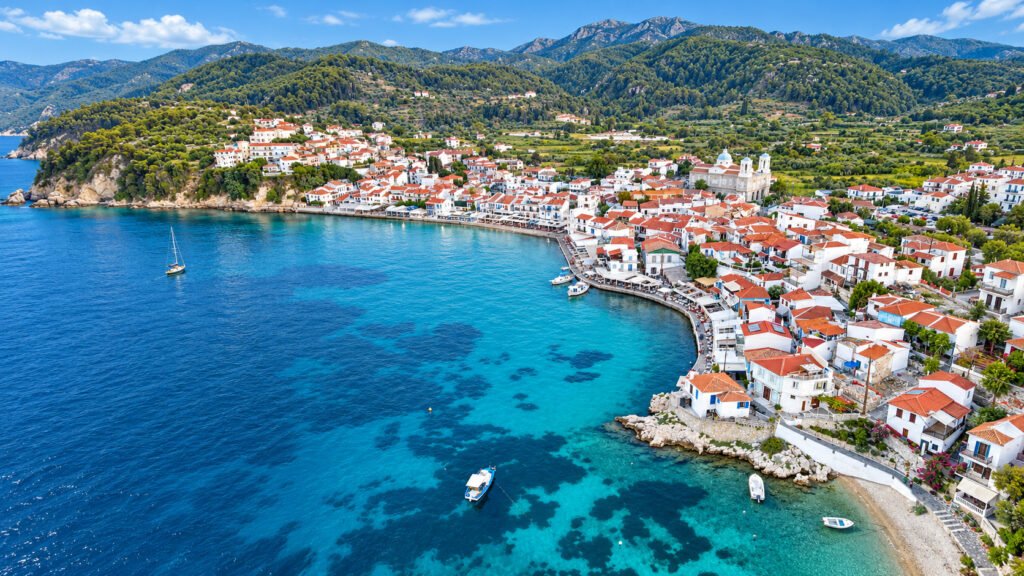
It is actually a beautiful island and much greener than many of the Greek islands, with pine-covered hills, olive groves and vineyards. It also has a long history and is the birthplace of Pythagoras, whose theorem has caused generations of schoolchildren considerably more grief than he could ever have imagined.
There were beaches, villages and ancient sites to explore.
We did not explore nearly enough of them.
First we lost our ferry tickets.
This produced the usual frantic search through backpacks, pockets, books, bags and every other place where the tickets quite clearly were not. Both of us could remember them being put somewhere safe.
This turned out to be extremely successful.
They were so safe we never saw them again.
Eventually we gave up and organised replacements, which was irritating but not disastrous.
Then we both got sick.
A stomach bug is capable of reducing even the most beautiful Greek island to a room with a bathroom, and once both of us were feeling dreadful there was very little enthusiasm left for sightseeing.
Suddenly Pythagoras, vineyards and picturesque villages could all wait.
Samos simply became one of those places that probably deserved a better chance than we gave it. Travel does not always work out neatly. Sometimes you arrive at the wrong time, stay in the wrong place, lose something important and then spend the next couple of days feeling too ill to care.
By the time we were due to leave, neither of us was especially upset about it.
Our next destination was Santorini.
Because we were travelling towards the end of the season, many of the faster and more direct ferries had already stopped running. Instead we found ourselves on what can only be described as the Aegean version of a milk run.
It stopped everywhere.
Every time the ferry appeared to be properly underway, it would slow down again and pull into another island. People got off, people got on, cars appeared, trucks disappeared, and then off we would go again for another short stretch before repeating the whole process somewhere else.
At one point I became convinced we had stopped at the same island twice.
We probably hadn’t.
But after enough hours on the ferry I was no longer prepared to swear to it.
The Aegean is beautiful, but there comes a point when another picturesque island appearing through the window simply means another half-hour at the dock.
Eventually, after a very long day, we reached Santorini.
I had expected Santorini to impress me immediately.
It didn’t.
Leaving the port and travelling across the island, it looked dry, dusty and rather barren. There were low scrubby hills, roads and not much else that immediately explained why people travelled halfway around the world to see it.
I remember looking around and thinking that it appeared to be another dry Greek island with an exceptionally good publicity department.
Then we reached the caldera.
That changed things.
The cliffs dropped almost vertically towards the deep blue water below, with the volcanic islands sitting in the middle of the enormous flooded caldera. White villages clung to the cliff tops and the Aegean stretched away into the distance.
It was extraordinary.
Suddenly all those photographs of Santorini made sense.
There are places that have been photographed so often that you arrive expecting the real thing to be slightly disappointing.
Santorini wasn’t.
The sheer scale of the caldera is difficult to understand from photographs. Standing there looking down into it, you finally understand why the island has become so famous.
We stayed a couple of kilometres outside Fira at Stavros Villas, a small family-run hotel that turned out to be a wonderful choice. By then the tourist season was almost over and the place was virtually deserted.
This suited us perfectly.
The weather was glorious, the pool was quiet and we had views across the Mediterranean. After Samos, lost tickets and several unpleasant days involving our digestive systems, we were not particularly interested in a demanding sightseeing schedule.
Breakfast, pool, a bit of exploring, lunch, perhaps another sit by the pool.
It was a routine we adapted to remarkably quickly.
Of course we went to Oia for the famous sunset.
You cannot really go to Santorini without eventually joining hundreds of other people standing around waiting for the sun to disappear.
By late afternoon people were positioning themselves on walls, steps, terraces and every other available piece of high ground, cameras ready.
Normally this level of organised sunset appreciation would make me slightly suspicious.
But it really was beautiful.
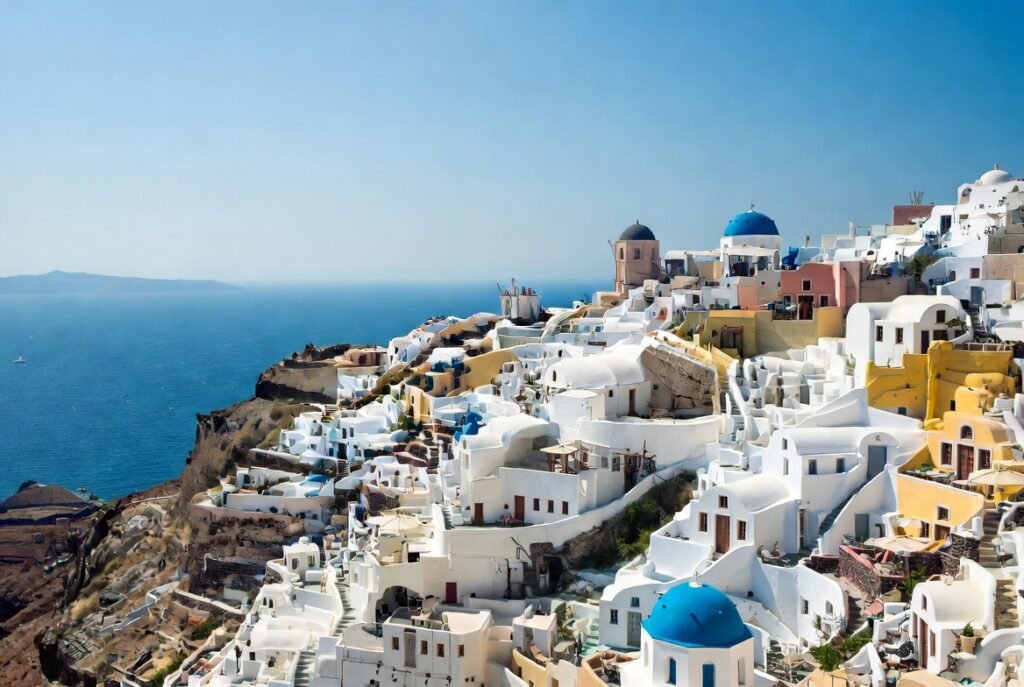
Oia itself was lovely, with its whitewashed houses spilling down the hillside, narrow lanes twisting between buildings and little blue-domed churches appearing between the rooftops.
As the sun began to drop, the light changed and the white buildings took on shades of gold and pink. The whole caldera seemed to glow.
For once, the hype was justified.
We also took a boat trip out into the caldera to visit the volcanic islands in the centre.
Santorini is the remains of a much larger volcanic island that was dramatically reshaped by a huge eruption thousands of years ago. The centre collapsed and the sea flooded in, creating the caldera that defines the island today.
You understand the scale much better from the water.
From below, the cliffs rise almost vertically out of the sea with the villages sitting along the top as though someone has carefully balanced them there.
It looked completely different from the view above and made my original assessment of Santorini as dry and dusty seem a little premature.
There was, apparently, rather more to it than that.
Eventually it was time to leave.
Our next destination was supposed to be Mykonos and, unusually for us, we had the ferry booked and everything appeared reasonably organised.
Naturally, a storm arrived.
The wind picked up, the sea became rough and ferries began disappearing from the schedule.
Ours was cancelled.
We were stranded on Santorini.
This sounds more dramatic than it was.
There are considerably worse places to be stranded than a nearly empty family-run hotel with a swimming pool and views across the Mediterranean.
There was nothing we could do about it anyway, so we stayed put, watched the weather roll across the Aegean and waited for someone to decide the sea had calmed down enough for ferries to start running again.
Samos and Santorini ended up giving us two completely different experiences.
Samos had begun well with a beautiful apartment overlooking the harbour, but lost ferry tickets, ordinary food and a stomach bug rather overwhelmed its better qualities.
Santorini did the opposite. It began with an interminable ferry journey and a first impression of dust and scrub, then completely redeemed itself the moment we saw the caldera.
By the time the storm cancelled our ferry, neither of us was particularly distressed about having to stay a little longer.
There was a pool.
We knew where the good food was.
And for once a cancelled travel plan had actually worked in our favour.
Santorini & Samos
Two Greek islands, one stomach bug and a very slow ferry through the Aegean
Our next Greek island was Samos. We arrived by ferry into a very pretty harbour town and made our way up the hill to an apartment overlooking the water. The apartment itself was lovely, with a balcony and a fabulous view across the harbour, so things were looking promising.
Unfortunately, Samos never really worked for us.
Perhaps we were unlucky, perhaps we were staying in the wrong part of the island, or perhaps it simply suffered by comparison with some of the other Greek islands we had already visited. Whatever the reason, it felt much more geared towards tourists and we never really settled into it.
The restaurants were expensive for what they were serving and much of the food was surprisingly ordinary. This was particularly disappointing because Greece had been feeding us extremely well up until then and we had become accustomed to sitting down almost anywhere and being given something simple, fresh and delicious.
Samos seemed determined to interrupt that run.
It is actually a beautiful island and much greener than many of the Greek islands, with pine-covered hills, olive groves and vineyards. It also has a long history and is the birthplace of Pythagoras, whose theorem has caused generations of schoolchildren considerably more grief than he could ever have imagined.
There were beaches, villages and ancient sites to explore.
We did not explore nearly enough of them.
First we lost our ferry tickets.
This produced the usual frantic search through backpacks, pockets, books, bags and every other place where the tickets quite clearly were not. Both of us could remember them being put somewhere safe.
This turned out to be extremely successful.
They were so safe we never saw them again.
Eventually we gave up and organised replacements, which was irritating but not disastrous.
Then we both got sick.
A stomach bug is capable of reducing even the most beautiful Greek island to a room with a bathroom, and once both of us were feeling dreadful there was very little enthusiasm left for sightseeing.
Suddenly Pythagoras, vineyards and picturesque villages could all wait.
Samos simply became one of those places that probably deserved a better chance than we gave it. Travel does not always work out neatly. Sometimes you arrive at the wrong time, stay in the wrong place, lose something important and then spend the next couple of days feeling too ill to care.
By the time we were due to leave, neither of us was especially upset about it.
Our next destination was Santorini.
Because we were travelling towards the end of the season, many of the faster and more direct ferries had already stopped running. Instead we found ourselves on what can only be described as the Aegean version of a milk run.
It stopped everywhere.
Every time the ferry appeared to be properly underway, it would slow down again and pull into another island. People got off, people got on, cars appeared, trucks disappeared, and then off we would go again for another short stretch before repeating the whole process somewhere else.
At one point I became convinced we had stopped at the same island twice.
We probably hadn’t.
But after enough hours on the ferry I was no longer prepared to swear to it.
The Aegean is beautiful, but there comes a point when another picturesque island appearing through the window simply means another half-hour at the dock.
Eventually, after a very long day, we reached Santorini.
I had expected Santorini to impress me immediately.
It didn’t.
Leaving the port and travelling across the island, it looked dry, dusty and rather barren. There were low scrubby hills, roads and not much else that immediately explained why people travelled halfway around the world to see it.
I remember looking around and thinking that it appeared to be another dry Greek island with an exceptionally good publicity department.
Then we reached the caldera.
That changed things.
The cliffs dropped almost vertically towards the deep blue water below, with the volcanic islands sitting in the middle of the enormous flooded caldera. White villages clung to the cliff tops and the Aegean stretched away into the distance.
It was extraordinary.
Suddenly all those photographs of Santorini made sense.
There are places that have been photographed so often that you arrive expecting the real thing to be slightly disappointing.
Santorini wasn’t.
The sheer scale of the caldera is difficult to understand from photographs. Standing there looking down into it, you finally understand why the island has become so famous.
We stayed a couple of kilometres outside Fira at Stavros Villas, a small family-run hotel that turned out to be a wonderful choice. By then the tourist season was almost over and the place was virtually deserted.
This suited us perfectly.
The weather was glorious, the pool was quiet and we had views across the Mediterranean. After Samos, lost tickets and several unpleasant days involving our digestive systems, we were not particularly interested in a demanding sightseeing schedule.
Breakfast, pool, a bit of exploring, lunch, perhaps another sit by the pool.
It was a routine we adapted to remarkably quickly.
Of course we went to Oia for the famous sunset.
You cannot really go to Santorini without eventually joining hundreds of other people standing around waiting for the sun to disappear.
By late afternoon people were positioning themselves on walls, steps, terraces and every other available piece of high ground, cameras ready.
Normally this level of organised sunset appreciation would make me slightly suspicious.
But it really was beautiful.
Oia itself was lovely, with its whitewashed houses spilling down the hillside, narrow lanes twisting between buildings and little blue-domed churches appearing between the rooftops.
As the sun began to drop, the light changed and the white buildings took on shades of gold and pink. The whole caldera seemed to glow.
For once, the hype was justified.
We also took a boat trip out into the caldera to visit the volcanic islands in the centre.
Santorini is the remains of a much larger volcanic island that was dramatically reshaped by a huge eruption thousands of years ago. The centre collapsed and the sea flooded in, creating the caldera that defines the island today.
You understand the scale much better from the water.
From below, the cliffs rise almost vertically out of the sea with the villages sitting along the top as though someone has carefully balanced them there.
It looked completely different from the view above and made my original assessment of Santorini as dry and dusty seem a little premature.
There was, apparently, rather more to it than that.
Eventually it was time to leave.
Our next destination was supposed to be Mykonos and, unusually for us, we had the ferry booked and everything appeared reasonably organised.
Naturally, a storm arrived.
The wind picked up, the sea became rough and ferries began disappearing from the schedule.
Ours was cancelled.
We were stranded on Santorini.
This sounds more dramatic than it was.
There are considerably worse places to be stranded than a nearly empty family-run hotel with a swimming pool and views across the Mediterranean.
There was nothing we could do about it anyway, so we stayed put, watched the weather roll across the Aegean and waited for someone to decide the sea had calmed down enough for ferries to start running again.
Samos and Santorini ended up giving us two completely different experiences.
Samos had begun well with a beautiful apartment overlooking the harbour, but lost ferry tickets, ordinary food and a stomach bug rather overwhelmed its better qualities.
Santorini did the opposite. It began with an interminable ferry journey and a first impression of dust and scrub, then completely redeemed itself the moment we saw the caldera.
By the time the storm cancelled our ferry, neither of us was particularly distressed about having to stay a little longer.
There was a pool.
We knew where the good food was.
And for once a cancelled travel plan had actually worked in our favour.