
The Loire Valley: Chambord & Cheverny
Royal hunting lodges, a hundred hounds and one very small tent
We had enjoyed our time in Avallon, strange camping-ground man and all, but by now there was no escaping the fact that our holiday was beginning to run out.
We still wanted to see a couple of the great châteaux of the Loire, and we wanted to leave ourselves a few days in Paris before flying back to Australia.
So once again we packed everything into the car and headed west, aiming for a camping ground somewhere south of Blois and within reasonable striking distance of the châteaux.
On paper, the camping ground looked impressive.
Swimming pools.
Tennis courts.
Games room.
Restaurant.
All the bells and whistles.
Unfortunately, it also appeared to contain half the population of northern Europe.
The place was jammed with enormous motorhomes and caravans, many surrounded by awnings, outdoor kitchens, bicycles, tables, chairs, inflatable toys and enough equipment to suggest their occupants had no immediate intention of returning home.
Then there was us.
Our entire tent fitted into a backpack.
We drove slowly through row after row of mobile palaces until somebody eventually directed us towards the outer reaches of the camping ground, where we were allocated a small patch of grass well away from the serious campers.
We put the tent up in a matter of minutes.
Looking around, I began to suspect we had been banished to the far corner because we lowered the tone.
Perhaps there was an unofficial minimum requirement of two bedrooms, a satellite dish and an outdoor kitchen before you were allowed anywhere near the swimming pool.
Our little backpacking tent clearly wasn’t going to make the grade.
Still, we were only there for a couple of nights.
Once settled, we wandered over to the restaurant expecting the sort of simple but decent meal we had found at so many camping grounds across France.
Hamburgers.
That was more or less it.
A hamburger.
After weeks of eating remarkably well in campsites all over the country, it was surprisingly disappointing.
Somewhere along the way we had obviously become spoilt.
A few weeks earlier a hamburger would probably have been perfectly acceptable. Now we were sitting in a French camping ground wondering where the duck confit had gone.
Never mind.
We hadn’t come to the Loire for the camping.
We had come for châteaux.
And châteaux we would see.
The following morning we set off for the granddaddy of them all.
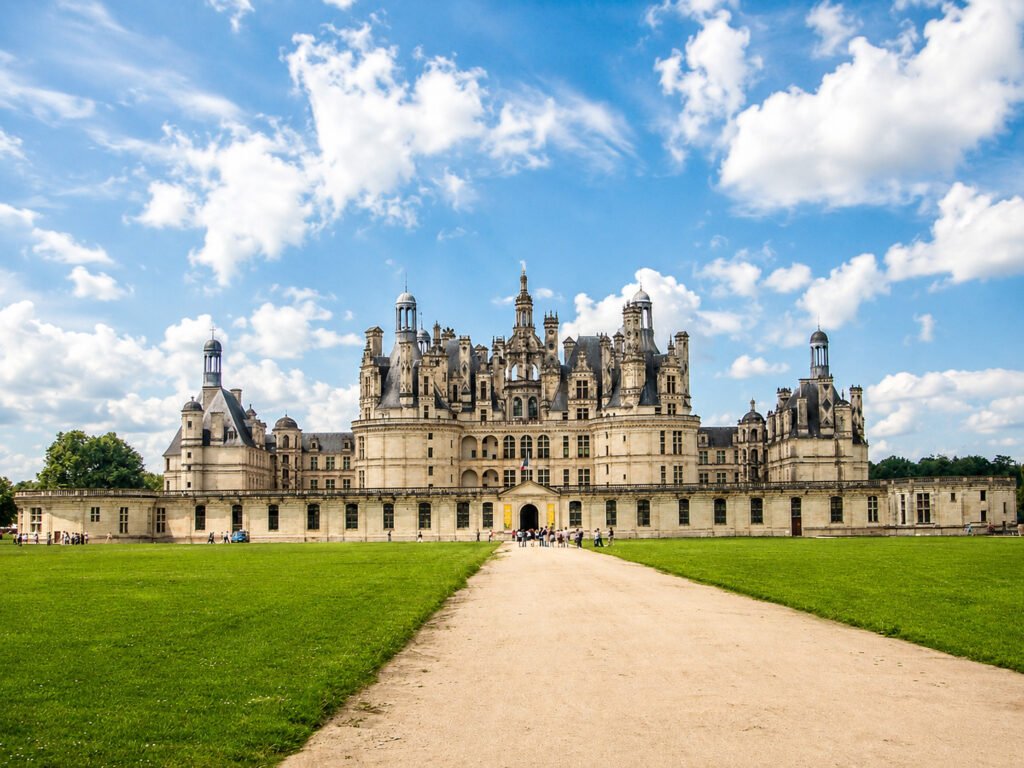
Château de Chambord.
Chambord is one of the great monuments of the French Renaissance, begun in 1519 for François I, a king with a passion for hunting, architecture and, it would seem, doing things on a scale that ensured nobody could possibly miss them.
It was conceived as a royal hunting retreat rather than a permanent home.
Although calling Chambord a hunting lodge does seem to be stretching the definition somewhat.
My idea of a hunting lodge is somewhere you might leave a pair of muddy boots beside the door.
François apparently had something else in mind.
The château eventually grew into an extraordinary mass of rooms, staircases, towers, terraces, chimneys and galleries, sitting in the middle of an equally extraordinary hunting estate.
The Domaine de Chambord covers more than 5,000 hectares of woodland, grassland and marsh, surrounded by a stone wall stretching for around thirty-two kilometres.
Thirty-two kilometres.
Even the fence was extravagant.
The forest was an important part of the reason Chambord existed at all. François I was a passionate hunter and wanted a grand royal retreat where he could hunt, entertain his court and impress visiting dignitaries.
The impressing people part certainly worked.
The strange thing is that after pouring so much energy into creating Chambord, François hardly lived there.
During his entire reign he spent only about fifty days at the château.
Fifty days.
It seemed a considerable amount of building for what amounted to a collection of long weekends.
But Chambord was never really intended to function like a modern house.
The French royal court was itinerant. The king travelled with an enormous entourage, and furniture, tapestries, supplies, servants and everything needed for royal life travelled with him.
When François arrived, Chambord came alive.
When he left, much of it became empty again.
Which perhaps explains why there was apparently no particular concern about making the place cosy.
And for all the history, photographs and statistics, nothing really prepares you for seeing Chambord for the first time.
We had parked the car and were walking towards the château when we came around a corner and suddenly there it was.
Chambord.
Even after all the castles and châteaux we had seen over the previous few weeks, it stopped us in our tracks.
It was enormous, but it wasn’t simply the size of the place.
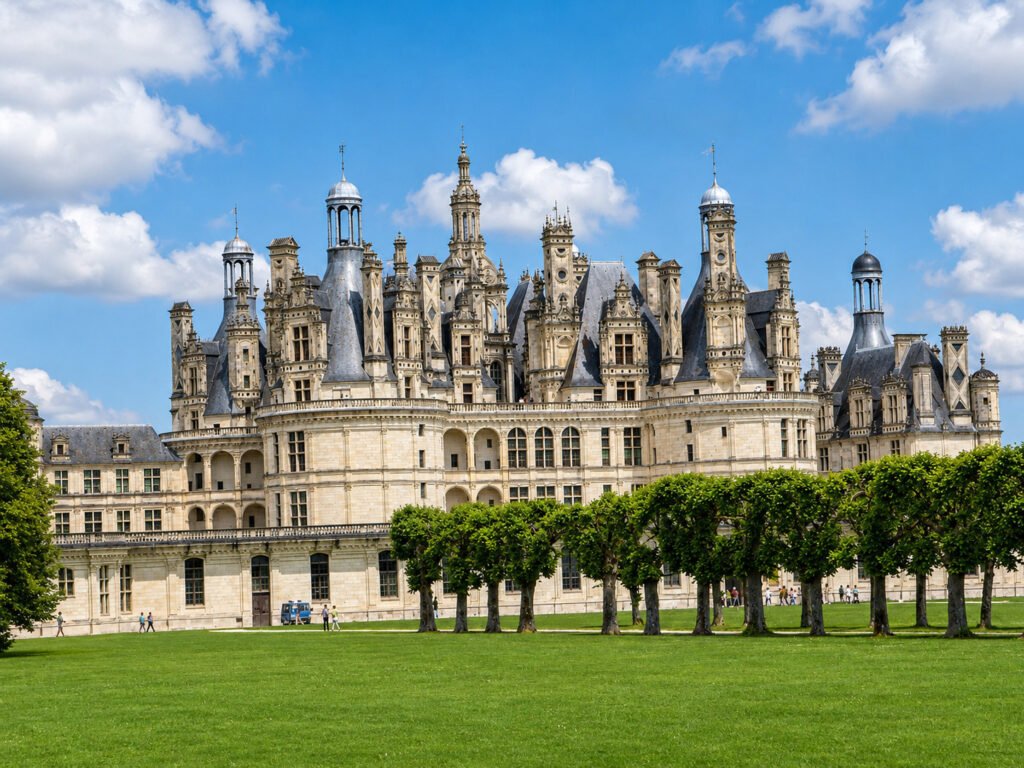
It was the roofline.
Towers, turrets, chimneys and lanterns rose in every direction, all crowded together above the vast pale stone building.
There seemed to be something new to look at wherever your eye landed.
For a moment we just stood there.
It was a genuine wow moment.
Then I was nearly knocked flying by a woman with an iPad attached to a tripod.
She was completely consumed by the business of getting the perfect photograph and appeared to have decided that the rest of us were simply obstacles standing between her and photographic greatness.
She darted one way and then another, repositioning the tripod, waving her arms and charging around without paying the slightest attention to anyone nearby.
At one point she came straight at me and I had to jump out of the way.
So much for quietly contemplating one of the masterpieces of the French Renaissance.
We gave her a very wide berth and continued along the magnificent approach towards the château, leaving her behind to conduct whatever complicated photographic operation was apparently underway.
Up close, Chambord became even more extraordinary.
There is something slightly mad about it.
The basic shape of the building is quite ordered and symmetrical, but above it rises this extraordinary forest of towers and chimneys, as though everyone involved in the construction had been allowed to add one more thing to the roof.
And then one more.
And perhaps another chimney while they were there.
Inside, the most famous feature is the great double-helix staircase at the centre of the château.
Two staircases wind around the same central core, allowing people to climb or descend at the same time, seeing one another through openings but without actually meeting.
Leonardo da Vinci is often associated with the idea. He spent the final years of his life in France under the patronage of François I, and the staircase shows the sort of fascination with geometry and movement that appears in Leonardo’s work, although exactly how involved he was in Chambord’s design remains uncertain.
Whatever the answer, it is brilliant.
We went up one side while visitors on the other staircase appeared and disappeared through openings across from us.
You could see them.
They could see you.
But somehow you never met.
We wandered through room after room, gallery after gallery, gradually working our way upwards until we reached the terraces.
And that was where Chambord really came together.
Standing among the towers and carved chimneys, looking out across the enormous forest surrounding the château, it became much easier to understand what François had been trying to create.
This wasn’t simply somewhere to stay.
It was a statement.
A very large statement.
We spent hours exploring the château and its grounds.
Chambord’s connection with horses and hunting has never completely disappeared, and the old stables and grounds are still used for equestrian demonstrations.
We stopped to watch the horses and riders performing with the château rising behind them.
It fitted the place perfectly.
With the horses, the forest and that extraordinary building in the background, it wasn’t difficult to imagine the estate centuries earlier when the king arrived with courtiers, servants, horses, hunting dogs and enough luggage to occupy half the Loire Valley.
It must have been quite an operation.
Eventually, reluctantly, we dragged ourselves away.
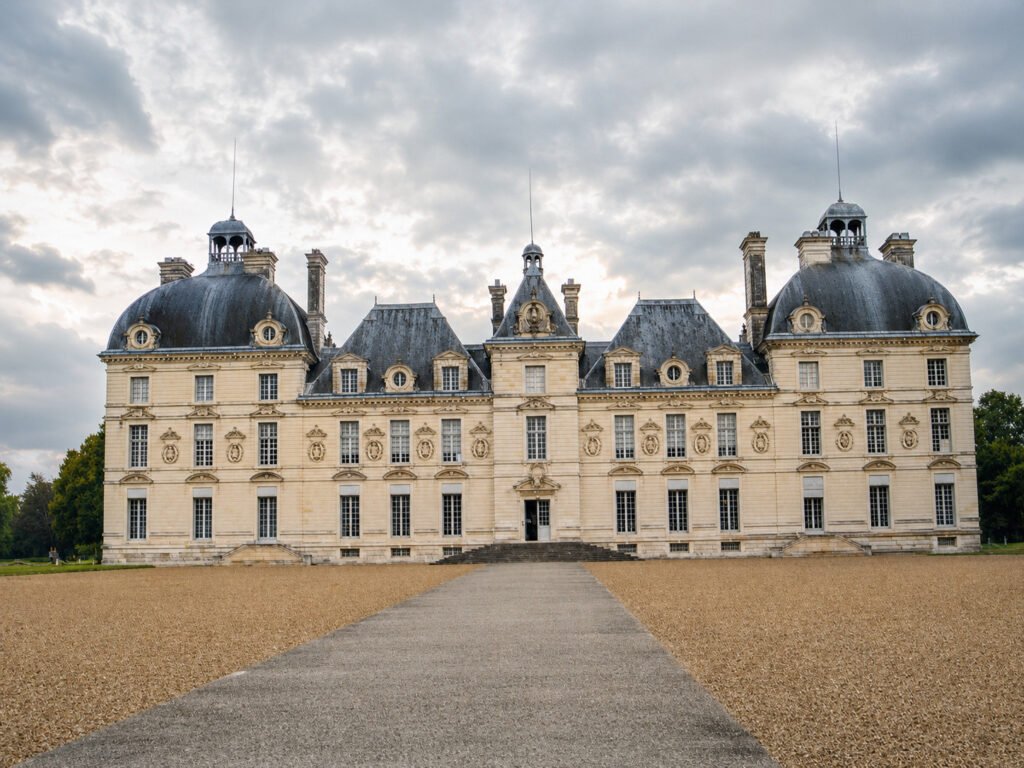
Our next stop was Château de Cheverny.
Cheverny couldn’t have been more different.
Where Chambord was vast, theatrical and determined to impress anyone within a thirty-kilometre radius, Cheverny felt almost restrained.
Admittedly, restrained is a relative term when discussing French châteaux.
The present château was built in the seventeenth century and has remained in the Hurault de Vibraye family for more than six hundred years.
Remarkably, it is still their home.
The family lives in the right-hand wing while much of the rest of the château is open to visitors.
That immediately gave Cheverny a completely different atmosphere.
Chambord felt monumental.
Cheverny felt lived in.
The rooms were beautifully furnished and filled with paintings, tapestries, furniture and family possessions.
You could actually imagine people living there.
Not us, obviously.
Our house still fitted into a backpack.
But somebody.
We explored the château and then wandered outside into the grounds.
One of my favourite parts was the garden.
It wasn’t simply ornamental.
There was a wonderful working vegetable garden where flowers, fruit, herbs and vegetables grew together in great colourful beds.
It was productive and beautiful at the same time, the sort of garden that makes you immediately believe you could go home and create something similar.
You couldn’t.
But for ten minutes you believe you could.
Then we found the dogs.
A lot of dogs.
Cheverny has a long association with hunting and maintains a large pack of French tricolour hounds in kennels on the estate.
There were around a hundred of them.
One hundred hunting dogs gathered together create quite an impression.
And quite a noise.
They milled around the kennels, climbed over one another and watched everyone passing with the intense concentration of animals convinced that something exciting might happen at any moment.
Between the dogs, the gardens and the château itself, Cheverny felt much more like a working estate than a grand historic monument preserved purely for visitors.
People still lived there.
The gardens still produced things.
The hunting tradition continued.
Life had simply carried on around the château for centuries.
By late afternoon we had walked ourselves into the ground.
We headed back to the camping ground and our little patch of grass among the motorhomes.
That evening, over another fairly simple dinner, we started talking about all the castles and châteaux we had seen during the trip.
Without really planning it, we had travelled through several completely different periods of French history.
Down in the Dordogne we had explored the great medieval fortresses, built at a time when castles were expected to do an actual job.
They sat high above rivers and valleys with thick walls, defensive towers and commanding views of the surrounding countryside.
During the Hundred Years’ War, control of the region shifted repeatedly between the English and French, and those castles belonged to a world where somebody appearing over the hill with an army was a perfectly reasonable concern.
You built high.
You built thick.
And you made it as difficult as possible for anyone to get inside.
The great châteaux of the Loire belonged to another France altogether.
By then the castle was becoming less about defence and much more about comfort, prestige, architecture and display.
And then there was Chambord.
Chambord wasn’t trying to keep anybody out.
It was trying to make sure everybody who saw it knew exactly who had built it.
And it succeeded.
After weeks travelling through France we had seen Roman ruins, medieval abbeys, fortified villages, castles, cathedrals, ancient battlefields and grand houses.
And somehow Chambord had still managed to stop us in our tracks.
Eventually the day caught up with us and we crawled back into our tiny tent.
Around us, the inhabitants of the enormous motorhomes disappeared inside vehicles considerably larger than some apartments I had lived in.
We zipped up our backpack-sized home and went to sleep.
Tomorrow we would pack it away for the last time.
Then it was back into the car, on to Blois to return it, and from there the train to Paris.
The road-trip part of our French adventure was almost over.
But we still had Paris.