
Kunming – Our Final Stop in China
Trains, Noodles, Roast Duck and Rather Strong Cocktails
Our lovely host in Shangri-La drove us to the railway station, where we were catching the 10.03 train to Kunming, the final stop on our month-long journey through China. Shangri-La’s railway station is enormous, modern and rather draughty, particularly when you are standing around waiting for a train in the mountain air. We bought a pork bun from a little shop, found somewhere to sit and settled in for the wait.
Right on time, twenty minutes before departure, our train was called and everyone began queuing to have their tickets checked. Chinese long-distance trains are enormous, and this one had sixteen carriages, so there is always a bit of a scramble to find the correct carriage, locate your seat and squeeze your luggage into whatever space remains. Never enough luggage room, anywhere in the world. Some things are apparently beyond even the Chinese ability to build infrastructure.
However, we are old hands at this Chinese train business now. We knew which queue to join, where to find our carriage and how to manoeuvre our bags into the available space without causing too much disruption. A considerable improvement on our earlier railway adventures, when simply finding the correct entrance to a station could become a major undertaking.
At exactly 10.03, we pulled away from Shangri-La and headed south towards Kunming, travelling back through Lijiang and the spectacular mountains of Yunnan. Much of the journey seemed to be spent underground. I am not exaggerating when I say we travelled through hundreds of kilometres of tunnels. The Chinese really do know how to build infrastructure, and where a mountain gets in the way, they simply go through it. Occasionally we emerged into daylight long enough to see another valley, mountain range or village before disappearing into the next tunnel.
As we descended from the mountains, the landscape gradually changed. We passed kilometre after kilometre of polytunnels and cultivated fields, farming villages, rivers and towns, with the countryside becoming greener and more densely populated as we approached Kunming. China has an extraordinary ability to make even a six-hour train journey interesting, and just as impressive is the railway’s reliability. Six hours after leaving Shangri-La, we pulled into Kunming station bang on time.
Kunming, the capital of Yunnan Province, is a large, modern city with a population of several million. Often called the City of Eternal Spring because of its relatively mild climate, it sits at an elevation of around 1,900 metres, considerably lower than Shangri-La. After our time in the mountains, we were looking forward to slightly warmer weather and a few days of taking things slowly before leaving China.
Kunming railway station, however, had other ideas about taking things slowly. It was absolute chaos. We had apparently arrived during peak hour, and the station was heaving with people heading in every conceivable direction. The metro was even busier. We eventually found our way to the ticket machines, although we were not entirely sure which line we needed. Fortunately, a helpful attendant came to our rescue, bought our tickets through the machine and pointed us in the right direction.
Through the usual X-ray machines and security screening we went, then down the escalators into the depths of the earth and onto the metro. Three stops later, we emerged within spitting distance of our hotel. Or at least we should have. Amap decided to take us on a short, unnecessary tour of the surrounding streets before eventually delivering us to the correct address. Even the best technology apparently likes to add a little sightseeing to the itinerary.
Our hotel was very nice, with a good-sized room, comfortable bed and, best of all, all the services we needed. I was still battling my allergies and the lingering effects of the dreaded lurgy, so a comfortable room where I could rest properly was exactly what I needed. After weeks of travelling, sightseeing and moving from place to place, I was quite happy to spend a little time doing absolutely nothing. AP, I suspect, was equally pleased at the prospect of not having to listen to me complain about feeling dreadful.
That evening we ate at a little restaurant downstairs from the hotel. The owners were friendly, the food was delicious and the prices were extremely reasonable. It was exactly the sort of place we enjoy finding when we travel, a small local restaurant serving good, honest food without any fuss. It quickly became our regular restaurant during our stay, and we returned several times.
On our first day we also found an excellent coffee shop, which was to become another of our regular haunts during our stay. We had already discovered Yunnan’s excellent coffee and China’s rapidly developing taste for the stuff while we were in Lijiang, so we were delighted to find somewhere in Kunming serving a decent cup. It turned out that the shop was part of the Yunnan State Farms group and was primarily there to showcase their locally grown coffee to potential commercial clients. Yunnan produces the vast majority of China’s coffee, predominantly Arabica beans grown in the warmer southern regions around Pu’er, Baoshan and Dehong, and the industry has grown enormously in recent decades. While China has traditionally been a nation of tea drinkers, coffee is becoming increasingly popular, with cafés springing up everywhere and locally produced beans gaining recognition for their quality. Fortunately for us, this particular establishment was also happy to serve ordinary customers, and the coffee was very good indeed. We returned every day for our morning fix. I doubt we were quite the sort of clients they were hoping to attract, but we did our best to contribute to the industry, one cup at a time.
Over the following days we explored Kunming at a leisurely pace, fitting our sightseeing around my determination to recover properly and, naturally, the important business of finding somewhere good to eat. Kunming turned out to be a pleasant city for wandering, with broad streets, busy commercial areas, parks and no shortage of restaurants. After the ancient towns of Lijiang and Shangri-La, it felt very modern, but it had its own character and we enjoyed our time there.
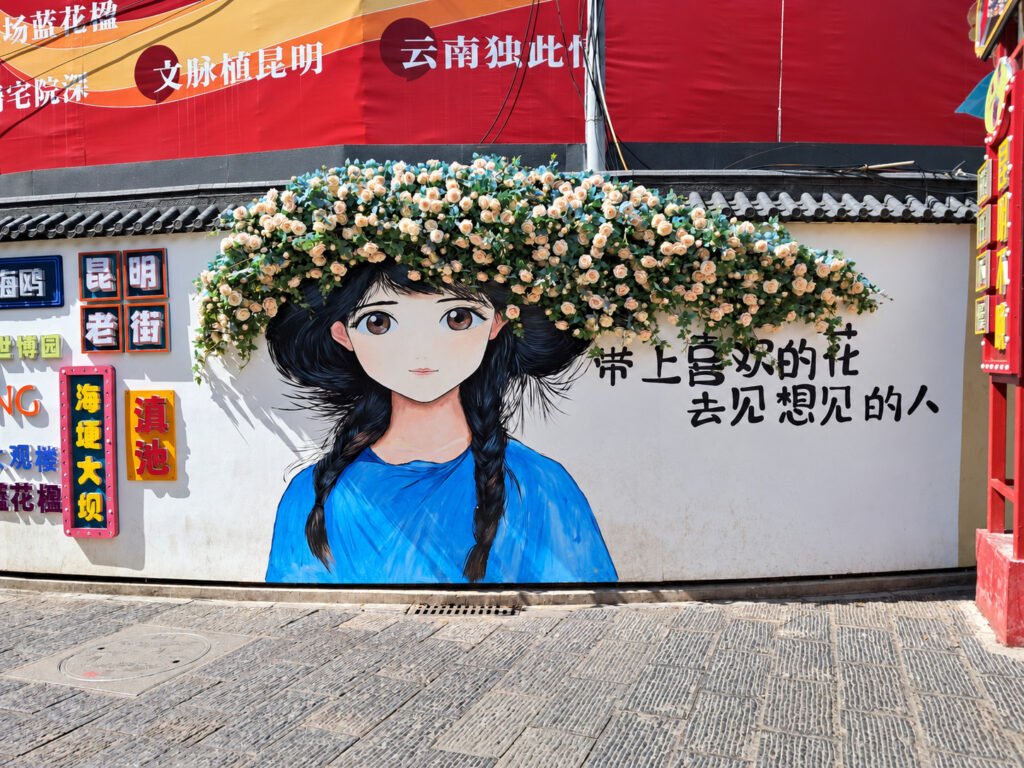
One of the places we visited was Nanping Pedestrian Street, one of Kunming’s main shopping and entertainment areas. It is a broad pedestrian precinct surrounded by shopping centres, shops, restaurants and food stalls, with a mixture of buildings intended to suggest something of old Kunming alongside thoroughly modern commercial developments. There were people everywhere, although whether they were locals or Chinese tourists I couldn’t say. It was busy, colourful and lively, if a little fabricated for my taste. Still, it was an excellent place to wander and watch people going about their business.
Unfortunately, it was also where I had the worst meal of our entire month in China. In fact, I think it was the only genuinely bad meal we ate during the trip. I ordered what I believed was chicken noodle soup, imagining a lovely bowl of noodles in a rich chicken broth. What arrived was something quite different. It appeared to be chicken bone soup, containing an assortment of bones and the occasional piece of offal floating around in the broth, with very little actual chicken in evidence.
Now, I am not opposed to offal. In fact, I quite like it, and I am generally happy to try unfamiliar dishes. But this was a step too far, even for me. There seemed to be far more bone than anything edible, and trying to extract a meal from it was becoming hard work. After spending the previous month enjoying some truly wonderful Chinese food, I suppose we were due for a disappointment. Still, one bad meal in an entire month is an excellent result, even if it did happen to be spectacularly bad.
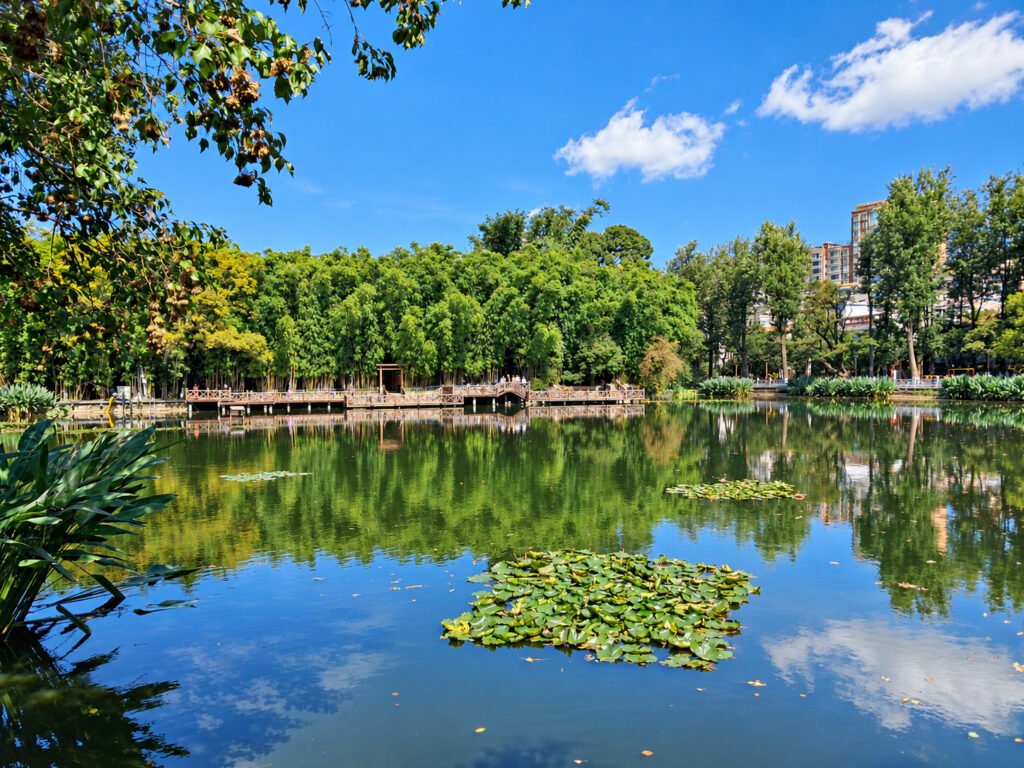
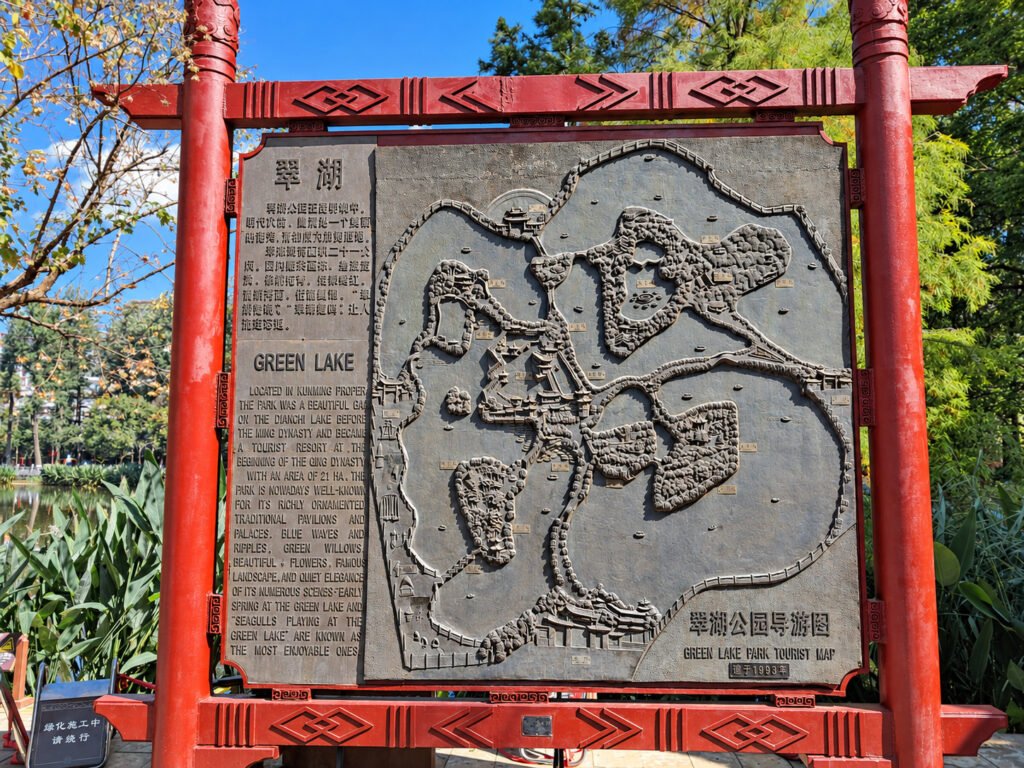
Another day we visited Green Lake Park, or Cuihu Park, a lovely green space in the centre of Kunming. The park is built around a series of lakes connected by pathways and bridges, with traditional Chinese pavilions, willow trees and gardens surrounding the water. It is a popular place for locals to walk, exercise, meet friends and generally enjoy being outdoors. There were people everywhere, but unlike the shopping district, the atmosphere was relaxed and peaceful.
We wandered around the lake for a while before finding somewhere to sit and drink tea overlooking the water. It was a lovely way to spend part of the afternoon, watching the activity around the lake and enjoying the fact that, for once, we weren’t rushing to catch a train or trying to work out how to get somewhere. Green Lake is the sort of park that makes a city more liveable, and I can understand why it is so popular with the people of Kunming.
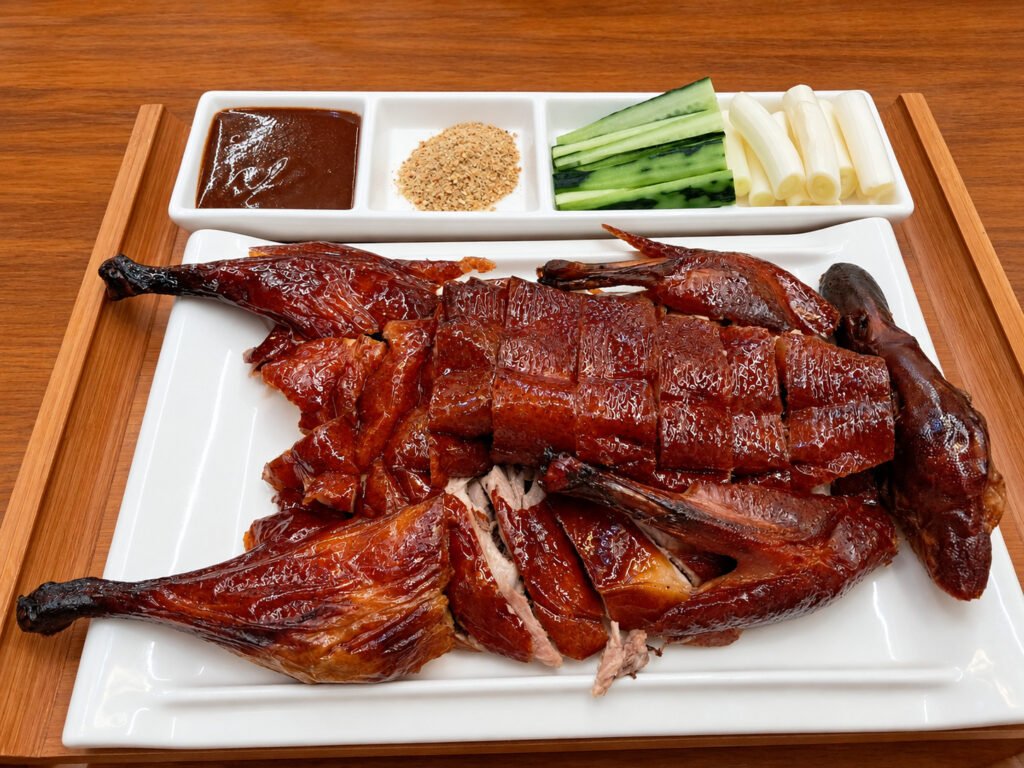
On our way back from the park we spotted a restaurant that looked rather nice and decided to stop for lunch. It turned out to be an excellent decision. We ordered roast duck and wood ear mushrooms, both of which were absolutely delicious. The duck was beautifully cooked, tender and full of flavour, while the mushrooms were a wonderful accompaniment. Mushrooms feature prominently in Yunnan cuisine, which is hardly surprising given the extraordinary variety that grows throughout the province.
It was one of the best meals we had in Kunming, and the entire lunch cost us around twenty Australian dollars, about ten dollars each. I have paid considerably more for far less impressive food in other parts of the world. We left very pleased with ourselves and with our faith in Kunming’s restaurants thoroughly restored after the unfortunate chicken bone soup incident.
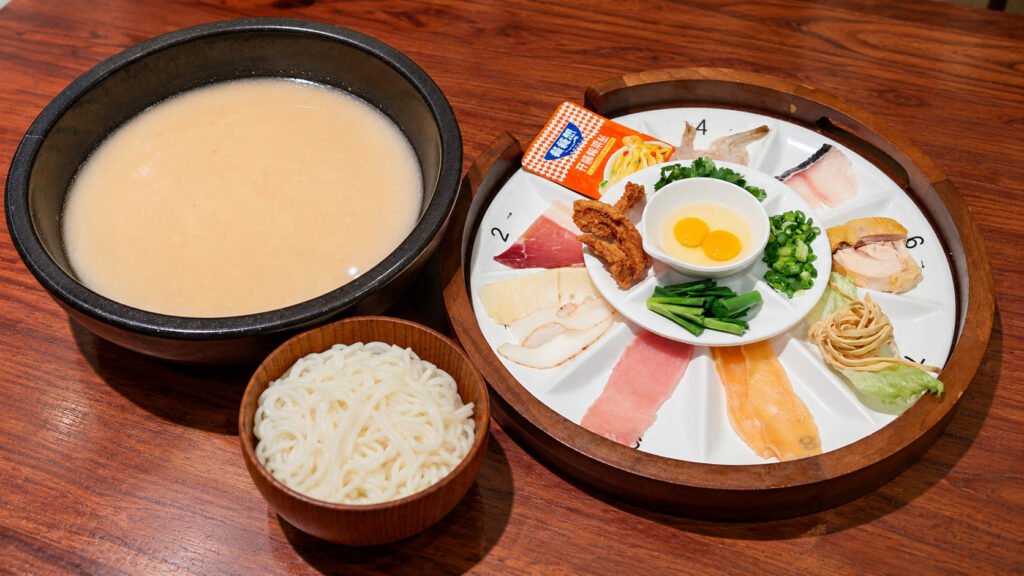
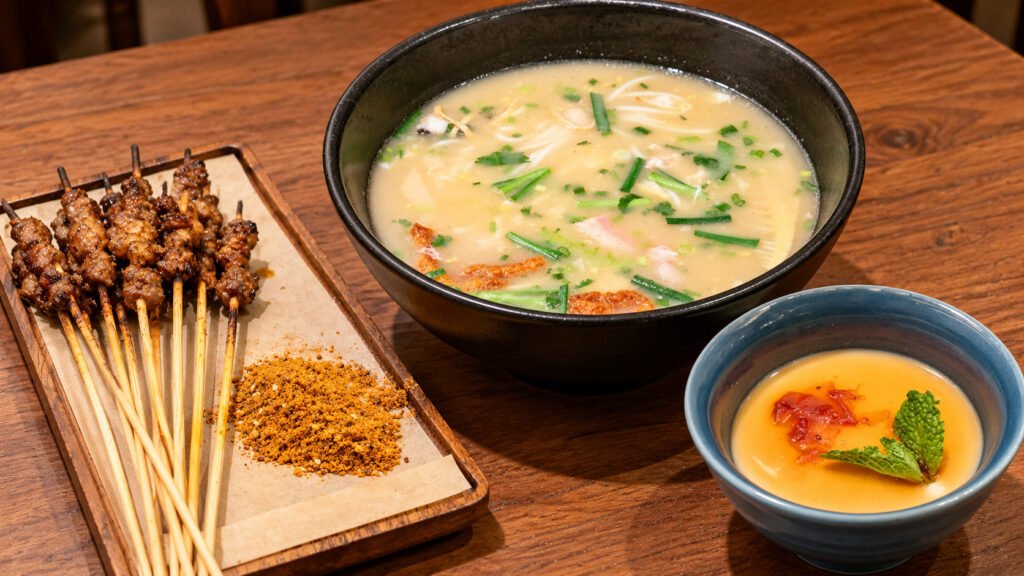
On another of our wanderings we came across a restaurant called Yun Qiao, where we were introduced to one of Yunnan’s most famous dishes, Crossing-the-Bridge Noodles, or Guoqiao Mixian. These are not simply another bowl of noodle soup. The dish arrives as a large bowl of extremely hot broth, accompanied by separate portions of rice noodles, thinly sliced meat, vegetables and other ingredients, which are added to the broth at the table.
The traditional story behind the dish involves a scholar studying on an island and his devoted wife carrying meals across a bridge to him. Unfortunately, by the time she arrived, the food had often gone cold. Eventually she discovered that keeping the ingredients separate and transporting a very hot broth protected by a layer of oil allowed everything to remain hot until it was time to eat. Whether this is entirely true or one of those lovely stories that improves with every retelling, I have no idea. What I can tell you is that it resulted in an excellent bowl of noodles.
At Yun Qiao the noodles were absolutely delicious, with a rich, flavourful broth and wonderfully fresh ingredients. We enjoyed them so much that two days later we went back and ordered exactly the same thing. There is something very satisfying about finding a dish you love and then returning for more, particularly when you know there are hundreds of other restaurants waiting to be explored. Sometimes it is best not to interfere with success.
A few nights before we were due to leave, we stumbled across a French restaurant called Coucou du Marais. Now, I know some people believe that when travelling in a country you should eat only the local cuisine. And generally speaking, we do. We had spent a month eating our way through China, enjoying everything from tiny local restaurants to regional specialities, with noodles and rice featuring rather prominently in our diet.
However, after a month of noodles and rice, rice and noodles, the sight of a French restaurant was surprisingly appealing. I ordered a pizza, AP had a bowl of pasta, and we accompanied dinner with a decent glass of red wine. The pizza was pretty good, the pasta was enjoyable and the wine was most welcome. I make absolutely no apologies. If you find a decent pizza after a month of Chinese food, it is perfectly acceptable to eat it. There is no international law requiring travellers to consume noodles every day of their lives.
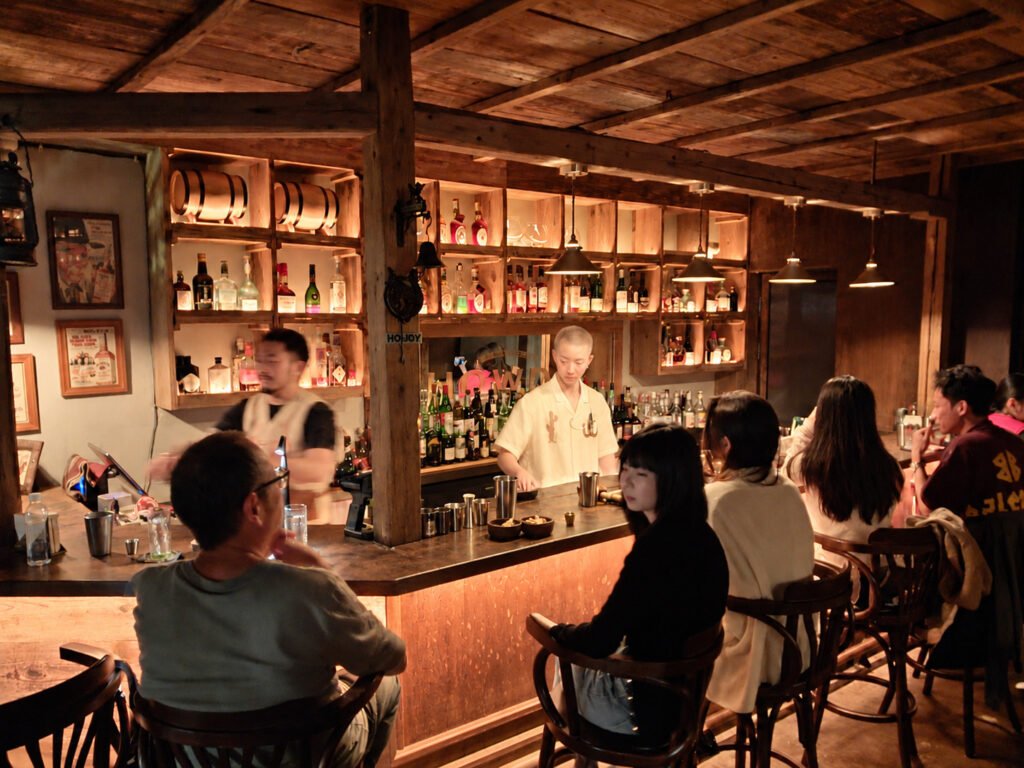
We enjoyed Coucou du Marais so much that we returned a couple of nights later. After another delicious dinner, we decided to investigate the bar next door, a place called Howdy. What a find that turned out to be. It was one of the coolest bars I have ever been into, full of fashionable young people, interesting décor and an atmosphere that was lively without being unpleasantly noisy.
And there we were, two rather scruffy old backpackers, sitting among Kunming’s cool and groovy young things. We were probably old enough to be the parents of most of the people in the bar, possibly even the grandparents of a few, but nobody seemed remotely concerned. Quite the opposite. The staff were wonderful and made us feel completely welcome.
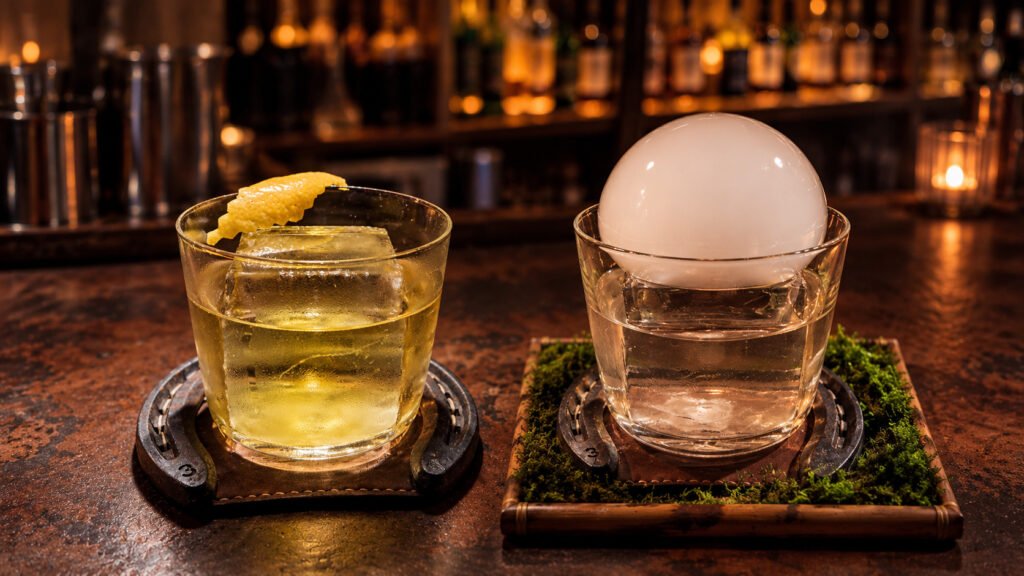
Before too long we were doing shots with the bartender and drinking cocktails that I suspect had started their lives as rocket fuel. They were extraordinarily strong, although at around twenty Australian dollars each they were also extraordinarily expensive by Chinese standards. Still, we were having such a good time that we decided not to worry too much about the cost. We laughed, chatted, drank rather more than intended and eventually staggered back to the hotel having had a thoroughly excellent evening.
We promised the bartender we would return the following night, and at the time I meant every word. The next morning, however, I was reminded that enthusiasm and alcohol are not always the best combination, particularly when one is no longer twenty-five. My head was a little fuzzy, and I spent part of the day reflecting on the wisdom of drinking extremely strong cocktails with people young enough to recover from them in approximately fifteen minutes.
On our final evening in Kunming we returned to Coucou du Marais, this time for a beautifully cooked steak and a couple of glasses of red wine. It was an excellent meal and a very pleasant way to finish our stay. We did, however, give Howdy a miss. We had a long travel day ahead of us, and I had no intention of arriving at the airport with the sort of head I had woken up with that morning. Occasionally, with age, comes wisdom. Not often, admittedly, but occasionally.
And just like that, our month-long journey through China was coming to an end. The following morning we packed our bags for the last time in China and headed to the airport on Kunming’s ever-efficient metro. By now we knew the routine: buy the tickets, pass through security, find the correct platform and settle in for the journey. What had seemed unfamiliar and occasionally bewildering when we first arrived in Chengdu had become second nature.
As I sat at the departure gate waiting for our flight, I thought back over the previous month. We had arrived in Chengdu, a city of enormous scale, modern infrastructure and wonderful food, and had immediately been reminded that travelling in China requires a slightly different approach to the rest of the world. There were new apps to master, a Chinese SIM to organise and the usual challenge of communicating in a language of which we understand approximately three words. Fortunately, Chinese people are extraordinarily patient with foreigners, and we found that a translation app and a bit of determination could solve almost anything.
We had wandered through the streets of Chengdu, visited its parks and explored the ancient town of Huanglongxi before heading west into Yunnan. In Lijiang we had spent days wandering the old streets, discovering its history and enjoying the remarkable mountain scenery around Jade Dragon Snow Mountain. We had travelled further north to Shangri-La, high on the Tibetan Plateau, where the culture, architecture and landscape were so different from the China we had experienced further east.
There had been wonderful guesthouses, beautiful mountain scenery, long train journeys, ancient towns, excellent food and some rather interesting culinary discoveries. We had also seen things that saddened us, particularly the loss of old buildings in Shangri-La, where modern construction is slowly replacing much of the original town. Travelling is not always about seeing things exactly as you would like them to be, and sometimes the changes taking place are as revealing as the history that remains.
What will stay with me most, though, is the Chinese people. Their honesty, generosity and willingness to help have been extraordinary. We have travelled through many countries over the years, and China remains one of the places where we feel most comfortable and secure. We have walked through cities at night, travelled independently through unfamiliar regions and relied on complete strangers for assistance, and time after time people have gone out of their way to help us.
Then there is the infrastructure. The trains, the metros, the roads and those seemingly endless tunnels through mountains have been nothing short of remarkable. China is an enormous country, yet travelling between its cities and regions is often astonishingly straightforward. I have spent far too much of my life waiting for trains in Europe to take this sort of efficiency for granted. Six hours across Yunnan and arriving precisely on time still seems rather miraculous to me.
Of course, a month is nowhere near enough time to see a country as vast and diverse as China. We have barely scratched the surface, and there are still so many places we would like to visit. But we had travelled through some spectacular country, eaten exceptionally well, met lovely people and enjoyed ourselves enormously. It had been another wonderful adventure, and I was genuinely sorry to be leaving.
Still, there was no need to be too melancholy. The journey wasn’t over. We were simply moving on to the next chapter, and waiting for us was Thailand, a country we have returned to many times and one that remains very close to my heart.
And our first stop? Bangkok. One of my favourite cities in the world.
I could already taste the Pad Thai.
Farewell China, you’ve been wonderful. Next stop, Bangkok, Thailand.