


The Tea Horse Road in China – History, Routes and Places to Visit
Long before modern highways and railway lines crossed the mountains of southwestern China, merchants and their pack animals travelled along an extraordinary network of trading routes connecting the tea-growing regions of Yunnan and Sichuan with the Tibetan Plateau.
Known as the Ancient Tea Horse Road, or Chamagudao, these routes carried enormous quantities of tea through mountain passes, remote valleys and settlements that developed into important trading centres. In return came horses, wool, animal hides, medicinal products and other goods from the highlands.
For centuries, caravans of horses, mules and sometimes yaks carried their loads across terrain that remains challenging even today. Traders crossed suspension bridges, climbed steep mountainsides and negotiated narrow paths above deep river gorges, often spending weeks or months travelling between trading centres.
But the Tea Horse Road was more than a commercial route. It brought different communities into contact, spreading religious traditions, languages, architectural styles, food and ideas throughout the region. Its influence is still visible in the historic towns, markets and cultural landscapes of Yunnan, Sichuan and Tibet.
Today, travellers can follow parts of this remarkable history through places such as Dali, Shaxi, Lijiang, Shangri-La, Kangding and Ya’an. Although the original caravans have largely disappeared, the towns, traditions and mountain landscapes offer a fascinating introduction to one of China’s great historic trading networks.
Understanding the Ancient Tea Horse Road
1. What Was the Tea Horse Road?
The Tea Horse Road was not one continuous highway. It was an extensive network of interconnected trading routes crossing the mountainous regions of southwestern China and the Tibetan Plateau.
The Chinese name, Chamagudao (茶马古道), translates roughly as Ancient Tea Horse Road. It reflects the historic exchange of tea produced in Chinese agricultural regions for horses and other livestock from the Tibetan highlands.
Commercial and cultural exchanges across these regions developed over many centuries. Tea-and-horse trading became particularly important during the Song Dynasty, when horses from the western borderlands were highly valued for military purposes.
As trade expanded, merchants developed routes between tea-producing areas, regional markets and settlements on the plateau. These routes changed over time according to political conditions, demand, geography and the availability of safe passage.
While the name suggests that tea and horses were the only commodities involved, the trading network carried considerably more. Salt, wool, animal hides, medicinal herbs, textiles, religious objects and everyday supplies also moved between communities.
The network eventually helped connect parts of southwestern China with Tibet and trading systems extending towards Nepal, India and other areas of South Asia.
Main Regions
Yunnan, Sichuan and Tibet, with connections extending into neighbouring Himalayan regions.
Chinese Name
Ancient Tea Horse Road – 茶马古道
Chamagudao
Historical Period
Trade connections developed over centuries, with formal tea-for-horse exchange particularly important from the Song Dynasty onward.
Traditional Transport
Pack horses, mules, donkeys, yaks and human porters, depending on the terrain and region.
Interesting Fact
The Tea Horse Road is often compared with the Silk Road, but it developed across very different geography, with steep mountains and deep river valleys shaping its routes and trading communities.
2. Why Was Tea So Important?
Tea was one of the most valuable products moving westward along the trading routes. The humid mountain regions of Sichuan and Yunnan provided ideal conditions for growing tea, while the high-altitude Tibetan Plateau was generally unsuitable for large-scale tea cultivation.
Over time, tea became an important part of everyday life in Tibetan communities. It was consumed in various forms, including the well-known Tibetan butter tea, traditionally prepared by combining brewed tea with butter and salt.
For long-distance transport, tea was often processed and compressed into bricks or cakes. These were considerably easier to stack, store and carry on pack animals than loose tea leaves.
Tea also became an important trading commodity because it could be transported over long distances and exchanged for goods needed in the lower agricultural regions.
Horses were particularly valuable to Chinese authorities because of their importance in transport and warfare. The exchange of tea for horses consequently acquired both commercial and political significance.
Although the balance between official exchange and private trade varied throughout history, the demand for tea helped support a vast network of merchants, transport workers, innkeepers and market communities.
Main Tea Regions
Ya’an and surrounding districts in Sichuan, and Pu’er and other tea-producing areas of southern Yunnan.
Traditional Transport
Compressed tea bricks and cakes were practical for packing and transporting over long distances.
Tea to Try
Pu’er tea in Yunnan and traditional Sichuan dark tea associated with the Tibetan trade.
Cultural Experience
Visit a traditional teahouse or tea shop and ask about the differences between loose tea, compressed tea cakes and the dark teas historically traded towards Tibet.
3. The Two Major Branches of the Tea Horse Road
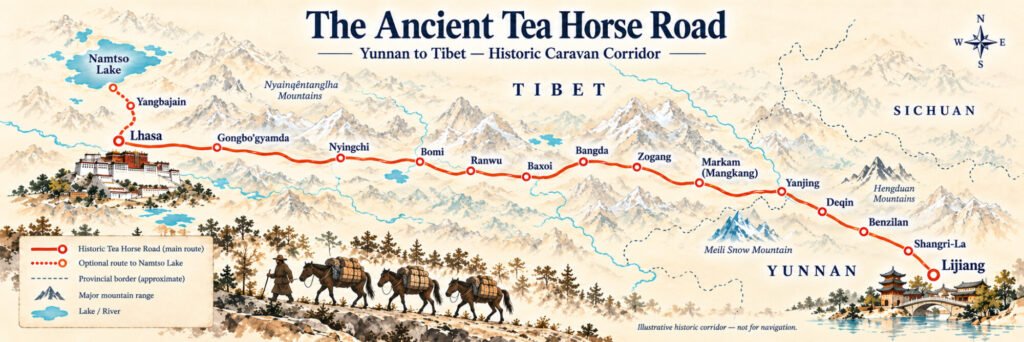
Although numerous paths developed over time, the Tea Horse Road is commonly described as having two major regional branches: the Yunnan–Tibet route and the Sichuan–Tibet route.
The Yunnan–Tibet Route
This southern network connected the tea-producing areas around Pu’er and Xishuangbanna with important trading centres farther north. Routes passed through the Dali region, Lijiang and the highlands around present-day Shangri-La before continuing towards Tibetan settlements.
Merchants travelled through a landscape of valleys, rivers, mountain passes and communities with different languages and traditions. Towns such as Shaxi developed as places where caravans could rest, trade and obtain supplies.
Some branches continued westward towards Lhasa, while other connections linked the network with trade routes extending into the Himalayan region and South Asia.
The Sichuan–Tibet Route
The Sichuan branch developed around tea-producing districts including Ya’an. From there, routes travelled west through places such as Luding and Kangding, historically known as Dartsedo, before continuing into the eastern Tibetan highlands.
Kangding became an especially important commercial and cultural meeting point, where merchants and communities from Sichuan and the Tibetan Plateau exchanged goods.
Neither branch followed one completely fixed line. Routes and market centres changed over the centuries, and some sections became more important than others depending on local conditions.
Yunnan Branch
Southern Yunnan tea regions through Dali, Lijiang and Shangri-La towards Tibet.
Sichuan Branch
Ya’an through Luding and Kangding towards the eastern Tibetan Plateau.
Travel Planning Tip
Rather than attempting to follow one continuous historical route, choose a series of towns that reveal different aspects of the trading network. The Yunnan section is particularly convenient for independent travellers.
Historic Towns Along the Tea Horse Road
4. Dali – Gateway to the Yunnan Tea Horse Road
Surrounded by the Cangshan Mountains and the beautiful waters of Erhai Lake, Dali was an important regional centre long before it became a popular destination for modern travellers.
Historically, the area occupied a strategic position between southern Yunnan, the mountain valleys to the north and trading connections extending westward. Its role as a political and commercial centre made it an important part of the wider network through which goods, people and ideas travelled.
Merchants passing through the region transported tea, textiles, livestock and other commodities between different communities. The surrounding valleys also supported agriculture and settlements that supplied travellers and trading caravans.
Today, Dali Old Town provides a fascinating introduction to the region’s history. Traditional-style streets, historic gateways, temples and local markets offer a glimpse into the cultural heritage of western Yunnan.
The surrounding Bai communities add another dimension to the visit. The Bai people have a long history in the region, reflected in distinctive architecture, local foods, traditions and crafts.
Although much of Dali Old Town now caters to tourism, it remains a useful starting point for exploring the landscapes and communities associated with the Tea Horse Road.
Location
Dali, western Yunnan Province, beside Erhai Lake and the Cangshan Mountains.
Chinese Name
Dali Ancient Town – 大理古城
Dali Bai Autonomous Prefecture – 大理白族自治州
Public Transport
Dali is served by rail and road connections from Kunming and other Yunnan destinations. Local buses and taxis connect Dali railway station with the Old Town.
Suggested Stay
Allow at least two days to explore the Old Town, Erhai Lake and nearby Bai villages.
Tea Horse Road Highlights
Explore Dali Old Town, visit traditional Bai settlements, discover regional markets and learn about the historic trading connections between southern Yunnan and the Tibetan highlands.
5. Shaxi – One of the Best-Preserved Caravan Market Towns
Of all the towns associated with the Tea Horse Road, Shaxi is one of the most atmospheric places to experience its trading history.
Located in a fertile valley between Dali and Lijiang, Shaxi developed as an important stopping point for merchants and pack-animal caravans travelling through northwestern Yunnan.
The town’s significance came from its position within the regional trading network. Caravans stopped to rest, exchange goods, purchase provisions and prepare for the next section of their journey.
At the heart of Shaxi is Sideng Square, an exceptionally well-preserved historic market area surrounded by traditional buildings. The old theatre stage, temple buildings and former trading premises provide an unusually evocative glimpse into the town’s commercial past.
One of its most interesting buildings is the historic theatre stage, which overlooks the square. Nearby is Xingjiao Temple, while the surrounding lanes lead past traditional houses and small businesses.
The nearby Yujin Bridge is another reminder of Shaxi’s historic position on the caravan routes. Pack animals and traders once crossed the local waterways as they travelled between settlements.
Shaxi’s historic market area became the focus of an important conservation project recognised by UNESCO’s Asia-Pacific Heritage Awards in 2005. The restoration helped preserve the traditional appearance and historic significance of the market-town environment.
Today, Shaxi is increasingly popular with visitors, but it remains a rewarding place to slow down, explore the narrow lanes and imagine the arrival of a caravan after days on the mountain trails.
Location
Jianchuan County, Dali Bai Autonomous Prefecture, between Dali and Lijiang.
Chinese Name
Shaxi Ancient Town – 沙溪古镇
Sideng Square – 寺登街
Public Transport
Travel by road from Dali or Lijiang, often via Jianchuan. Connections may require a transfer, while private drivers provide a more straightforward option.
Suggested Stay
One or two nights allow time to explore the market square, surrounding countryside and historic buildings without rushing.
Don’t Miss
Sideng Square, the old theatre stage, Xingjiao Temple, Yujin Bridge and the surrounding traditional lanes. Shaxi is one of the most rewarding destinations for travellers specifically interested in Tea Horse Road heritage.
6. Lijiang – A Historic Naxi Trading Centre
With its winding canals, narrow stone streets and distinctive traditional architecture, Lijiang is one of the best-known historic towns in Yunnan and an important destination for understanding the Tea Horse Road.
Situated beneath the dramatic peaks of Jade Dragon Snow Mountain, Lijiang developed at a strategic point between the lower valleys of western Yunnan and the high-altitude routes leading towards Tibet.
The town became an important commercial centre where merchants could exchange goods, organise transport and obtain provisions before continuing north through increasingly difficult terrain.
Lijiang’s position on these trading routes contributed to the development of its distinctive cultural identity. The Naxi people, who have inhabited the region for centuries, developed traditions influenced by interactions with neighbouring Tibetan, Bai, Han and other communities.
Today, Lijiang Old Town is recognised as a UNESCO World Heritage Site. Its network of canals, traditional houses, bridges and narrow streets reflects a historic urban environment shaped by geography, trade and local culture.
Although the Old Town is now extremely popular with tourists, visitors can still discover quieter lanes away from the busiest shopping streets. The nearby towns of Shuhe and Baisha also provide opportunities to explore traditional settlements associated with the wider Lijiang region.
Lijiang is an especially useful stop on a modern Tea Horse Road journey because it combines historical interest with convenient transport connections to Dali, Shaxi, Shangri-La and the surrounding mountains.
Location
Northwestern Yunnan Province, beneath Jade Dragon Snow Mountain.
Chinese Name
Lijiang Ancient Town – 丽江古城
Shuhe Ancient Town – 束河古镇
Public Transport
Lijiang is served by railway and airport connections. Road and rail services link it with Dali and Shangri-La.
Suggested Stay
Two or three days for Lijiang Old Town, nearby historic settlements and the surrounding countryside.
Tea Horse Road Highlights
Explore Lijiang’s historic streets, visit Shuhe and Baisha, and discover the Naxi cultural heritage that developed through centuries of regional exchange.
7. Shangri-La – Gateway to the Tibetan Highlands
Continuing north from Lijiang, the landscape rises dramatically towards the Tibetan Plateau. Forested valleys give way to alpine grasslands, high mountain passes and settlements where Tibetan culture becomes increasingly prominent.
Shangri-La, historically known as Zhongdian and associated with the Tibetan name Gyalthang, occupies an important position within this mountainous region.
For centuries, the area formed part of the trading connections between Yunnan and Tibet. Caravans travelling north carried tea and other products through the highlands, while goods from Tibetan communities moved south towards the markets of Yunnan.
These routes were physically demanding. Merchants had to negotiate steep mountainsides, fast-flowing rivers and changing weather conditions, often at elevations where cold temperatures and reduced oxygen made travel exhausting.
Today, Shangri-La provides a fascinating introduction to the Tibetan-influenced culture of northwestern Yunnan. Dukezong Old Town, with its traditional architecture and winding streets, is one of the principal attractions.
Ganden Sumtseling Monastery, situated just outside the town, is an important centre of Tibetan Buddhism and offers a remarkable insight into the religious traditions of the region.
The surrounding countryside includes grasslands, mountain villages and alpine lakes, making Shangri-La a rewarding destination for travellers interested in both the Tea Horse Road and the landscapes through which the historic caravans travelled.
Location
Diqing Tibetan Autonomous Prefecture, northwestern Yunnan Province.
Chinese Name
Shangri-La – 香格里拉
Dukezong Ancient Town – 独克宗古城
Public Transport
Shangri-La is connected with Lijiang by rail and road. Local buses, taxis and private drivers provide access to nearby attractions.
Suggested Stay
Two or three days to explore Dukezong Old Town, Sumtseling Monastery and the surrounding landscapes.
Tea Horse Road Highlights
Explore Dukezong’s historic streets, experience Tibetan tea culture and visit the surrounding villages and monasteries to understand the region’s role as a cultural crossroads.
Altitude
Shangri-La is approximately 3,200 metres above sea level. Allow time to acclimatise, particularly when arriving from lower elevations.
8. Kangding – Where Sichuan Met the Tibetan Plateau
Kangding, historically known as Dartsedo, was one of the most important trading centres on the Sichuan–Tibet branch of the Tea Horse Road.
Located in the mountains of western Sichuan, Kangding occupied a strategic position between the tea-growing regions farther east and the Tibetan highlands to the west.
Caravans carrying tea from Sichuan travelled through difficult mountain terrain to reach the town, where merchants exchanged goods with traders from Tibetan communities.
The town developed into a major commercial meeting place, handling tea, wool, hides, livestock and other commodities. Its markets brought together different languages, traditions and communities, making Kangding a significant cultural crossroads.
The surrounding landscape also influenced the nature of the trade. Deep valleys, high mountain passes and challenging weather meant that transporting goods required considerable organisation and physical endurance.
Today, Kangding is a gateway to the dramatic scenery of western Sichuan. The town combines Tibetan and Han cultural influences, while nearby mountain landscapes provide a sense of the difficult terrain once crossed by trading caravans.
Travellers interested in the Sichuan branch of the Tea Horse Road can use Kangding as a base for exploring the history and geography of this remarkable region.
Location
Garzê Tibetan Autonomous Prefecture, western Sichuan Province.
Chinese Name
Kangding – 康定
Historical Tibetan name – Dartsedo
Public Transport
Road connections from Chengdu and other Sichuan destinations. Journey times depend heavily on route and mountain-road conditions.
Suggested Stay
One or two days for the town, with additional time for nearby mountain landscapes.
Historical Significance
Kangding was a major exchange point between Sichuan tea merchants and traders from the Tibetan Plateau, making it central to understanding the northern branch of the Tea Horse Road.
9. Ya’an – The Tea-Producing Heart of the Sichuan Route
To understand the Sichuan branch of the Tea Horse Road, it is worth beginning with the tea itself, and few places are more closely associated with the trade than Ya’an.
Located west of Chengdu, Ya’an lies in a humid and often misty region where conditions are particularly suitable for tea cultivation.
For centuries, tea produced in Ya’an and the surrounding districts travelled west towards the Tibetan Plateau. The region became closely associated with the production of dark tea intended for Tibetan markets.
Tea was processed, compressed and packed for the difficult journey through the mountains. From the producing areas, merchants and porters transported their loads towards Kangding and beyond.
Human porters played an important role in parts of this trade, carrying extremely heavy loads along steep paths where pack animals were not always practical.
Ya’an’s connection with tea continues today, and visitors can learn about regional tea production, traditional processing methods and the important relationship between the agricultural lowlands and highland trading communities.
The surrounding mountain landscapes help explain why the trade routes were so demanding and why towns such as Kangding developed as important intermediate markets.
Location
Western Sichuan Province, southwest of Chengdu.
Chinese Name
Ya’an – 雅安
Ya’an Tibetan Tea – 雅安藏茶
Public Transport
Rail and road connections link Ya’an with Chengdu and other destinations in Sichuan.
Suggested Stay
One or two days to explore tea culture and the surrounding countryside.
Tea Experience
Visit a tea shop or producing area to learn about Sichuan dark tea and the compressed tea traditionally transported west along the Tea Horse Road.
Planning a Journey Along the Tea Horse Road
10. Suggested Tea Horse Road Travel Routes
Because the Tea Horse Road was a network rather than a single highway, there is no one correct way to explore it today.
Modern travellers can choose a route based on their interests, available time and preferred destinations. The Yunnan section is particularly suitable for visitors wanting to combine historic towns with spectacular mountain scenery.
Yunnan Tea Horse Road Journey
A practical itinerary follows the historic trading corridor north through western Yunnan:
| Destination | Suggested Stay | Main Interest |
|---|---|---|
| Dali | 2 days | Regional trading history and Bai culture |
| Shaxi | 1–2 days | Preserved caravan market town |
| Lijiang | 2–3 days | Naxi culture and historic trading centre |
| Shangri-La | 2–3 days | Tibetan culture and highland trade connections |
This journey can be completed in approximately eight to ten days, although a slower pace allows time to explore villages, countryside and attractions beyond the principal towns.
Sichuan Tea Horse Road Journey
For travellers interested in the tea-producing regions and the historical relationship between Sichuan and the Tibetan Plateau, a separate journey can begin in Chengdu before continuing through Ya’an and Kangding.
From Kangding, further travel into western Sichuan reveals dramatic highland landscapes and communities shaped by centuries of movement between the agricultural lowlands and the Tibetan Plateau.
Yunnan Route
Dali – Shaxi – Lijiang – Shangri-La.
Sichuan Route
Chengdu – Ya’an – Kangding, with optional onward travel into western Sichuan.
Suggested Duration
Approximately 8–10 days for the main Yunnan towns, or longer when adding rural excursions and slower travel.
Travel Planning Tip
Consider spending an extra night in Shaxi. Its preserved market square and surrounding countryside make it particularly rewarding for travellers interested in the original caravan trading network.
11. Experiencing Tea Culture Along the Route
One of the most enjoyable ways to connect with the history of the Tea Horse Road is through the tea itself.
Tea culture varies significantly across the regions linked by the trading network. In Yunnan, Pu’er tea is particularly important, while Sichuan has its own traditions of dark tea historically produced for markets on the Tibetan Plateau.
Pu’er tea is commonly sold as loose leaves or in compressed cakes. Different processing and ageing methods create a wide range of flavours, from earthy and mellow to more complex and aromatic.
Traditional Tibetan butter tea provides another fascinating example of how tea became incorporated into the food and cultural traditions of highland communities.
Visitors can explore tea shops, attend tastings and learn about the techniques used to process and compress tea for storage and transport.
Understanding the effort required to produce, pack and transport tea adds another dimension to the historic routes. What now seems like an ordinary cup of tea was once the product of a trading system involving enormous distances and considerable physical hardship.
Yunnan Tea
Try Pu’er tea, particularly the traditional compressed cakes associated with long-distance trading.
Sichuan Tea
Explore Ya’an’s dark tea traditions and the tea historically produced for Tibetan markets.
Tibetan Tea
Try traditional butter tea, commonly prepared with brewed tea, butter and salt.
Pro Tip
Rather than simply buying packaged tea, seek out a shop that offers tastings and explains how the different teas are processed and traditionally consumed.
12. Can You Still Walk the Ancient Tea Horse Road?
Parts of the original trading network survive as old paths, stone-paved routes, bridges and trails connecting villages and historic settlements.
However, there is no single continuous, maintained walking route covering the entire Tea Horse Road. Much of the original network has been replaced by modern roads, altered by development or absorbed into rural landscapes.
Visitors can sometimes explore preserved sections through local heritage walks or organised excursions. These may provide opportunities to see traditional routes, caravan bridges and settlements away from the larger tourist centres.
Anyone planning to walk historic trails should confirm that the route is officially open, accessible and suitable for their experience. Some mountain areas are remote, and weather, altitude and terrain can make walking difficult.
In particular, visitors should not assume that a route mentioned in an older travel guide is currently open to tourists.
Walking Options
Short heritage walks, village trails and locally organised excursions where routes are officially accessible.
Best Conditions
Spring and autumn often provide comfortable temperatures for exploring lower-elevation historic towns and villages.
Safety
Verify trail access, weather, local regulations and transport arrangements before attempting remote sections. Do not enter undeveloped or restricted mountain areas.
13. Practical Tips for Travelling the Tea Horse Road
Exploring the historic Tea Horse Road is relatively straightforward when concentrating on major towns in Yunnan and Sichuan. However, travelling between smaller settlements can involve additional planning.
Modern rail connections make it convenient to travel between several major Yunnan destinations, while Shaxi and many smaller villages are reached by road.
Travellers heading into higher mountain areas should allow time to acclimatise. The elevation rises significantly between Lijiang and Shangri-La, and visitors arriving quickly from lower regions may notice breathlessness or other symptoms of altitude sickness.
Weather also varies considerably along the route. Southern Yunnan can be warm and humid, while mountain passes and Tibetan-influenced highland regions may be cold, even during otherwise pleasant seasons.
For international travellers, using Chinese mapping, transport and payment applications can make independent travel considerably easier. In smaller towns, it is also useful to save destination names in Chinese.
Transport
Use rail between major destinations where available, with buses, taxis and private drivers for smaller towns and rural areas.
Best Time to Travel
Spring and autumn generally offer pleasant conditions, although weather varies considerably with altitude and location.
Useful Preparation
Save Chinese place names, download offline maps and confirm how to pay for local transport and accommodation.
Altitude and Tibet Travel
Highland destinations require altitude awareness. Travel into the Tibet Autonomous Region may involve additional permits and arrangements for foreign visitors; confirm the rules before planning onward travel.
Slow Travel Tip
The Tea Horse Road is best appreciated through the places and communities it connected. Spend time in markets, villages and traditional teahouses rather than treating the journey as a race between historic towns.
Frequently Asked Questions About the Tea Horse Road
14. What Is the Tea Horse Road Famous For?
The Tea Horse Road is famous for the historic exchange of tea produced in Yunnan and Sichuan for horses and other goods from the Tibetan Plateau. It also played an important role in cultural exchange between communities across southwestern China.
15. Where Did the Tea Horse Road Begin and End?
There was no single starting point or destination. Major branches connected tea-producing regions of Yunnan and Sichuan with Tibetan trading centres, while some networks extended farther towards South Asia.
16. How Old Is the Tea Horse Road?
Trade between southwestern China and the Tibetan highlands developed over many centuries. Formal tea-for-horse exchange became particularly important during the Song Dynasty, although the routes and trading systems evolved significantly over time.
17. Why Were Horses Traded for Tea?
Horses from the western highlands were valued for transport and military use, while tea grown in Sichuan and Yunnan was in demand among communities on the Tibetan Plateau. This created an important commercial relationship between the regions.
18. Which Town Is Best for Experiencing the Tea Horse Road?
Shaxi is particularly rewarding because its preserved market square and traditional buildings provide a strong connection with the historic caravan trade. Lijiang and Shangri-La are also excellent destinations for exploring the wider cultural heritage of the route.
19. Can You Follow the Tea Horse Road Today?
Yes, although modern travellers usually follow parts of the historic network using roads, trains and shorter heritage walks. There is no single continuous tourist trail corresponding to the complete trading network.
20. What Type of Tea Was Carried Along the Route?
Traders transported various teas, including compressed Pu’er tea from Yunnan and dark tea produced in Sichuan for Tibetan markets. Compression into bricks or cakes made tea easier to store and transport over long distances.
Final Thoughts – Discovering China’s Ancient Tea Horse Road
A Journey Through History, Culture and Extraordinary Landscapes
The Ancient Tea Horse Road offers a fascinating perspective on the history of southwestern China. Unlike a single monumental road, it was an extensive network shaped by trade, geography and the movement of people between communities separated by enormous mountain ranges.
For centuries, merchants and pack animals travelled through difficult terrain carrying tea, horses and countless other goods. Their journeys connected agricultural valleys with the Tibetan Plateau and helped shape the cultures of the towns and villages along the way.
Today, places such as Dali, Shaxi, Lijiang and Shangri-La provide an excellent introduction to the Yunnan branch of the trading network, while Ya’an and Kangding reveal the importance of tea production and exchange along the Sichuan route.
Some destinations have become major tourist centres, while others retain a quieter atmosphere and a stronger connection with their historic market-town character.
Perhaps the most rewarding way to experience the Tea Horse Road is to travel slowly. Explore the old streets, stop in local markets, drink the regional tea and allow time to appreciate the landscapes through which merchants once travelled.
The caravans may have largely disappeared, but their influence remains woven into the history, architecture, food and traditions of southwestern China. For travellers interested in more than simply reaching the next destination, the Tea Horse Road offers an extraordinary journey into the region’s past.
Our Recommendation
For a first introduction to the Tea Horse Road, follow the Yunnan route from Dali through Shaxi and Lijiang to Shangri-La. It combines historic trading towns, traditional cultures and some of China’s most spectacular mountain scenery.
Historical information reflects published research on the Tea Horse Road and its major trading routes. Transport arrangements, visitor access and local travel requirements may change. Confirm current details before travelling, particularly when planning excursions into remote mountain areas or onward travel towards Tibet. Updated October 2026.