
China Train Guide
How to Travel by Train in China – Complete Metro and High-Speed Rail Guide
China has one of the most impressive railway networks in the world, and travelling by train is one of the easiest, most comfortable and affordable ways to explore the country.
From enormous high-speed railway stations connecting distant cities to efficient underground metro systems, trains are an essential part of everyday life in China.
For first-time visitors, however, the system can initially appear rather daunting. Stations are enormous, there are multiple types of trains, tickets are linked to passports, and security checks are part of the process.
The good news is that once you understand how everything works, travelling by train in China is remarkably straightforward.
We travelled extensively by both metro and long-distance train during our time in China, and while the first journey required a little concentration, we soon found the system incredibly easy to navigate.
This guide explains the different types of trains in China, the available travel classes, how to purchase tickets, how to find your train and what to expect at the station.
It also includes practical advice based on our experience, particularly for foreign travellers using passports rather than Chinese identity cards.
China’s Railway Network – How Big Is It?
China has developed the world’s largest high-speed railway network, transforming the way people travel across this enormous country.
At the end of 2025, China’s national railway network extended approximately 165,000 kilometres, including more than 50,000 kilometres of high-speed railway.
Urban rail systems are equally impressive. By the end of 2025, 58 cities across mainland China operated urban rail networks, connecting residential areas, railway stations, airports, shopping districts and major tourist attractions.
These figures explain why trains are such a practical option for travelling in China. You can move between major cities at high speed and then use local metro networks to reach your accommodation or explore the city.
In many cases, there is little need for taxis or private transport.
Understanding the Different Types of Trains in China
China’s passenger trains fall into two broad categories: urban metro trains and longer-distance national railway services.
Long-distance trains are further divided into high-speed services and conventional trains. These are identified by letters appearing before the train number.
Understanding these letters makes choosing the right train much easier.
| Train Type | Description | Typical Use |
|---|---|---|
| Metro | Urban rapid-transit trains, usually with numbered lines. | Travelling around cities and reaching airports or railway stations. |
| G Trains | High-speed services, often operating at up to 300–350 km/h on suitable lines. | Fast travel between major cities. |
| D Trains | Fast electric trains, often operating around 200–250 km/h. Some overnight sleeper services are included. | Intercity journeys and selected overnight routes. |
| C Trains | Intercity services connecting nearby cities or regional centres. | Shorter journeys between neighbouring cities. |
| Z Trains | Conventional express trains with relatively few stops. | Long-distance and overnight journeys. |
| T Trains | Conventional express trains, generally stopping more frequently than Z services. | Long-distance travel. |
| K Trains | Conventional services with more stops and longer journey times. | Budget travel and smaller destinations. |
Handy Tip – Which Train Should You Choose?
For most travellers moving between major cities, a G-series high-speed train is the simplest choice. These trains are modern, comfortable and extremely efficient.
For shorter regional journeys, D or C services may be equally convenient.
Conventional trains can be cheaper and remain useful for overnight journeys or destinations that are not connected to the high-speed network.
Always compare departure times, journey duration, station location and ticket price rather than choosing solely by the train letter.
Travelling on China’s Metro Systems
China’s metro systems are among the easiest urban transport networks we have used.
They are generally clean, efficient, inexpensive and well organised. Stations are clearly signposted, many announcements are made in both Chinese and English, and information screens make it easy to follow your journey.
Metro lines are numbered, which is incredibly helpful when navigating a city where you may not be familiar with the language.
The networks in major cities can be enormous, with numerous lines and interchange stations. However, the basic system is remarkably consistent, meaning that once you have used the metro in one Chinese city, you will generally feel comfortable using it elsewhere.
One of the most useful things to understand is how to identify the correct direction of travel. Once you have mastered that, most journeys are straightforward.
How to Buy a Metro Ticket in China
Identify Your Destination Station
Before heading to a ticket machine, establish which metro station you need to travel to.
Use a metro map or navigation app and identify three things:
- The name of your destination station.
- The number of the metro line you need.
- The name of the final station at the end of that line in the direction you are travelling.
The third point is particularly important. Once you reach the platform, the direction of travel will generally be identified by the terminal station.
If your journey requires changing lines, identify the interchange station as well.
Find the Automated Ticket Machine
Most metro stations have automated ticket machines near the entrance.
Many machines offer an English-language option, making the process considerably easier for foreign visitors.
Look for the language selection on the screen and choose English if available.
The machine will display a network map or a list of metro lines and stations.
Select Your Destination
Choose the line number and destination station.
If your journey involves changing lines, you generally select the final destination rather than buying separate tickets for each line.
The system calculates the appropriate fare automatically.
Select the number of tickets required.
Pay for Your Ticket
Payment options vary between cities and machines.
Depending on the system, you may be able to pay using:
- Alipay
- WeChat Pay
- Chinese yuan cash
- Accepted bank cards
Some major-city networks now support foreign Visa or Mastercard payments, but this is not universal and should not be relied upon without checking.
We found Alipay particularly convenient for everyday transport payments in China.
If your payment method is not accepted, look for another ticket machine or a staffed service counter.
The machine will issue a single-journey ticket, often a small plastic token or card.
Handy Tip – Metro QR Codes
In many Chinese cities, travellers can use a metro QR code through Alipay or a supported local transport app.
Once activated for the relevant city, the code can be scanned at the ticket gates, removing the need to buy a separate ticket for every journey.
This can be extremely convenient if you are spending several days in one city. However, registration requirements vary, so single-journey tickets remain a straightforward option for occasional users.
Entering the Metro Station
Go Through Security Screening
Before entering the paid section of the metro, you will generally need to pass through a security checkpoint.
Chinese metro systems routinely use security screening, particularly at larger stations.
Bags are placed through an X-ray scanner, while passengers pass through a security screening area.
The process is similar to airport security, although generally much quicker.
Some items may require additional inspection, and certain dangerous or restricted items cannot be carried onto the metro.
Once your bags have been checked, collect them and continue towards the ticket gates.
Pass Through the Ticket Gates
Use your ticket or QR code at the automated turnstile.
Depending on the system, you may need to tap a plastic token or card against the reader, insert a ticket or scan a QR code.
The gates will open, allowing you to enter.
If you are using a physical ticket, keep it somewhere accessible because you will generally need it again when leaving the metro.
Finding the Correct Metro Platform
Follow the Signs to Your Line
After passing through the ticket gates, follow the signs showing your metro line number.
You may need to travel down an escalator, descend stairs or walk through a connecting passageway.
Large interchange stations can involve quite a bit of walking, but the signs are generally clear.
Once you reach the platform, the next task is to make sure you are waiting on the correct side.
Check the Direction of Travel
This is where knowing the final station on your line becomes particularly useful.
Look above the platform doors or along the platform wall. You will usually see a diagram showing the stations along the line.
The diagram generally identifies the direction of travel and the terminal station.
Find your destination on the line diagram and check that it lies ahead of your current station in the direction the train is travelling.
If it does, you are in the right place. If not, you need the platform for the opposite direction.
Our Most Useful Metro Tip
Don’t rely solely on recognising the name of your destination station. Always check the terminal station for the direction you are travelling.
Chinese metro lines are numbered, and the combination of line number and terminal station makes navigating even a complicated network considerably easier.
Boarding and Travelling on the Metro
Wait for the Train
Many Chinese metro stations have glass platform screen doors separating passengers from the railway tracks.
When the train arrives, its doors line up with the platform doors, allowing passengers to board.
Some older stations use different arrangements, but the boarding process is similar.
Stand clear of the doors and allow passengers to leave the train before boarding.
Floor markings frequently show where waiting passengers should stand.
Follow Your Journey Inside the Train
Once aboard, look above the carriage doors or at the electronic information displays.
Many trains have illuminated line diagrams showing each station, with lights indicating the current position of the train or the next stop.
Stops are often announced in both Chinese and English, although announcements can be difficult to hear in a crowded carriage.
The illuminated station diagrams make it simple to see how many stops remain before your destination.
If your journey involves changing lines, leave the train at the interchange station and follow the signs for your connecting line.
Exit the Metro Station
When you reach your destination, follow the signs marked Exit.
Larger stations may have several exits, identified by letters or numbers. If possible, check which exit is closest to your accommodation or destination before leaving the station.
At the ticket gates, use your ticket or QR code again.
If you have a single-journey plastic token, there is usually a slot where you insert it. The machine retains the token and opens the gate.
You can then follow the signs to street level.
Long-Distance Train Travel in China
If China’s metro systems are impressive, its long-distance railway network is extraordinary.
China has invested heavily in rail infrastructure, creating an extensive network that connects its largest cities, regional centres and many smaller destinations.
The high-speed trains are particularly impressive. Modern carriages, comfortable seating, clear station announcements and efficient boarding procedures make them an excellent way to cover considerable distances.
We found travelling by long-distance train in China very straightforward once we understood the booking and station procedures.
The biggest difference from train travel in many other countries is that Chinese railway tickets are linked to your identity document.
For foreign travellers, this generally means your passport.
High-Speed Train Classes in China
Most high-speed trains offer several seating classes. The available options depend on the particular train, but the three main categories are Second Class, First Class and Business Class.
All three provide a comfortable journey. The main differences are seat size, available space, additional services and price.
Second Class
Second Class is the standard category on most high-speed trains.
Seats are generally arranged three on one side of the aisle and two on the other.
Carriages are air-conditioned, seats are allocated, and there is usually sufficient legroom for a comfortable journey.
Charging facilities are available on many trains, although arrangements vary.
Best for: Budget-conscious travellers and most daytime journeys.
First Class
First Class provides wider seats, additional legroom and a quieter environment.
Seats are generally arranged two on each side of the aisle.
Depending on the service, additional amenities may be provided.
First Class is particularly appealing on longer journeys when the price difference is modest.
Best for: Travellers wanting more personal space.
Business Class
Business Class is the premium category on many high-speed trains.
Seats are larger and often recline significantly, with some almost fully flat.
Additional amenities may include refreshments and special waiting areas.
Business Class can be considerably more expensive and often has limited availability.
Best for: Travellers prioritising maximum comfort.
Which Class Would We Choose?
Second Class offers excellent value and is comfortable enough for most journeys.
First Class is a worthwhile upgrade when the additional cost is reasonable, particularly on longer trips.
Business Class is extremely comfortable, but not essential for enjoying China’s high-speed railway network.
Conventional Trains and Sleeper Classes
Not every journey in China requires a high-speed train.
Conventional trains remain important, particularly for overnight journeys and routes that are not connected to the high-speed network.
They are generally slower but can be considerably cheaper.
For travellers who enjoy overnight rail journeys, sleeper trains can also save the cost of accommodation.
| Class | What You Get | Best For |
|---|---|---|
| Hard Seat | Basic seating in a shared carriage. The name refers to the category rather than necessarily meaning an unpadded seat. | Short budget journeys. |
| Soft Seat | More comfortable seating on selected conventional trains. | Daytime travel. |
| Hard Sleeper | Usually six bunks in an open compartment, with upper, middle and lower berths. | Budget overnight travel. |
| Soft Sleeper | Generally four bunks in an enclosed compartment with a door. | Comfortable overnight journeys. |
| Deluxe Soft Sleeper | Usually two berths in a more private compartment, available on limited services. | Extra privacy and comfort. |
Handy Tip – Choosing a Sleeper
Hard Sleeper is the economical option but provides less privacy.
Soft Sleeper offers four berths in an enclosed compartment and is often worth considering for longer overnight journeys, particularly when travelling as a couple.
Some overnight D-series trains offer different sleeper arrangements, so check the exact accommodation when booking.
How to Buy Long-Distance Train Tickets in China
For foreign travellers, one of the simplest ways to book Chinese train tickets is through Trip.com.
The app and website are available in English, and the booking process is familiar to anyone who has purchased airline or train tickets online.
Trip.com acts as a booking agent. You select your journey, enter your passenger details and pay through the platform, which then arranges the railway ticket.
The official China Railway platform, 12306, is another option and also supports foreign passport holders.
Search for Your Train
Open Trip.com and select the train booking section.
Enter your departure city, destination city and intended travel date.
Compare available trains, departure times, journey durations and seating classes.
Be careful when selecting stations. Major Chinese cities frequently have several railway stations, sometimes separated by considerable distances.
Always confirm the exact departure and arrival stations.
Select Your Train and Travel Class
Choose the service that best suits your journey.
For high-speed trains, compare Second Class, First Class and Business Class where available.
For overnight journeys, check the different sleeper options.
Some services sell out quickly, particularly during national holidays and on popular routes.
Enter Your Passport Details
Chinese railways operate a real-name ticketing system.
For foreign travellers, this means entering passport information when booking.
Make sure your name and passport number match the document you will use for travel.
You generally do not need a separate paper ticket.
Very Important – Your Passport Is Your Ticket
Your long-distance railway reservation is linked to the passport used when purchasing the ticket.
You must bring that original passport to the station.
A booking confirmation on your phone is useful, but it does not replace the identity document linked to your reservation.
When Do Chinese Train Tickets Go on Sale?
China Railway generally releases tickets 15 days before departure, including the day of travel.
Trip.com may accept reservation requests before official ticket sales open.
However, placing an advance reservation does not guarantee that a ticket has been secured.
When tickets become available, Trip.com attempts to purchase the requested ticket on your behalf.
If successful, you receive confirmation through the app and by email.
If the train or selected class has sold out, your reservation may remain pending or be placed on a waiting list, depending on the booking arrangements.
Our Most Important Booking Tip
Make a note of the date your tickets are due to go on sale.
Even if you have placed an advance reservation, check Trip.com after official sales open to confirm that your ticket has actually been purchased.
Some routes sell out quickly, particularly in First Class and Business Class. If your preferred ticket is not confirmed, consider changing departure time or seating class rather than assuming your reservation will eventually be successful.
At the Railway Station – Step-by-Step Guide
Chinese long-distance railway stations can be enormous, often resembling airports more than traditional railway stations.
However, the process is straightforward once you understand the procedure.
Arrive Approximately One Hour Early
We recommend arriving approximately one hour before departure.
Large stations may have multiple entrances, security screening areas, enormous departure halls and numerous boarding gates.
Allowing an hour provides sufficient time to pass through security and locate your train without rushing under normal conditions.
During major holidays or at particularly busy stations, allow additional time.
Show Your Passport
At many long-distance railway stations, you will need to present your passport before entering the departure area.
Staff may scan the document or check it against your railway reservation.
Once your identity and journey are verified, continue to security.
Go Through Security
Your bags pass through an X-ray scanner, while passengers pass through a security screening area.
The process is generally efficient, although queues can develop during busy periods.
Collect your belongings and continue into the departure hall.
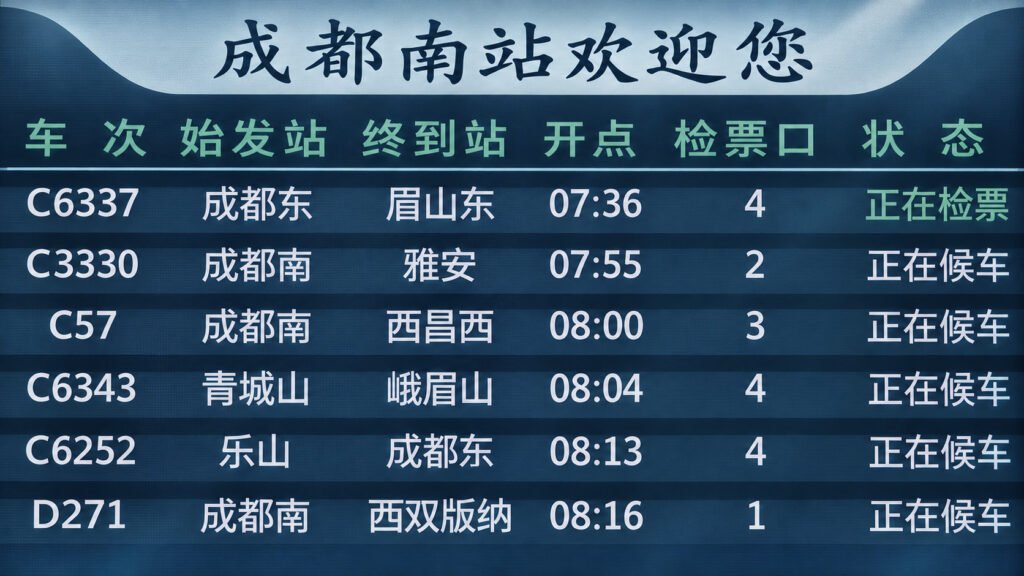
Find Your Train Number
One of the most important pieces of information to know is your train number.
This is usually a letter followed by several numbers, such as G1234 or D5678.
Large electronic departure boards display train numbers, destinations, departure times and boarding gates.
Many boards alternate between Chinese and English.
Look for your train number rather than relying only on the destination name.
Locate Your Boarding Gate
Once you have identified your train, find the allocated boarding gate.
The gate may appear in your booking app, but station departure boards and announcements should be treated as the most current information.
Boarding gates can change, so check the electronic displays when you arrive.
Wait for Boarding
Boarding often begins approximately 15 to 20 minutes before departure, although this varies between services and stations.
Passengers gather near the allocated gate and wait for boarding to begin.
The train number will normally be displayed prominently when the gate opens.
Do not leave boarding until the last minute because gates generally close before departure.
Have Your Passport Checked
Chinese passengers commonly use national identity cards at automated railway gates.
Foreign travellers use the passport linked to their booking.
Some modern automatic gates can read foreign passports, although this is not available consistently at every station.
If the automatic reader does not recognise your passport, look for a staffed inspection point, usually located at one side of the boarding gates.
A railway employee can scan or manually verify your passport and reservation.
Passport Tip – Look for the Staffed Gate
We found the staffed passport-check queue the simplest option when travelling with foreign passports.
If you are unsure which queue to join, ask an attendant where foreign passports should be checked.
Find Your Carriage and Seat
After passing through the boarding gate, follow the signs down to the platform.
Your reservation will show a carriage number and seat number, or sleeper berth if travelling overnight.
Carriage numbers are displayed on or beside the train doors.
Some platforms also have markings showing where particular carriages will stop.
Find your carriage, board the train and locate your seat.
Onboard Chinese Long-Distance Trains
Chinese high-speed trains are generally comfortable, clean and well organised.
Most carriages have luggage racks above the seats, with larger luggage storage areas near the carriage ends.
There are toilets onboard, and hot drinking water is commonly available.
Many passengers bring their own food, drinks or instant noodles, taking advantage of the hot water facilities.
Food and Drink
Food and beverages are sold on many long-distance trains, and some services have a dining or buffet car.
The dining car is often located around the middle of the train, although this varies depending on the service.
Bringing your own snacks and drinking water is also a convenient and inexpensive option.
Ordering Food to Your Seat
On some high-speed trains, you may notice a QR code on the seat armrest, seatback or nearby information panel.
Where supported, scanning the code through Alipay or another approved service can provide access to onboard food ordering.
Depending on the train and route, food may be delivered directly to your seat.
Availability varies, and not every QR code provides the same service.
Handy Tip – Check the QR Code
Before walking to the dining car, check whether the QR code near your seat offers food ordering.
On supported services, you may be able to order refreshments without leaving your seat.
Knowing When to Get Off
Stations are announced as the train approaches each stop, often in both Chinese and English.
Electronic information displays inside the carriage also show upcoming stations.
We recommend checking the expected arrival time in your booking confirmation and keeping an eye on the onboard displays.
As your destination approaches, collect your belongings and prepare to leave the train.
Exiting the Railway Station
After leaving the train, follow the signs towards the station exit.
Depending on the station, you may need to pass through another passport or ticket-check gate.
If required, use your passport at an automatic reader or the staffed inspection point.
Once outside the controlled railway area, follow signs for the metro, taxis, buses or other onward transport.
Many major railway stations connect directly to local metro systems.
Practical Tips for Travelling by Train in China
Check the Exact Railway Station
Major Chinese cities often have several railway stations, sometimes located considerable distances apart.
Always confirm the full station name before setting off.
Keep Your Passport Accessible
You may need your passport at the station entrance, boarding gate or exit.
Keep it somewhere secure but easy to reach.
Confirm Your Ticket Has Been Issued
If you have placed an advance reservation through Trip.com, check that the actual railway ticket has been issued once sales open.
A reservation request is not the same as a confirmed seat.
Allow Time for Security
Security screening is routine at both metro and long-distance railway stations.
Keep restricted items out of your luggage and allow enough time for screening.
Remember Your Train Number
Your train number is the easiest way to identify your departure on the electronic information boards.
Bring Snacks and Water
Although food is available on many trains, bringing snacks and drinking water is convenient, particularly on longer journeys.
Use a Translation App
English signage is common in major stations, but a translation app remains useful when communicating with staff or checking unfamiliar information.
Keep Alipay Working
Alipay is useful for metro tickets, local transport payments, food purchases and many other travel expenses.
Make sure your phone is charged and you have a reliable mobile connection.
Plan Carefully Around Chinese Holidays
Railway travel becomes particularly busy during Chinese New Year, National Day Golden Week and other major holidays.
Tickets on popular routes can sell out quickly, so check release dates and plan accordingly.
Metro Versus Long-Distance Trains – Quick Comparison
| Feature | Metro | Long-Distance Train |
|---|---|---|
| Purpose | Travel within cities | Travel between cities and regions |
| Ticket Purchase | Station machines, QR codes and local payment methods | 12306, Trip.com or station ticket office |
| Passport Required | Usually not for an ordinary single-journey ticket | Yes, for foreign passport-based bookings |
| Seat Allocation | No | Usually yes |
| Security Screening | Common | Standard procedure |
| Advance Booking | Generally unnecessary | Recommended on popular routes |
| Luggage | Carried with you | Stored onboard, subject to railway rules |
Useful Websites for Booking Trains in China
Trip.com
Trip.com is one of the simplest options for foreign travellers who prefer booking in English.
The app allows you to compare train times, travel classes and prices, place advance reservation requests and manage confirmed bookings.
It is particularly useful if you are booking several journeys during a longer trip.
Visit Trip.com Train BookingChina Railway 12306
12306 is the official Chinese railway booking platform.
It provides train schedules, ticket purchases and reservation management.
An English-language website and app are available, and foreign passport holders can register and purchase tickets.
Booking directly through 12306 generally avoids the agency service fees that may apply to third-party platforms.
Visit China Railway 12306Final Thoughts – Travelling by Train in China
China’s railway system is one of the country’s greatest travel assets.
The combination of extensive high-speed rail connections and modern urban metro networks makes it remarkably easy to travel between cities and explore them once you arrive.
For first-time visitors, the system can initially appear complicated. There are enormous stations, numerous railway lines, different train classes and passport checks that may be unfamiliar.
However, once you understand how the process works, travelling by train in China becomes surprisingly straightforward.
Our approach was simple: use the metro for getting around cities, book long-distance journeys through Trip.com, keep our passports handy and arrive at major railway stations with plenty of time.
The most important things to remember for long-distance journeys are your train number, departure station, boarding gate and the passport linked to your booking.
For metro travel, knowing your line number and the terminal station in the direction you are travelling makes navigation considerably easier.
After a few journeys, what initially seems like a complicated transport system becomes one of the easiest ways to get around.
And given the size of China, the quality of its trains and the enormous distances involved, travelling by rail is not simply practical. It is one of the best ways to experience the country.