
Ao Nang – An Airport, A Tourist Circus and a Ferry to the Past
Over the years I have travelled through Paris Charles de Gaulle Airport more times than I care to remember, and I have formed a very clear opinion of it.
It is, without question, the worst airport I have ever encountered.
Not because it is the biggest, the busiest or even the most confusing. There are certainly airports around the world that are larger and more chaotic. No, CDG has a special talent. It combines inefficiency, poor signage, endless walking, inexplicable queues and a remarkable ability to make passengers feel as though they are an inconvenience simply for turning up.
So whenever we encounter an airport that seems particularly determined to test our patience, it is immediately compared to CDG.
Which brings us to Kuala Lumpur.
Is Kuala Lumpur Airport worse than Paris Charles de Gaulle?
That is a difficult question.
The answer, ultimately, is no. Nothing has yet managed to knock CDG from its position at the top of my personal list of airport disasters.
But KL Airport is certainly making a respectable attempt at second place.
It was finally time to leave Kuala Lumpur after our unexpectedly extended stay, so we summoned a Grab and headed to the airport, blissfully unaware that we were about to descend into the depths of self-check-in hell.
Airports all over the world have embraced the wonderful concept of self-service. It sounds efficient enough. Check in online. Print your own boarding pass. Print your own luggage tags. Attach them yourself. Deposit your bags at the automated counter and stroll away feeling as though modern technology has made travel easier.
In reality, it often feels like the airlines have simply outsourced half their work to the passengers.
Our first bag disappeared into the system exactly as planned.
Our second didn’t.
Well… it did and it didn’t.
The computer confidently informed us that a twenty-kilogram bag had been checked in successfully. The bag itself, however, had other ideas. It sat stubbornly at the end of the conveyor belt refusing to go anywhere while the system happily believed everything was functioning perfectly.
Trying to explain this to airport staff proved surprisingly difficult.
We were told to print another luggage tag.
Then to try another machine.
Then to join another queue.
Apparently, when faced with a missing bag, the preferred solution is to move the passenger around until someone else inherits the problem.
After about thirty increasingly frustrating minutes—with departure time creeping ever closer—we finally found someone who understood the rather simple concept that the computer and reality were telling two completely different stories. Our bag was checked in manually, and disaster was narrowly avoided.
Passport control and security followed, providing the usual opportunities to remove belts, unpack electronics, empty pockets and question whether travelling has somehow become an elaborate obstacle course.
Eventually we reached the gate, collapsed into our seats and agreed that we had earned a holiday from our holiday.
The flight to Krabi was thankfully uneventful.
From there it was about a forty-minute drive to Ao Nang Beach, where we planned to spend a single night before catching the morning ferry to Koh Yao Noi.
We had stayed in Ao Nang more than ten years earlier and, if we’re honest, hadn’t been especially impressed. Then again, we had also stayed in a fairly ordinary hotel tucked well back from the beach, and anyone who travels regularly knows that where you stay can colour your entire impression of a place.
A wonderful location with a terrible room can make you dislike a place. A mediocre destination with the perfect little hotel can sometimes make you forgive it.
This time we had booked an older beachfront hotel and hoped perhaps we had judged Ao Nang a little harshly.
It turned out we hadn’t.
The moment we arrived we found ourselves in what can only be described as a monument to over-tourism.
The streets were clogged with cars, tuk-tuks and motorbikes weaving through impossible gaps. The pavements overflowed with visitors wandering between restaurants, tour agencies, massage shops and souvenir stalls. Every second shop appeared to sell the same collection of elephant pants, fake designer sunglasses, beachwear and those wooden frogs that make an oddly satisfying croaking noise when you rub a stick along their backs.
It was all a little overwhelming.
Normally we avoid places like this altogether. One of the joys of travelling slowly is that we can usually choose quieter towns where life still revolves around local people rather than organised tours and happy hours.
This time, however, we had no choice.
Our ferry departed early the following morning, and Ao Nang was simply where we needed to be.
Fortunately, our hotel turned out to be a glorious little pocket of calm in the middle of the chaos.
It was clearly from another era, built back when Ao Nang was still a sleepy beachside town rather than one of Thailand’s busiest tourist destinations. It wasn’t shiny or modern, and the rooms were perhaps a little tired, but it had something many newer resorts lack: character.
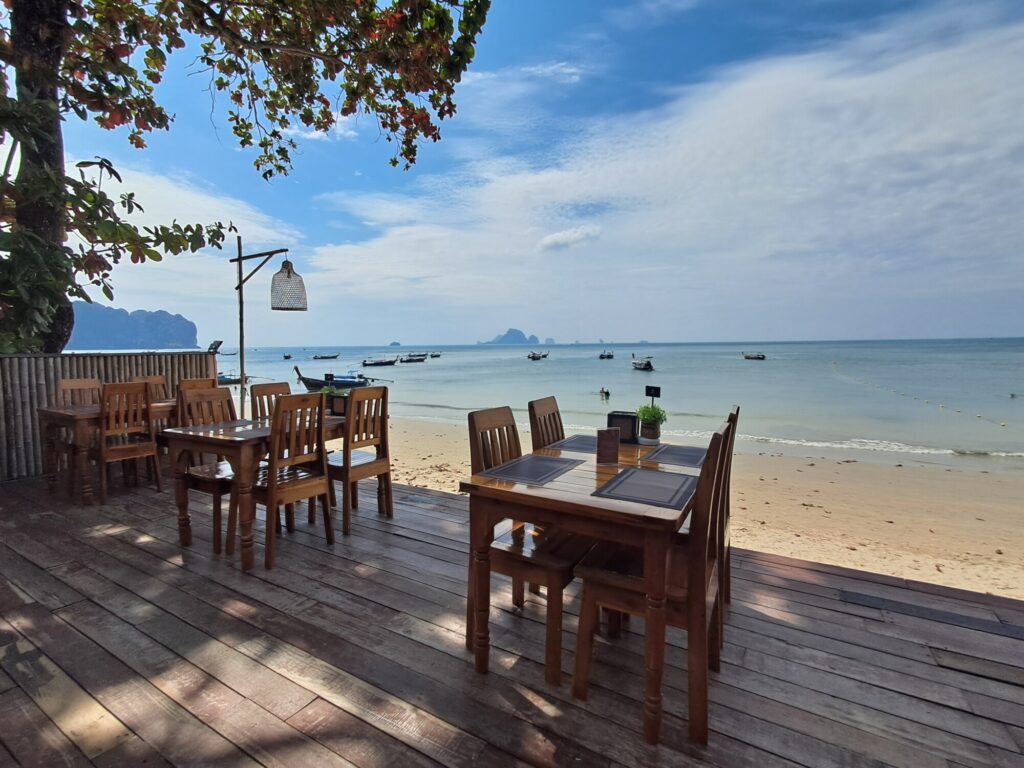
Best of all, it sat directly on the beach and had a wonderful restaurant overlooking the sand.
The moment we saw it, we made a very important decision.
We were not leaving the hotel again until it was time to catch the ferry.
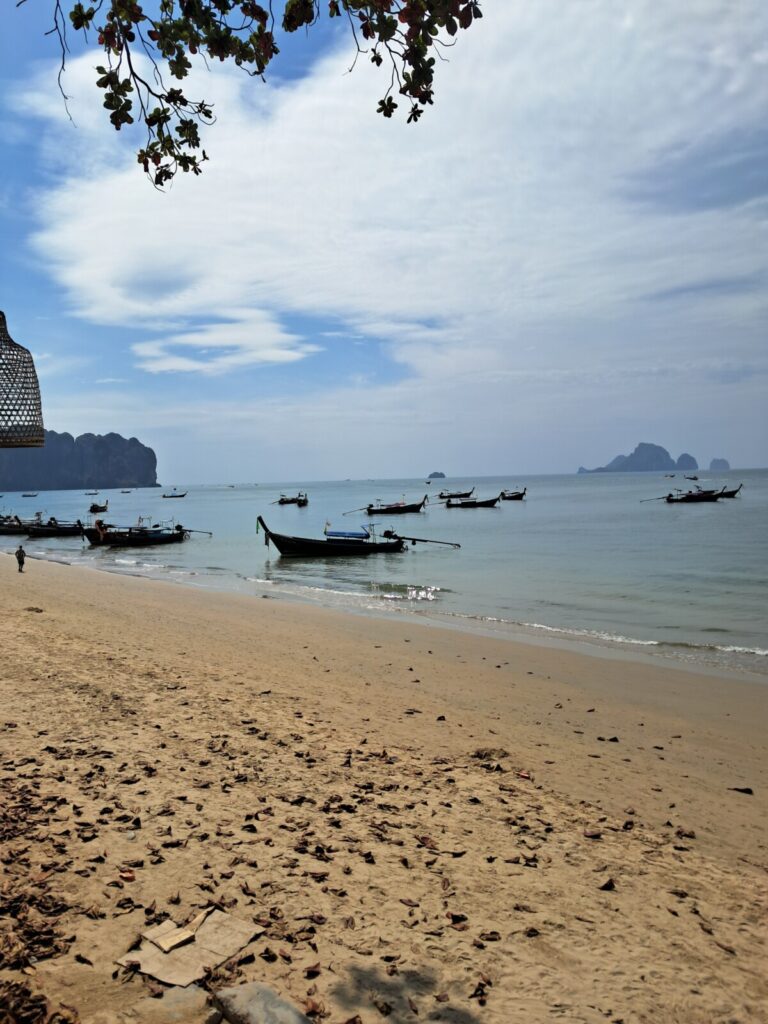
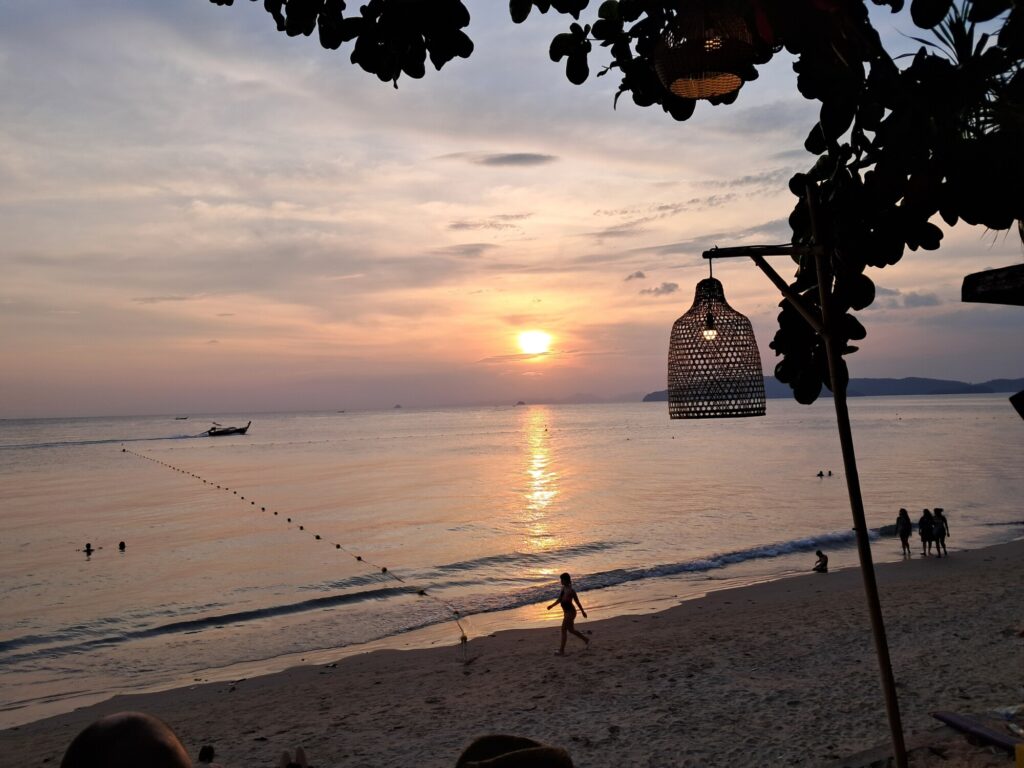
Instead, we settled into a beachfront table, ordered cocktails and watched the sun slowly disappear into the Andaman Sea while long-tail boats drifted across the horizon.
It was absolute bliss.
Dinner followed, and it was every bit as good as we had hoped. For a few hours we could almost forget that outside the hotel gates thousands of tourists were wandering around buying matching elephant trousers.
The following morning we enjoyed a leisurely breakfast overlooking the beach before our transfer arrived to take us to the ferry pier.
If Kuala Lumpur Airport had been organised chaos, the ferry terminal was simply chaos.
Ferries departed from here for islands scattered throughout Phang Nga Bay, and the entire area was filled with travellers clutching tickets, dragging luggage and looking increasingly uncertain about where they were supposed to be.
Watching first-time visitors navigate the system was wonderfully entertaining.
There was a lot of nervous wandering, frantic questioning of staff and the occasional blank expression when the answer was inevitably some variation of:
“Just wait.”
Somehow, despite appearances, it all worked.
Eventually our ferry was called.
Getting aboard was an adventure in itself. First came the walk across the beach, which is always a reminder that sand and luggage are natural enemies. We handed our backpacks to ferry staff, who casually tossed them aboard, then climbed a slightly wobbly ladder and scrambled onto the boat ourselves.
Watching other passengers attempt the same journey with enormous hard-shell suitcases was both entertaining and slightly painful.
Seriously, who brings a full-size suitcase to a Thai island?
At that moment we thanked ourselves once again for travelling light.
Soon the engines started, the ferry pulled away from shore and Ao Nang slowly disappeared behind us.
Ahead lay Koh Yao Noi.
We had first visited the island many years earlier, back when it was a quiet little corner of the Andaman Sea. There were simple beach shacks, sleepy villages, dusty roads and only a handful of travellers wandering around.
It was one of those rare places that somehow existed alongside Thailand’s booming tourism industry without being swallowed by it.
Places like that are becoming increasingly difficult to find.
The question was whether Koh Yao Noi had managed to hold onto the charm we remembered, or whether the inevitable march of tourism had finally caught up with it.
Returning to a place you loved years earlier is always a gamble.
Sometimes it is even better than you remember.
Sometimes you wish you had left the memory untouched.
We were about to find out.