
Unplanned Adventures in Athens
Ancient ruins, too much ouzo and AP’s rather optimistic approach to navigation
After Delphi it was time to head on to Athens, so we climbed aboard yet another bus and eventually arrived at the enormous and slightly chaotic Athens bus station. By then we had become fairly relaxed about arriving in places without having much idea where we actually were.
AP, however, was confident.
He had a compass.
This apparently meant everything was under control.
He announced that he knew both where we were and which direction we needed to go. I looked around at the traffic, the concrete, the complete absence of anything remotely familiar and had rather less faith in the situation.
Nevertheless, off we went.
AP marched confidently ahead with the compass while I followed behind carrying my pack in the blazing heat. We walked for what felt like several hours, although in reality it was probably closer to one. Either way, it was long enough for me to begin questioning both the route and the wisdom of letting a small magnetic needle make our travel decisions.
Eventually we stumbled across a metro station.
AP would probably maintain that this was precisely where he had intended us to end up.
I have always regarded it as one of the luckier moments of the trip.
Whatever the truth, the sight of the metro entrance was extremely welcome. We abandoned the compass expedition, went underground and caught a train to somewhere considerably closer to where we actually needed to be.
Our destination was the Aphrodite Hostel.
The hostel itself was nothing particularly special. It wasn’t especially cheap, the facilities were fairly basic and there was very little about the rooms that would have inspired anyone to write home about them.
Fortunately, nobody was staying there for the rooms.
Downstairs was a basement bar.
And the basement bar more than compensated for most of the hostel’s shortcomings.
It was run by a friendly backpacker who seemed to regard the accepted measure of ouzo as merely a suggestion. Drinks arrived generously poured and, most nights, so did half the hostel.
It quickly became our regular evening destination.
Travellers drifted downstairs from every corner of the building and before long the little basement would be full of people from all over the world drinking, talking and becoming considerably better acquainted than they probably would have done over tea.
We drank far too much ouzo.
This became something of a routine.
Among the people we met was a Japanese guy who spoke virtually no English at all.
This did not seem to bother him in the slightest.
He joined in with everything, laughed at the appropriate moments and was somehow one of the most social people in the room despite sharing almost no common language with most of us.
It was a useful reminder that conversation is apparently optional once enough ouzo has been consumed.
One night face paints appeared.
I have no idea where they came from or why anyone thought this was a good idea.
At the time, however, it apparently made perfect sense.
Before long various people around the bar had acquired stripes, symbols, badly executed artwork and other decorations across their faces. Nobody seemed particularly concerned about what they looked like.
We were all going to regret the photographs more than the face paint.
During the day we did make an effort to see Athens rather than simply recover from the previous evening.
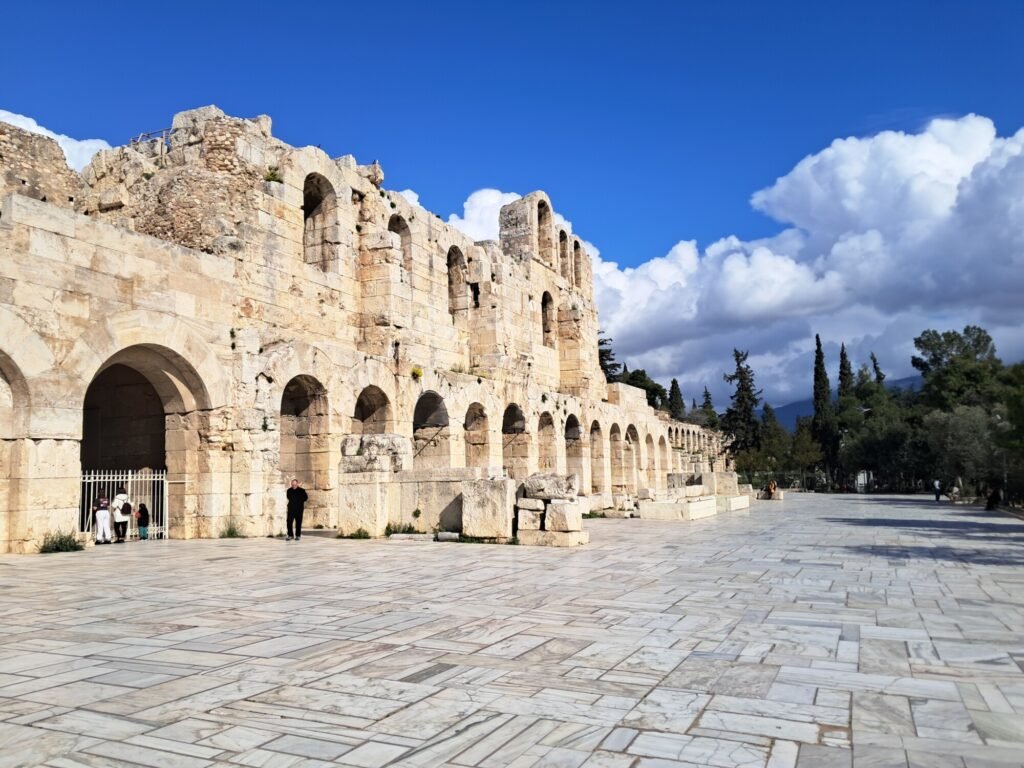
The city is an extraordinary mixture of the ancient and the completely ordinary. You can be walking along a busy modern street filled with traffic, apartment blocks and cafés and suddenly find yourself looking at ruins that have been sitting there for more than two thousand years.
The Acropolis dominates the city and, wherever we seemed to wander, sooner or later it appeared above us.
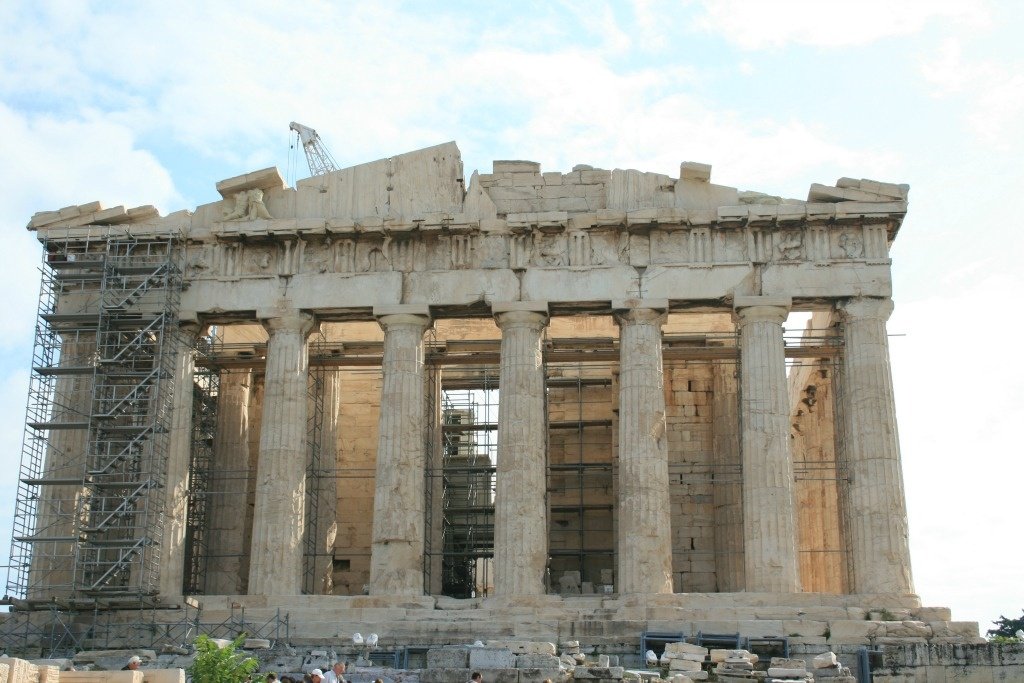
We made our way up to the Acropolis and the Parthenon, along with everybody else in Athens. There really is no avoiding the fact that it is spectacular. The Parthenon has been standing above the city for nearly two and a half thousand years and, despite wars, explosions, earthquakes, occupations and generations of people helping themselves to bits of it, there is still enough left to make an impression.
The views across Athens were just as extraordinary. The city seemed to stretch forever, a vast spread of white buildings packed into the basin between the surrounding hills.
We wandered through the Agora, past ancient temples and around the old parts of the city, usually without much of a plan. This had become our preferred method of sightseeing. Pick a direction, walk until something interesting appeared, then stop for coffee or food.
It was considerably more successful than AP’s compass system.
We spent plenty of time around Plaka, with its narrow lanes, old buildings, restaurants and little shops tucked beneath the Acropolis. It was touristy, but it was also one of those places where wandering aimlessly worked particularly well.
Our favourite restaurant was hidden down a steep set of steps in the Plaka district. I cannot remember how we found it, which probably means we were lost at the time.
The restaurant was small, unpretentious and served wonderful Greek food.
We went back more than once.
There was grilled meat, salads, vegetables, feta, bread, wine and all the wonderfully simple things Greek food does so well without feeling any need to turn them into something complicated.
After weeks of travel we had become very good at recognising the sort of restaurant we liked. If it was small, slightly tucked away and didn’t have somebody standing outside waving a menu at us, it was usually worth investigating.
We ate extremely well in Athens.
We also developed a fairly relaxed approach to stopping during the day. Walk for a while, have a coffee. Walk a bit further, find something to eat. Look at another ruin, decide a glass of wine would be reasonable.
It was a very manageable sightseeing schedule.
What I liked most about Athens was that the ancient city had not been separated neatly from the modern one. The ruins were simply there, surrounded by everything that had been built afterwards.
The Acropolis and Parthenon sat above a sprawling modern capital filled with traffic, markets, bars, cafés and people getting on with their lives. Around Monastiraki and Plaka the old streets were busy from morning until late at night, while a few blocks away modern Athens carried on with absolutely no obligation to look picturesque.
It was noisy, hot, messy in places and full of life.
We liked it enormously.
Looking back, I remember the Acropolis and the Parthenon, but I remember the basement bar just as clearly.
I remember following AP and his compass across Athens in the midday heat, finding the metro largely by accident, the Japanese guy who didn’t need English to have a good time, the face painting, the restaurant down the steps in Plaka and far more ouzo than was strictly necessary.
Athens gave us plenty of ancient history.
We provided most of the bad decisions ourselves.
It was an excellent combination.