
Veliko Tarnovo, Bulgaria
A dramatic canyon, a very good hostel and another travel plan that didn’t quite go to plan
After ten days in Sighișoara it was finally time to move on. We travelled down out of Transylvania to Bucharest and from there caught another train south towards Bulgaria. Much of the journey crossed the enormous flat plain around the Danube, where the landscape seemed to stretch away forever with very little to interrupt it.
One thing that struck us was how open the countryside looked. There seemed to be remarkably few fences compared with the heavily divided farmland we were used to seeing elsewhere. Whether this was a hangover from the old collective farming system or simply the way the land was being used, I couldn’t say, but mile after mile rolled past with barely a fence in sight.
Bulgaria was really only supposed to be a convenient stop on the way to Istanbul. We had met a couple of girls travelling in the opposite direction who had stayed at a hostel in Veliko Tarnovo and raved about it, so with no particularly better plan we decided that was good enough for us.
For the first part of the journey into Bulgaria, I wasn’t entirely convinced.
The landscape was flat, dry and not especially inspiring, and after several hours staring out of a train window we were beginning to wonder whether the girls had perhaps been unusually enthusiastic people.
Then, quite suddenly, everything changed.
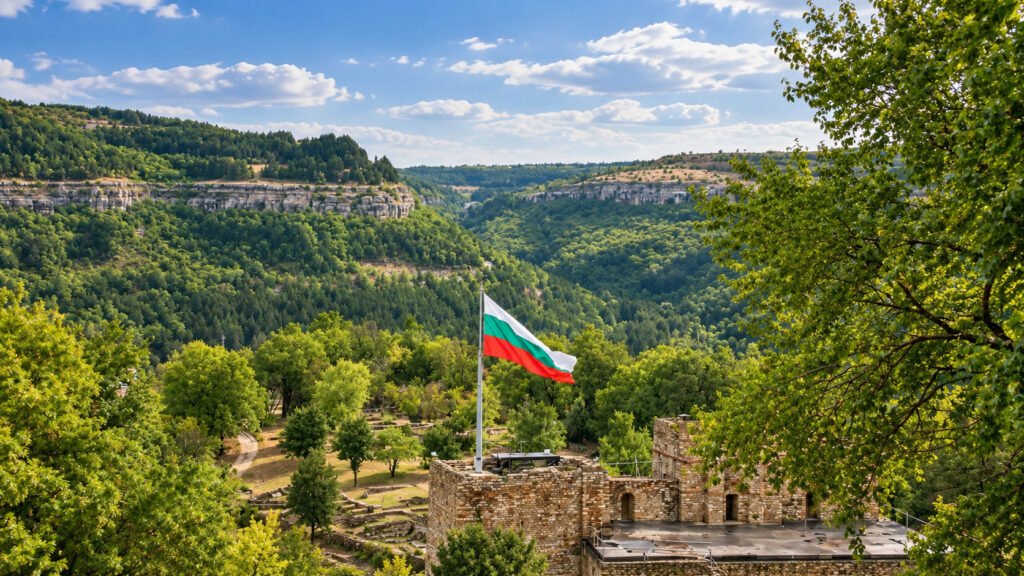
The railway dropped into a deep gorge and the flat dry landscape disappeared. We were surrounded by steep wooded hills with a river twisting through the bottom of the valley and houses clinging to the slopes. It was green, dramatic and completely unexpected after the country we had just spent hours travelling through.
Perhaps the girls knew what they were talking about after all.
We were staying at Hostel Mostel, and thankfully this recommendation turned out to be a very good one. We had a comfortable private room with our own bathroom, there were big communal areas, a lovely garden and terrace, decent WiFi and a very good breakfast included in the price. After weeks of moving around, these things suddenly become far more exciting than they probably sound.
It was also one of those hostels where people actually talked to each other rather than sitting silently around a table staring at their phones, which made a pleasant change.
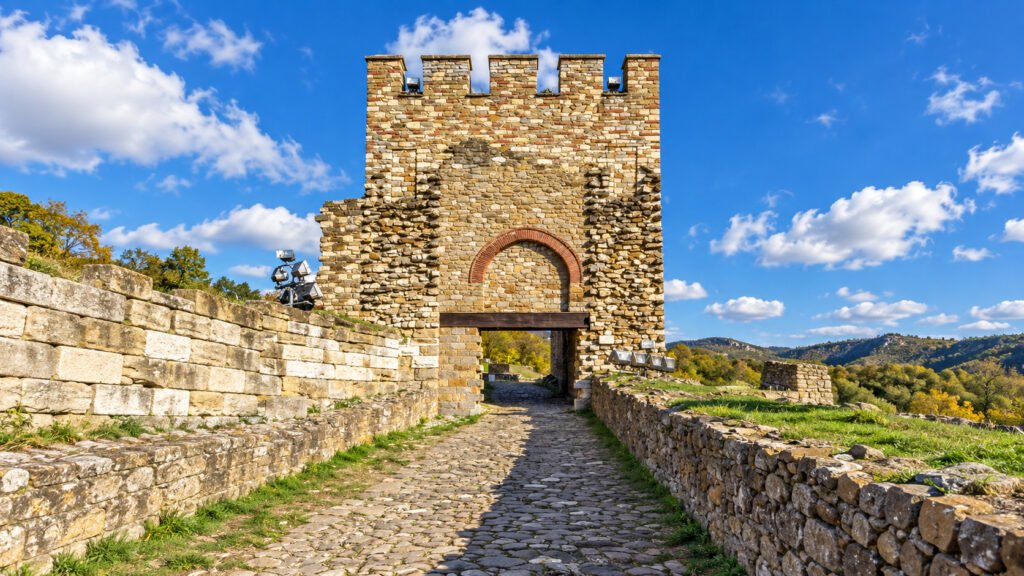
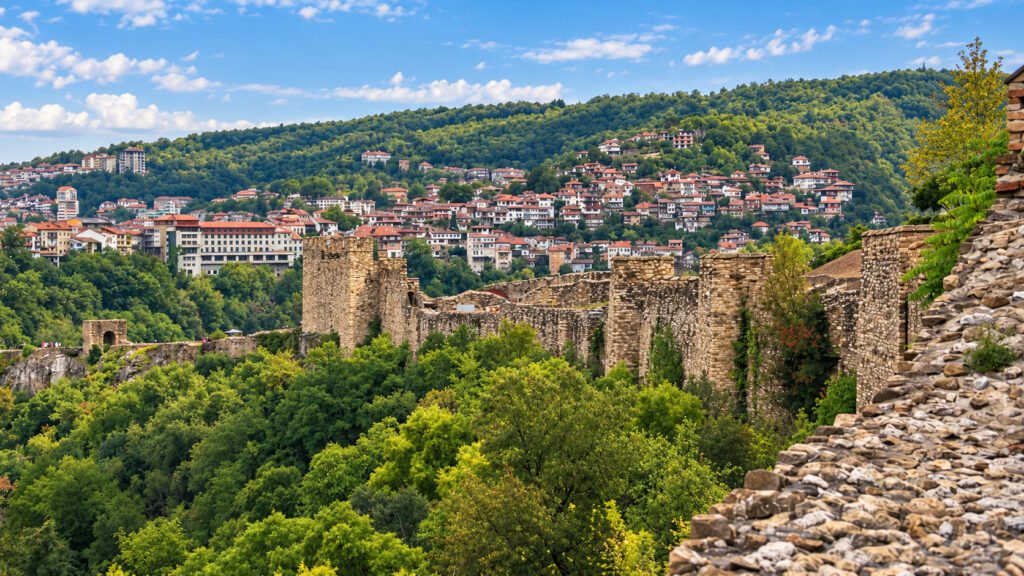
Veliko Tarnovo itself is built dramatically across a series of steep hills above the Yantra River, with houses appearing to be stacked almost on top of each other as they climb up from the valley. It had been the capital of the Second Bulgarian Empire during the Middle Ages and the remains of the great fortress of Tsarevets still dominate one of the hills above the town.
We spent plenty of time simply wandering around. This involved rather more climbing than the map suggested, as maps have a habit of presenting very steep hills as perfectly innocent little streets.
The old part of town was full of narrow roads, traditional houses and views across the gorge, while Tsarevets Fortress was impossible to miss. The fortress had once been the centre of medieval Bulgarian power, containing royal buildings, churches and defensive walls spread across the hilltop. Today much of it is ruins, although enough remains to give you a very good idea of just how important the place once was.
And, being on top of a hill, it naturally involved more climbing.
We explored the fortress, wandered along the old streets and spent quite a lot of time eating. Bulgarian food was hearty, inexpensive and very welcome after a day spent walking up and down hills. There was plenty of grilled meat, salads, bread, cheese and the sort of meals that arrive at the table in quantities suggesting nobody expects you to need anything else for several hours.
We liked Veliko Tarnovo, although there was something about it that made us slightly uneasy at times. There seemed to be a surprising number of serious-looking men in dark glasses driving very expensive black Mercedes with heavily tinted windows.
They may, of course, all have been perfectly respectable accountants.
There just appeared to be rather a lot of prosperous accountants in Veliko Tarnovo.
Nothing actually happened and nobody bothered us in the slightest, but the town had a slightly edgy feeling that we could never quite put our finger on. It did not stop us enjoying the place, although unlike Sighișoara it wasn’t somewhere we immediately began discussing staying for another ten days.
Our plan from Bulgaria was to continue directly to Istanbul. We had tickets booked on the night train and, for once, everything appeared to be organised.
This should probably have warned us.
On the afternoon we were due to leave, we were sitting in the garden at Hostel Mostel doing very little when the manager came outside looking for us.
There had been a major storm in Turkey.
The railway line had been damaged.
Our train to Istanbul had been cancelled.
Of course it had.
There wasn’t much point getting upset about it. The train wasn’t going to Istanbul regardless of how strongly we felt about the matter, so out came the map and we started looking for another way south.
Greece looked promising.
Instead of heading east into Turkey, we would head south and catch the night train to Thessaloniki. Turkey could wait.
So our brief Bulgarian stop, chosen largely because two girls had told us about a good hostel, ended with yet another change of plan and us heading off in a completely different direction.
Which, by then, was becoming fairly normal.
Veliko Tarnovo had never really been part of the plan, but it turned out to be well worth the stop. We found a great hostel, an extraordinary town built across a gorge, ate very well and then had our train to Istanbul cancelled. A fairly standard few days, really.