

Calais to Nice: Three Weeks Across Every Corner of France
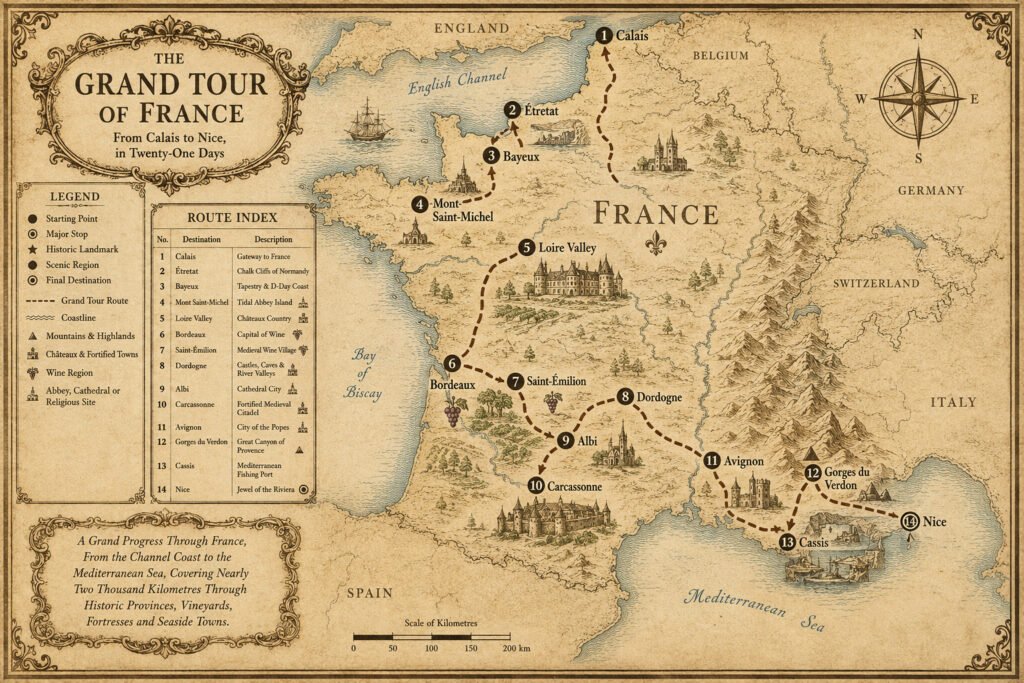
This is the grand tour — three weeks, 2,000 kilometres, and a dozen distinct French regions experienced in a single, carefully paced journey. Beginning on the chalk-white shores of the English Channel and ending on the pebble beaches of the Mediterranean, this itinerary weaves through Normandy’s war memorials and cider routes, Brittany’s granite coast and crêperies, the Loire Valley’s fairy-tale châteaux, the wine estates of Bordeaux, the prehistoric caves of the Dordogne, the walled city of Carcassonne, the lavender fields of Provence, the turquoise gorges of Verdon, and the glamorous coastline of the Riviera. Estimated budget: €3,000–4,200.
21-Day Itinerary Overview
Route: Calais → Étretat / Honfleur (2) → D-Day Beaches / Bayeux (2) → Mont Saint-Michel / Brittany (2) → Loire Valley (2) → Bordeaux & Saint-Émilion (2) → Dordogne (2) → Albi / Carcassonne (2) → Avignon / Luberon (2) → Gorges du Verdon / Cassis (2) → Nice & Riviera (3)
Best for: Travellers with three weeks who want to see the full range of France; road trip enthusiasts; photographers; anyone who wants to finish a trip feeling like they really know the country
Budget: €3,000–4,200 per person (excluding international flights)
Direction: One-way from Calais to Nice — never doubling back, always moving south
Day-by-Day Itinerary
Days 1–2: Calais → Normandy — Arrival, Cliffs & Cider
Day 1: Arrive via Eurotunnel at Calais/Fréthun. Pick up the car and drive 1 hour to Étretat. Walk the Alabaster Coast cliffs in the afternoon — the dramatic chalk arches and needle rock are your first taste of how different France looks from the UK.
Day 2: Drive to Honfleur (45 min), the prettiest harbour in Normandy with its 17th-century slate-covered port houses. Explore the wooden church of Sainte-Catherine (built by shipbuilders) and sample Calvados (apple brandy) at a local distillery. Afternoon drive through the Pays d’Auge cider route to overnight in a farmstead between Honfleur and the D-Day beaches.
Accommodation: Honfleur B&B or farm stay (€70–110/night).
Entry: Étretat cliffs (free), Honfleur old port (free).
Days 3–4: D-Day Beaches & Bayeux — The Cost of Freedom
Day 3: Full day on the D-Day landing beaches. Visit Arromanches (Mulberry Harbour remains), Omaha Beach, the American Cemetery at Colleville-sur-Mer, and Pointe du Hoc. The scale of what happened here is unimaginable until you stand on the beach looking up at the cliffs.
Day 4: Morning at the Bayeux Tapestry Museum — 70 metres of 11th-century embroidery that tells the story of the Norman conquest of England in bloody, vivid detail. Afternoon exploring Bayeux’s half-timbered old town before dining on moules-frites and local cider.
Accommodation: Bayeux centre hotel (€65–100/night).
Entry: Bayeux Tapestry (€12), American Cemetery (free).
Days 5–6: Mont Saint-Michel & Brittany — Island Abbey & Emerald Coast
Day 5: Drive to Mont Saint-Michel (45 min). Spend the full day exploring the abbey, the ramparts, and the tidal bay. Walk the causeway at low tide to feel the full scale of this island monastery. Eat an omelette at La Mère Poulard (touristy but historically famous).
Day 6: Drive west into Brittany. Visit Saint-Malo (walled Corsair city with a dramatic tidal pool), then the medieval town of Dinan (half-timbered houses and a 15th-century clock tower). Afternoon drive to Carnac for the megalithic standing stones — 3,000 prehistoric menhirs older than Stonehenge, stretching across the heath in silent rows.
Accommodation: Dinan or Carnac area guesthouse (€60–90/night).
Entry: Mont Saint-Michel Abbey (€13), Carnac stones (free).
Days 7–8: Loire Valley — Châteaux & Vineyards
Day 7: Drive 2.5 hours south-east to the Loire Valley. Visit Chambord (the largest and most dramatic château) and Chenonceau (the most beautiful, spanning the River Cher on a gallery bridge). Overnight in Amboise or Tours.
Day 8: Morning at Villandry’s extraordinary geometric gardens. Afternoon driving the wine route through Vouvray (famous for white Chenin Blanc — sparkling, dry, or sweet). Visit one of the troglodyte cave cellars carved into the tuffeau limestone cliffs for a tasting before continuing south.
Accommodation: Tours or Amboise centre (€60–95/night).
Entry: Chambord (€17), Chenonceau (€17), Villandry (€14).
Days 9–10: Bordeaux & Saint-Émilion — Wine Country
Day 9: Drive 2.5 hours south-west to Bordeaux. The city itself is a UNESCO-listed masterpiece of 18th-century architecture — Place de la Bourse, the Miroir d’Eau (the world’s largest reflecting pool), and the Cité du Vin (an immersive wine museum in a stunning modern building shaped like a swirling decanter). Evening in the Chartrons district — the heart of the wine trade.
Day 10: Drive to Saint-Émilion (40 min), a medieval village built into a limestone hillside and surrounded by the most famous wine appellations in the world. Tour the monolithic church (a single chamber carved entirely underground), then visit a château for a tasting. The clay-limestone soils here produce Merlot-based wines that are among the most sought-after on earth.
Accommodation: Bordeaux city hotel (€65–110/night) or Saint-Émilion guesthouse (€80–140).
Entry: Cité du Vin (€22 — includes a tasting), Saint-Émilion church (free).
Days 11–12: Dordogne — Prehistoric Caves & Medieval Villages
Day 11: Drive 2 hours east to the Dordogne region. Visit the Lascaux IV museum in Montignac — a full-scale, to-the-millimetre replica of the original Lascaux cave, featuring 17,000-year-old paintings of aurochs, horses, and deer that are so sophisticated they look modern. The original cave is closed to protect the paintings; Lascaux IV is the finest replica ever made and utterly breathtaking.
Day 12: Explore Sarlat-la-Canéda, the most beautiful town in the Dordogne — a perfectly preserved medieval city where every building is classified as a historical monument. Canoe the Dordogne River through the valley beneath the château of Beynac and Castelnaud. Visit a walnut farm or foie gras producer for the full Périgord culinary experience.
Accommodation: Sarlat area B&B (€60–100/night).
Entry: Lascaux IV (€20), canoe rental (€20–30).
Days 13–14: Albi & Carcassonne — Cathar Country & the Walled City
Day 13: Drive 2.5 hours south to Albi. The Sainte-Cécile Cathedral is unlike any church you’ve seen — a massive red-brick fortress on the outside, a riot of Italian Renaissance frescoes and a massive Last Judgement painting on the inside. The Toulouse-Lautrec Museum houses the world’s largest collection of works by the painter who was born here.
Day 14: Drive 1 hour south to Carcassonne, the most complete medieval walled city in Europe. With its 52 towers and double ring of ramparts, it looks like something from a fairy tale — because that’s exactly what Eugène Viollet-le-Duc was aiming for when he restored it in the 19th century. Spend the entire day walking the walls, crossing the medieval bridge, and eating cassoulet (the region’s famous bean and duck stew) at a restaurant in the Bastide Saint-Louis.
Accommodation: Carcassonne Bastide or La Cité hotel (€65–120/night).
Entry: Carcassonne ramparts (€12), Toulouse-Lautrec Museum (€12).
Days 15–16: Avignon & the Luberon — Papal City & Provencal Villages
Day 15: Drive 2 hours east to Avignon. Visit the Palais des Papes and the Pont Saint-Bénézet. Spend the afternoon exploring the lovely streets of the intramuros city. Evening at a bistro on Place des Corps Saints — far better than the tourist traps on Place de l’Horloge.
Day 16: Day trip into the Luberon. Visit Gordes, Roussillon (walk the Ochre Trail), and the Abbaye de Sénanque with its lavender fields. Have lunch at a farm in the Luberon valley — fresh goat cheese, cold rosé, and a view across the valley. Return to Avignon for the night or push on to a guesthouse near Aix.
Accommodation: Avignon or Luberon guesthouse (€65–100/night).
Entry: Palais des Papes (€14), Ochre Trail (€2.50).
Days 17–18: Gorges du Verdon & Cassis — Canyons & Calanques
Day 17: Drive 2 hours east to the Gorges du Verdon. Spend the day kayaking on the Lac de Sainte-Croix or hiking the Sentier Blanc-Martel along the canyon rim. The vibrant turquoise water against the cream-coloured limestone creates colours you’d swear were photoshopped. Overnight in Moustiers-Sainte-Marie.
Day 18: Drive 2 hours south to Cassis, the pastel-coloured fishing village at the foot of the Calanques. Take an afternoon boat tour through the Calanques fjords (€18–25, 1.5 hours) and swim in the clear water. Eat bouillabaisse in Cassis port — it’s cheaper here than in Marseille and just as good.
Accommodation: Cassis seaside hotel (€70–130/night).
Entry: Kayak rental (€25–35), Calanques boat tour (€18–25).
Days 19–21: Nice & the French Riviera — Three Days on the Coast
Day 19: Drive 1 hour to Nice along the Corniche des Maures — a stunning coastal road. Settle in, walk the Promenade des Anglais, explore Vieux Nice. Dinner: socca (chickpea pancake) from a street stall, then a proper Niçoise salad at a restaurant on Cours Saleya.
Day 20: Visit Monaco (20 min by train from Nice). See the Prince’s Palace, the cathedral, and the Oceanographic Museum. Then take the little train up to Èze (429 metres above sea level) for the most vertiginous view of the Riviera coastline. The Jardin Exotique with its giant cacti and sculpture garden is worth the entry fee.
Day 21: Final morning — one last swim at Villefranche-sur-Mer (2 min by train from Nice). Then back to Nice for the airport tram. Pick up a final pain au chocolat from a boulangerie, find a bench on the Promenade des Anglais, and watch the Mediterranean lap at the pebbles while you eat it. You’ve crossed an entire country on two wheels and your own steam — you’ve earned this last moment.
Accommodation: Nice city centre near Old Town (€70–120/night).
Transport: Train Nice → Monaco → Nice (€7.60 return).
Budget Summary: 21-Day France Grand Tour
Estimated Total: €3,000–4,200 per person
- Car rental (21 days, economy one-way Calais→Nice): €550–950
- Fuel: €220–300
- Tolls (extensive — A13/A11/A10/A63/A20/A9/A8): €150–200
- Eurotunnel ferry: €59–85
- Accommodation (20 nights): €1,200–2,000
- Château and museum entries: €180–240
- Wine tasting and purchases: €80–150
- Kayak and boat tours: €45–65
- Meals: €500–700
Best Season: Late May–early July (long daylight, lavender in bloom, hiking perfect, sea warm enough) or September (harvest season, fewer crowds, sea still warm)
Recommended For: Travellers with three full weeks who want the most comprehensive possible French road trip; anyone who’s never been to France and wants to decide which region to return to; photographers; food and wine lovers with stamina
Disclaimer: Prices are estimates and may vary by season. One-way car rentals (Calais pick-up, Nice drop-off) incur additional fees of €100–250. The A8 and A9 motorways in the south are among France’s most expensive toll roads. Book Lascaux IV, Pont du Gard, and Cité du Vin tickets in advance during summer. This itinerary is for general reference only.