
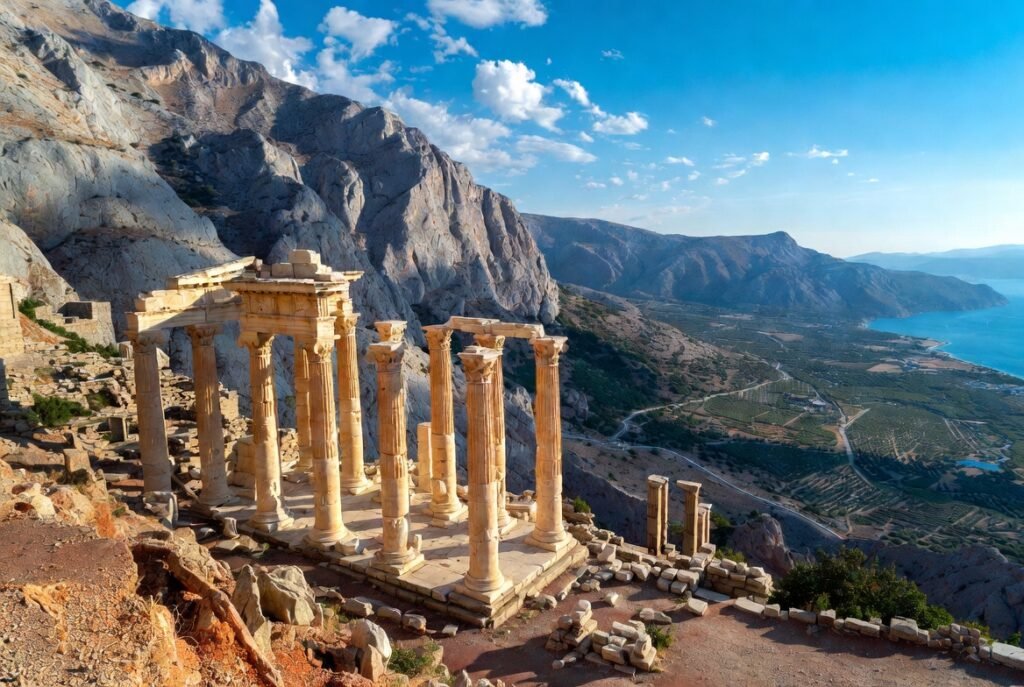


Delphi, Greece
Twenty-three hours, several trains, several buses and one completely unhinged taxi ride
With our train from Bulgaria to Istanbul cancelled because storms had damaged the tracks in Turkey, we had done what we usually did when a travel plan fell apart — looked at the map and come up with another one. Greece was now the plan, so instead of heading east towards Istanbul we were heading south to Thessaloniki and then somehow onwards to Delphi.
First, however, we had to get to the station.
The hostel organised us a taxi and we climbed in with our bags, expecting a fairly uneventful drive through the hills.
It was not uneventful.
Our driver was apparently very keen to make sure we did not miss the train. Either that or he simply drove everywhere as though being pursued.
We tore through the valleys and canyons at an extraordinary speed, hitting every bump in the road hard enough to send me bouncing out of my seat and repeatedly smacking my head against the roof of the car.
Seatbelts would have been useful.
I don’t remember there being any.
As if the driving wasn’t enough to concentrate on, the taxi driver was also involved in an increasingly serious dispute with his car radio. It clearly wasn’t working properly and every so often he would rip it out of the dashboard, bash it violently against the steering wheel, shove it back into the hole and continue driving.
This did not appear to improve the radio.
Nor did it encourage him to slow down.
For most of the journey I couldn’t decide whether to watch the road, the cliffs or the ongoing fight with the stereo.
Eventually I stopped worrying about all three and just hoped we would arrive at the station before either the taxi or the radio gave up completely.
We did.
I have rarely been so pleased to get out of a car.
From there we boarded the overnight train towards Greece and, rather wonderfully, managed to get ourselves a private sleeper compartment. After the taxi ride, being shut in a small room on a train suddenly seemed exceptionally safe.
For a few hours everything was quiet and we actually managed to sleep.
Then, at around three in the morning, we reached the border.
Anyone who travelled around Eastern Europe by train at that time will probably remember the border crossings. There was apparently no way to inspect a passport quietly.
Doors banged open, lights came on, officials marched up and down the carriage and people shouted at each other in corridors while the rest of us sat blinking into the light wondering exactly which country we were currently in.
Passports were collected, inspected, returned and occasionally inspected again for good measure.
Eventually everybody went away and we were allowed to return to bed.
By dawn we had arrived in Thessaloniki.
Our introduction to Greece was a spanakopita.
This was an immediate improvement on the border crossing.
After a night on the train, a hot pastry filled with spinach and feta was magnificent. We stood there eating it in the early morning and briefly considered whether Greece might already have justified the change of plan.
There wasn’t much time to ponder this because we still had a long way to go.
From Thessaloniki we caught another train to Larisa, then changed onto a bus for Lamia, and from Lamia boarded yet another bus for Delphi.
By this point we had been travelling for most of a day and the novelty of changing transport had worn off considerably.
We were also discovering that getting to Delphi involved a great deal more Greece than we had anticipated.
On the final bus journey I overheard a group of passengers becoming extremely excited about what they believed was an ancient aqueduct running alongside the road.
There was much pointing and considerable admiration for the engineering brilliance of the ancient Greeks.
I looked out of the window.
It was a modern concrete water channel.
They were enjoying it, so I saw absolutely no reason to interfere.
After around twenty-three hours of trains, buses, border checks and the Bulgarian taxi driver from hell, we finally arrived in Delphi.
By then we were ready for a decent bed.
Our hotel felt outrageously luxurious.
It probably wasn’t, but after weeks of fairly basic accommodation, fresh white sheets, fluffy towels and a proper comfortable room seemed extravagant enough to require some adjustment.
Then there was the food.
We had arrived in Greece hungry and discovered very quickly that this was an excellent country in which to have that problem.
After spending the better part of a day eating whatever we could find between trains and buses, sitting at a table with proper Greek food and no imminent departure time was wonderful.
We settled into Delphi very easily.
The town itself sits high on the slopes of Mount Parnassus, with the mountains falling away below towards a vast valley filled with olive groves and, in the distance, the Gulf of Corinth. It is an extraordinary setting even before you get anywhere near the ruins.
The following morning we headed out to the ancient sanctuary.
Delphi was one of the most important religious centres of the ancient Greek world and, according to Greek mythology, the centre of the world itself. One version of the story has Zeus releasing two eagles from opposite ends of the earth and the birds meeting at Delphi.
Apparently that settled the matter.
The sanctuary became associated with Apollo and was home to the famous Oracle of Delphi, where people travelled from across the Greek world seeking advice on everything from war and politics to business, marriage and personal problems.
The oracle was delivered through the Pythia, the priestess of Apollo, whose pronouncements were interpreted for those who had come looking for answers.
Unfortunately, those answers had a reputation for being somewhat open to interpretation.
Apparently even two and a half thousand years ago it was difficult to get a straight answer out of a consultant.
The Temple of Apollo stood at the centre of the sanctuary, surrounded by treasuries, monuments and statues donated by cities and rulers from across the Greek world. Delphi was not simply a religious site; it was also a place where wealth, politics and prestige were very much on display.
It was also home to the Pythian Games, held in honour of Apollo and second in importance only to the Olympic Games. Competitions included athletics, but also music and other events, which seemed a rather civilised way to run a sporting festival.
We followed the ancient Sacred Way up through the site, passing the remains of treasuries, temples and monuments as the path climbed steadily higher.
And it did climb.
The ancient Greeks clearly had no objection to putting important things at the top of hills.
The theatre sits above the Temple of Apollo and higher again is the stadium where the Pythian Games were held. By the time we reached it we had certainly earned the view.
And the view was spectacular.
What makes Delphi so impressive is not simply the ruins. It is where they are.
The sanctuary clings to the mountainside with Mount Parnassus behind it and the enormous valley opening below. Olive groves stretch towards the Gulf of Corinth and mountains rise in every direction.
You could remove every ancient stone and it would still be a remarkable place.
Fortunately nobody has.
After exploring the site we went into the archaeological museum, which turned out to be considerably more interesting than I had expected. Museums attached to archaeological sites can occasionally involve rather more broken pottery than my attention span can cope with, but Delphi has some extraordinary pieces.
Among them is the Charioteer of Delphi, a remarkably well-preserved bronze statue dating from the fifth century BC. There is also the enormous Sphinx of Naxos, which once stood on a tall column within the sanctuary, along with sculptures, friezes and offerings that had once decorated the site.
Seeing them after walking through the ruins made the whole place much easier to imagine.
When you walk around an archaeological site two thousand years after everybody has gone home, there is inevitably a lot of stone.
Foundations.
Broken columns.
Bits of wall.
It can take some imagination to turn that back into the enormous, colourful and extremely wealthy sanctuary it once was.
The museum helped.
At its height Delphi had been crowded with temples, statues, treasuries and offerings brought there by cities and rulers keen to demonstrate both their devotion and, one suspects, their ability to afford very large monuments.
What survives today is only a fraction of it.
By the time we walked back towards town, the slightly ridiculous journey from Bulgaria seemed a long way behind us.
Twenty-three hours of taxis, trains, buses, border guards and transport connections had delivered us somewhere that was absolutely worth the effort.
Thousands of years earlier people had travelled across the ancient world to come to exactly the same place, although presumably without spanakopita at Thessaloniki station or a Bulgarian taxi driver attempting to beat a radio into submission.
Standing high above the valley with the mountains behind us and the Gulf of Corinth in the distance, it wasn’t difficult to understand why the Greeks had chosen this particular place for one of their most important sanctuaries.
Whether it was actually the centre of the world was another matter.
But after taking twenty-three hours to get there, we were prepared to give them the benefit of the doubt.