

Travelling in Sighișoara
A night train, a dreadful first impression and ten days in a town we almost left immediately
After a week in Budapest it was time to move on, so we packed our bags and headed to the station for the overnight train to Sighișoara in Romania. Sighișoara is a small Transylvanian town built around a medieval citadel and is traditionally associated with the birthplace of Vlad III, better known as Vlad the Impaler and, much later, dragged into the whole Dracula business.
We shared our sleeper compartment with two young Romanians. One was a young woman who had married a Hungarian and was going home for the weekend, while the other was a young guy studying in Budapest. They did not appear to have much money, but they were delightful company and we spent the first part of the journey chatting before everyone attempted to get some sleep.
Our conductress was a large, cheerful Romanian woman who bustled up and down the carriage making sure everyone was where they were supposed to be. At some point she handed us little show-bags of goodies to get us through the night, which was rather lovely and immediately put Romanian Railways ahead of several other countries we had travelled through.
Actually getting a night’s sleep was another matter.
At around one in the morning we were woken for passport checks on the Hungarian side of the border. Lights came on, doors opened, passports were handed over and everyone sat around looking exactly as delighted as you would expect at one in the morning. Eventually the officials disappeared, the lights went out and we all climbed back into bed.
Just as we had drifted off again, the Romanian border officials arrived and we did the whole thing for a second time.
By then we had achieved that particular kind of sleep you get on night trains where technically your eyes are closed but absolutely nothing else about you believes you are asleep.
The train was supposed to arrive in Sighișoara at around five in the morning, so we set the alarm. When it went off the train was slowing into a station, which seemed fairly conclusive. We dragged ourselves out of bed, pulled on our packs and staggered into the corridor ready to get off.
Our conductress suddenly came charging down the passage waving her arms and shouting, “Non qua! Non qua! Prossima stazione! Prossima stazione!”
I stood there looking at her in a sleep-deprived haze.
Surely she was speaking Italian.
For a brief moment I genuinely wondered whether we had somehow got onto the wrong train in Budapest and were now heading for Italy. It seemed unlikely, but not sufficiently unlikely to dismiss immediately.
The young Romanian guy from our compartment eventually stuck his head into the corridor and explained that the train was running nearly two hours late. This was not Sighișoara. We would not be arriving until closer to seven.
So we took the packs off and went back to bed.
We had always known that Romanian was a Romance language, but until then we had not realised just how much of it could sound familiar if you knew some Italian. This was encouraging. Our Italian was rusty, but rusty Italian was still a considerable improvement on our Romanian, which at that point consisted of nothing at all.
Eventually, at something approaching seven, the train finally pulled into Sighișoara.
We climbed down from the carriage directly onto the railway tracks because the platform appeared to have lost interest after about the third carriage. As we stood there with our packs trying to work out which way to go, a sleepy young guy jumped down from the carriage in front of us and asked, “Is this Brașov?”
“No,” we said.
He looked at us, then at the train.
The train was already moving.
He took off after it.
AP took off after him.
I stayed where I was because somebody had to look after the luggage.
The guy managed to grab hold of the doorway and AP gave him one final shove up the very steep steps before the train gathered speed and carried him off towards Brașov.
I still have a very clear memory of the two of them sprinting beside the train and the guy disappearing through the door at the last possible moment. Apparently missing your stop in Romania involved considerably more exercise than I had expected.
We wandered up to the station building and were surprised to discover a new station complete with luggage storage and reasonably decent toilets. This was excellent because neither of us had any desire to carry our backpacks around town while we worked out where the town actually was.
We dumped the bags and set off, following the tried and tested traveller’s navigation system of looking for a church steeple and heading towards it. It is not particularly scientific, but churches have been putting themselves in town centres for centuries and we saw no reason not to take advantage of this.
After a couple of kilometres we reached the citadel and climbed up into the old town.
It looked awful.
The streets had been torn apart. There was rubble everywhere, the roads were unmade and people appeared to be asleep in cars all over the place. This was not quite the picturesque medieval Transylvanian town I had been expecting.
We wandered around for a while hoping it might improve around the next corner.
It didn’t.
Eventually AP looked at me and said, “Where the F*** have you brought me?”
I did not have a particularly convincing answer.
By this stage we had been woken twice for passport checks, got ourselves completely dressed and ready to leave the train two hours too early, arrived on a platform that barely existed and walked several kilometres to discover what appeared to be a medieval building site full of people sleeping in cars.
I was beginning to think AP had a point.
Getting back on the train and continuing somewhere else briefly seemed like a very sensible option, but fortunately we were too tired to organise it.
Instead, we decided that before condemning the whole of Sighișoara we should probably have some sleep.
The first place we tried was Residence Fronius, a beautiful old guesthouse right inside the citadel in a building that had once housed local nobility. It was five star and somewhat beyond our normal travelling budget.
At any other time we would have thanked them, walked out and found somewhere cheaper.
Exhaustion is remarkably effective at changing one’s financial principles.
We booked a room.
It would not be ready until eleven, but rather than send us back out onto the streets they invited us into the lounge, gave us breakfast and generally treated us with extraordinary kindness.
This was our first real taste of Romanian hospitality and immediately improved matters.
Food and a comfortable chair can change one’s opinion of an entire country quite quickly.
Eventually we walked back to the station, collected our packs, returned to Residence Fronius and collapsed into bed.
When we woke in the early afternoon we discovered that someone had apparently replaced Sighișoara while we were asleep.
The streets were still dug up, but it turned out they were restoring the old cobblestones rather than simply destroying the town for entertainment.
The people who had been asleep in their cars were not evidence of some wider Romanian social collapse either. They had come from all over Europe for an annual festival.
By afternoon the same streets that had looked almost deserted at seven in the morning were packed with people. There was music and dancing, food stalls everywhere, cafés had opened and the little squares were full.
Sighișoara was suddenly wonderful.
Apparently seven in the morning, after a night on a train, is not the ideal time to form strong opinions about a town.
After our first night at Residence Fronius we moved to the considerably more affordable Hotel Frânca and settled in. What had been intended as a relatively short stay began to stretch out and, instead of getting back on the train, we ended up staying for about ten days.
So much for wanting to leave before breakfast.
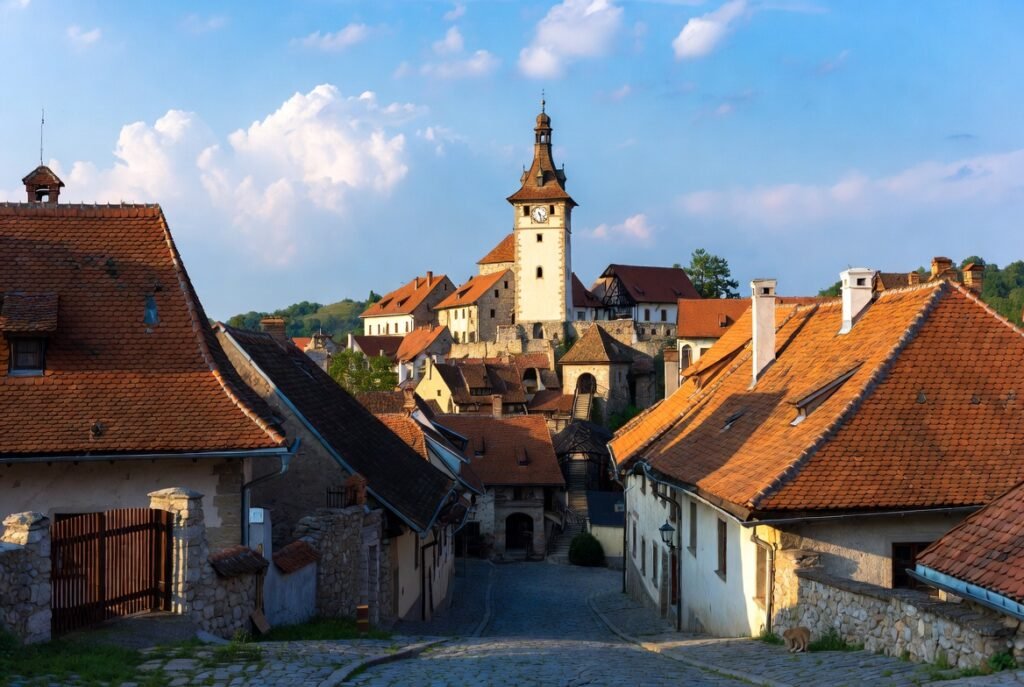
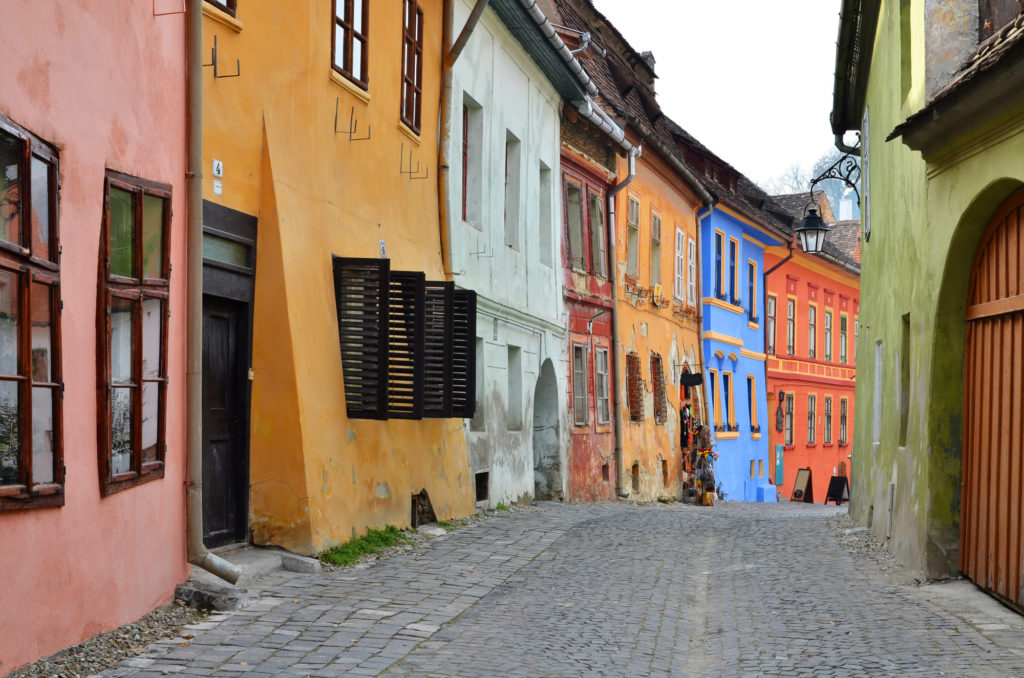
Once we were rested and the festival was properly underway, we spent hours wandering around the citadel. Colourful old houses lined the cobbled streets, towers rose above the rooftops and little lanes disappeared off in every direction. It was compact enough that we didn’t really need a plan, which suited us perfectly.
Sighișoara had been developed as a fortified town by the Transylvanian Saxons during the Middle Ages. German-speaking settlers had been invited into Transylvania from the 12th century onwards, partly to settle and defend the region, and their influence is still obvious throughout this part of Romania.
One of the best things we did during our stay was a tour through the surrounding countryside with a Dutch anthropologist who had settled in Romania. He took us out to visit Saxon villages, fortified churches and Roma communities and it became one of those days when you realise how little you actually know about the place you are travelling through.
Before arriving in Transylvania we knew virtually nothing about the Saxons. What fascinated us was that they had lived in Romania for centuries while maintaining their own language, customs and culture. Many villages remained distinctly Saxon and the architecture was very different from anything we had expected to see in Romania.
The fortified churches were extraordinary. These were not simply little village churches surrounded by a wall. Some were substantial defensive complexes with towers, storage rooms and fortifications where villagers could retreat during an attack.
Clearly Sunday worship in medieval Transylvania came with rather more infrastructure than usual.
During the twentieth century many of the Saxon population left Romania for Germany, particularly after the Second World War and again during the later Communist years. By the time we visited, some villages had only a small number of Saxon residents left, but the buildings, churches and villages they had created were still everywhere.
Visiting the Roma villages was just as interesting and gave us another view of Romania that we would never have seen from the old town. Having an anthropologist with us who knew the communities and understood the history and relationships between the different groups made the whole day far more worthwhile than simply being driven around looking at villages.
As part of the same trip we headed further up into the hills to visit a sheep farm, where we watched the shepherds bring the sheep in and milk them by hand. It was all wonderfully basic and very much a working farm rather than something put on for visitors. They made feta and several other sheep’s cheeses right there on the property using the milk from the flock.
Our Dutch guide explained all this with great enthusiasm, then suggested that under no circumstances should we ask to see where the cheese was actually made. Apparently the facilities were fairly primitive and, in his words, if we saw the process we might never eat cheese again.
This seemed sensible advice.
We therefore chose to preserve both the mystery and our future relationship with feta.
Back in Sighișoara we settled into a very pleasant routine. We wandered around the citadel, watched the festival, explored the surrounding countryside and ate a great deal of goulash and bean soup.
There was also a café around the corner from our hotel that made a surprisingly decent pizza, which became useful when we reached the point where another bowl of bean soup seemed unnecessary.
The funny thing was that within a few days the place we had seriously considered leaving within an hour of arriving had become somewhere we were in no hurry to leave at all.
Our first impression of Sighișoara had been spectacularly wrong.
In our defence, we had arrived at seven in the morning after very little sleep to find the streets dug up and half of Europe asleep in cars.
It was not the town’s best angle.
Ten days later, when we finally packed our bags and headed off, we were very glad exhaustion had stopped us from making any important decisions that first morning.