


Walking the Cinque Terre
Riomaggiore, Corniglia, Vernazza and an unexpected change of plans
We set off very early from Venice, first catching the train to Florence, where we made a quick change, and then continuing on to Genoa.
At Genoa station we left our main luggage in storage, transferred just enough for a couple of days into our day packs and climbed aboard the little train that runs along the coast behind the five villages of the Cinque Terre.
It had already been a fairly long day by the time we finally arrived in Riomaggiore, the southernmost of the five villages.
We had no booking.
We also had no real plan.
This was pretty much how we travelled — turn up, have a look around and work it out from there.
We wandered around the village for a while until we spotted a handwritten note in a window advertising accommodation. We knocked on the door, there was a brief conversation involving my Italian, several gestures and the usual amount of hopeful smiling, and before long we found ourselves being shown up to an enormous room tucked into the top of a house.
The views were extraordinary.
From the windows we could look out over the village and towards the sea, and in the bathroom was the most magnificent marble sink I had ever seen.
For one brief and completely impractical moment, I wondered if it would fit in my backpack.
It would not.
We were tired after a long day of trains and hauling ourselves from one place to another, so after a quick meal at a nearby trattoria we headed back to our apartment in the roof and called it a night.
The following morning we were up early and ready to tackle the Cinque Terre trail.
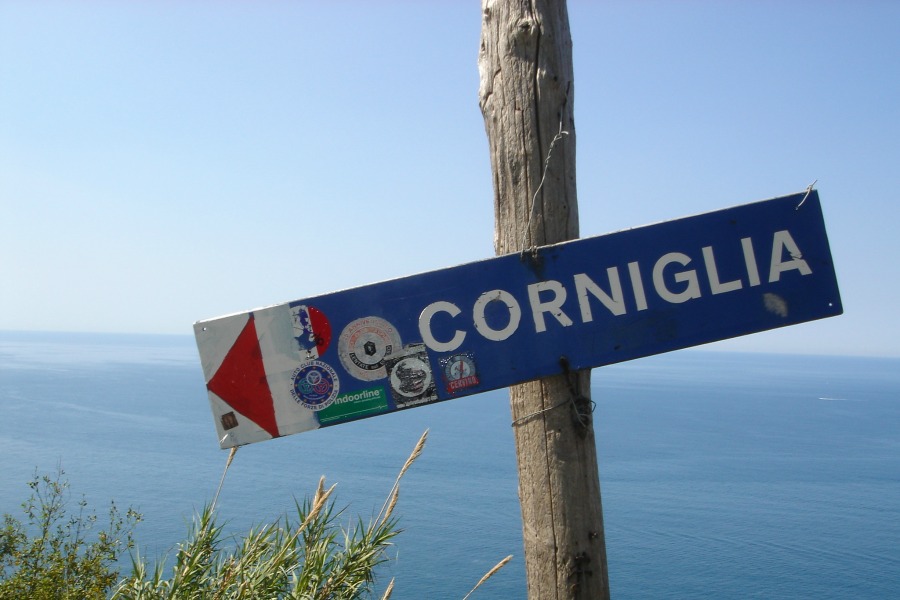
Our plan for the day was to walk as far as Corniglia, the middle of the five villages, and spend a few days there.
I had been to the Cinque Terre a few years earlier and had walked the trail then, also staying in Corniglia. At that time the area was still relatively unknown to international visitors. We had walked entire sections of the trail without seeing another person and wandered through villages that felt almost deserted.
It was one of the things I had loved about it.
So we set off from Riomaggiore towards the next village, Manarola, along the Via dell’Amore.
The walk was ridiculously easy by Cinque Terre standards. It was paved, almost completely flat and hugged the cliffs above the sea. After about half an hour we wandered into Manarola, where we stopped for coffee and breakfast before setting off again.
The next stretch, from Manarola to Corniglia, was a little more like the Cinque Terre walking I remembered.
The trail ran for a little over two kilometres and took us around an hour and a half, although we were in no hurry. There seemed little point in marching along a coastline like that with your head down trying to beat a time.
We stopped often.
Sometimes because of the views.
Sometimes because we wanted a drink.
Sometimes simply because there was a convenient rock and we felt like sitting on it.
Leaving Manarola, the path climbed briefly past the cemetery before settling into a narrow trail carved into the hillside above the Ligurian Sea. For much of the walk we followed the coastline, with the water below us and steep terraced hills rising above.
The path crossed the dry Valle Asciutta and continued towards Corniglia, eventually bringing us down near the railway station.
Unfortunately, Corniglia itself is not beside the railway station.
It is above it.
Quite a long way above it.
Between us and the village was the Lardarina staircase, nearly 380 stone steps zigzagging up the hillside.
This was the point where I became extremely grateful that we had left our main luggage in Genoa.
With our lightweight day packs we climbed steadily upwards while passing people attempting the same thing with enormous suitcases and backpacks. There was a fair amount of huffing and puffing going on around us, and some very unhappy-looking travellers who were probably reconsidering several of their packing decisions.
Eventually we reached the top and emerged into Corniglia.
Corniglia is the only one of the five Cinque Terre villages without direct access to the sea, which has always made it slightly less popular than the others.
It was also exactly why I liked it.
Perched high above the water, it is a beautiful little village surrounded by terraced hillsides, vineyards and sweeping views across the Ligurian Sea. It felt quieter and more removed from everything below.
Once again, we had no accommodation booked.
And once again, this somehow wasn’t a problem.
We found a lovely little apartment owned by a smiling nonna, with views across the hills and a location close to the centre of town.
It was perfect.
Over the next couple of days we wandered around the village, ate anchovies, bought delicious crostini from the shop downstairs and generally did very little.
Which was exactly what we wanted to do.
But eventually it was time to move on.
We packed our bags, returned the keys to our smiling nonna and were preparing to leave when A.P. suddenly realised something.
His passport was still inside the apartment.
The now locked apartment.
Oh dear.
Back we went to find the nonna.
I attempted to explain the problem in my limited Italian, although I’m not entirely convinced she spoke much standard Italian herself. Many older people in that part of Italy still spoke the local dialect, which added another layer to an already slightly complicated conversation.
I said passaporto several times.
I pointed back towards the apartment.
There was considerable gesturing.
She looked puzzled.
I gestured some more.
Then suddenly her face changed.
“Ahhh!”
Success.
She handed us the keys.
We hurried back upstairs, retrieved the passport, returned the keys once more and set off again.
Emergency over.
Our next destination was Vernazza, where we planned to spend another night or two.
The trail from Corniglia to Vernazza was around four kilometres and considerably more demanding than the gentler stretches we had walked before. The path climbed away from Corniglia through terraced hillsides and vineyards, twisting along narrow sections of trail high above the sea. There were stone steps, uneven ground and plenty of climbing, but the views made up for it.
Every now and then the path opened up and the coastline stretched away below us, with the blue of the Ligurian Sea filling almost everything beyond the hills.
We passed a few people along the way, but not many.
It took us somewhere between an hour and a half and two hours. Again, we weren’t racing. We stopped when we wanted to, looked at the view, took photos and generally enjoyed being there.
Then the path began its steep descent towards Vernazza.
We worked our way down the stone steps, and eventually the village appeared below us, clustered around its little harbour.
From above, it looked beautiful.
Then we reached the bottom.
Chaos.
After seeing hardly anyone on the trails and having Corniglia almost to ourselves, Vernazza felt as though somebody had emptied several tour buses directly into the main street.
It turned out we had arrived during a public holiday long weekend and, apparently, at the same time as spring break in the United States.
The place was packed.
There were bright young things everywhere, being very loud, very energetic and very determined to get wherever they were going before everybody else.
It was quite a shock after the previous few days.
Vernazza is probably the prettiest of the Cinque Terre villages, which is also precisely why it is one of the most popular. Its little harbour, colourful houses and waterfront are undeniably lovely.
But after walking for several days through villages and trails where we had barely seen another person, the crowds were astounding.
I remember looking around and wondering where they had all come from.
Then I realised.
Most of them had probably arrived by train.
They had stepped off, photographed Vernazza, ticked it off the list and would soon get back on the train and move to the next village.
Which seemed to rather defeat the purpose of the place, but there you go.
We started looking for somewhere to stay.
Nothing.
Everywhere seemed to be booked.
The streets were packed, restaurants were heaving and the whole place felt unbearably busy.
We stood there for a while, looked at each other and had a very short discussion.
France?
France.
And that was that.
Back onto the train we went.
We returned to Genoa, collected our main luggage from the station and then boarded a fast train along the coast towards Nice.
By the time we arrived it was late.
A.P. knew a hostel, so we headed straight there hoping they might have something available.
They did.
Sort of.
The only beds left were in mixed dorm rooms.
After a day that had begun in a tiny Italian hilltop village, involved several kilometres of walking, a passport emergency, a descent into the chaos of Vernazza, a train back to Genoa and then another train across the border into France, neither of us had the energy to care.
Beds were beds.
We took them.
I had first visited the Cinque Terre about three years earlier, when it had been wonderfully quiet. There had been a handful of people wandering around, the trails were almost empty and the villages still felt like places people actually lived rather than destinations everyone had suddenly discovered.
Back then, it had simply been a beautiful walk along the coast, with little villages where you could stop for the night whenever you felt like it.
Now, in 2007, it seemed tourism had found the Cinque Terre.
And standing in the middle of packed Vernazza after several days of remembering how quiet it had once been, I wasn’t entirely sure that was a good thing.