


Chiang Mai, Thailand – Not Quite Our Cup of Tea
Ancient temples, magnificent noodles and a hostel that had apparently decided bed linen was an unnecessary luxury
After a couple of thoroughly enjoyable days in Bangkok, we caught a flight north to Chiang Mai, a city often described as the cultural capital of northern Thailand and something of a backpacker’s paradise. Having heard so many wonderful things about it over the years, we were looking forward to discovering what all the fuss was about.
Chiang Mai has a long and fascinating history. Founded in 1296 by King Mangrai, it became the capital of the Lanna Kingdom, which ruled much of northern Thailand for centuries. Unlike Bangkok, with its enormous modern buildings, traffic and general chaos, Chiang Mai is famous for its historic old city, Buddhist temples, traditional markets and surrounding mountains. It sounded wonderful, and we arrived expecting to be thoroughly charmed.
Unfortunately, our introduction to Chiang Mai was rather less wonderful than we had anticipated. We had booked ourselves into a budget hostel which, on arrival, turned out to be truly terrible. It was old, grubby and had most definitely seen better days. Quite a lot of better days, actually. In fact, I suspect its better days had packed up and left some considerable time before we arrived.
Now, we have stayed in budget accommodation all over the world and are certainly not precious about where we sleep. We don’t need luxury, fluffy bathrobes or someone appearing at the end of the bed with a chocolate on a silver tray. A reasonably clean room, a comfortable bed and functioning plumbing are generally enough to keep us happy. Apparently, even these modest expectations were asking rather a lot.
The most extraordinary thing about the hostel was that it didn’t provide bed linen. None whatsoever. This was a first for us, and not a particularly welcome one. In fact, most hostels we had stayed in specifically prohibited guests from using their own bedding or sleeping bags, quite sensibly in my opinion, as dragging linen of dubious cleanliness from one hostel to another is a wonderful way to spread bedbugs.
But here we were, in a decidedly dodgy hostel in Chiang Mai, sleeping under a towel. A towel! I have no idea what happened to the concept of providing sheets with a bed, but apparently the management considered them an optional extra, or perhaps an unnecessary extravagance. Whatever the reasoning, it was not an arrangement we were particularly keen to repeat.
Needless to say, we checked out the following morning and found ourselves a budget hotel, which was infinitely better. Although, to be fair, almost anything would have been better than the hostel. At least we now had proper bedding, which we appreciated with an enthusiasm normally reserved for rather more exciting things. Sometimes it really is the simple pleasures in life.
Accommodation problems sorted, and having enjoyed the novelty of sleeping between actual sheets, we set off to explore Chiang Mai. The historic old city is surrounded by remnants of ancient walls and a moat, forming a roughly square area that is very easy to explore on foot. Within the walls are narrow streets, traditional wooden buildings, small restaurants and an extraordinary number of Buddhist temples.
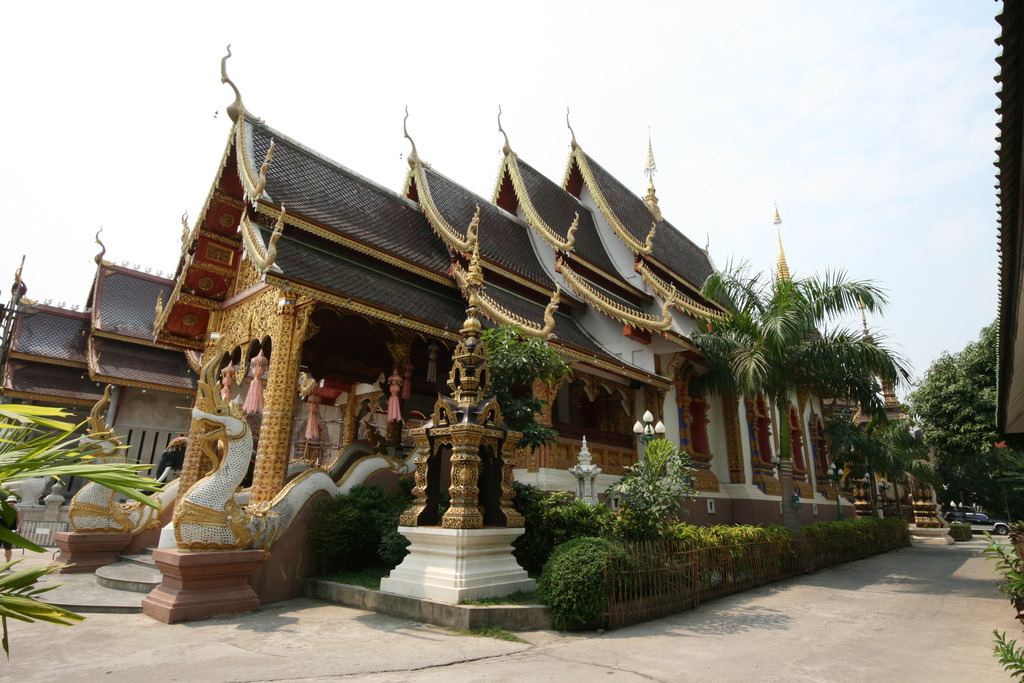
Chiang Mai is said to have hundreds of temples across the greater city, many associated with the former Lanna Kingdom. It is an impressive concentration of religious buildings, and you are rarely far from a beautifully decorated entrance, an elaborate golden roof or a peaceful courtyard tucked away behind the busy streets.
We spent the next couple of days wandering through the old city, stopping at temples and exploring the streets. There was certainly no shortage of interesting places to visit, and the city’s long history was evident almost everywhere we went.
One of the most impressive temples was Wat Chedi Luang, whose enormous brick chedi dominates the surrounding buildings. Construction began in the fourteenth century, and at one time it was among the tallest structures in the Lanna Kingdom. The upper part was damaged centuries ago, traditionally attributed to an earthquake, but the surviving structure is still remarkable. Even in its partially ruined state, it is an imposing monument and a wonderful reminder of Chiang Mai’s former importance.
Interestingly, Wat Chedi Luang once housed the famous Emerald Buddha, which is now kept at Wat Phra Kaew in Bangkok, where we had seen it only a few days earlier. Clearly, the Emerald Buddha had travelled rather more extensively around Thailand than we had appreciated.
Not far away was Wat Pan Tao, a beautiful temple known for its traditional teak architecture. Its wooden prayer hall was quite different from the elaborate gilded structures found in many Thai temples, and it was a lovely example of traditional Lanna craftsmanship. The dark timber, intricate carvings and elegant proportions gave the building a character entirely its own.
We also visited Wat Phra Singh, one of Chiang Mai’s most important temples, with its ornate buildings, golden decorations and beautiful traditional architecture. Dating from the fourteenth century, it remains an important religious centre and is particularly famous for its revered Buddha images. The temple complex was beautifully maintained, and there was plenty to admire as we wandered through its grounds.
Another interesting temple was Wat Chiang Man, believed to be the oldest temple in Chiang Mai. Built around the time the city was founded in 1296, it is particularly recognisable for its chedi supported by carved stone elephants. The elephants are a wonderful feature, standing patiently around the base of the structure as they have done for centuries, presumably without complaint.
And then there was the Three Kings Monument, standing in a square in the centre of the old city. The monument depicts King Mangrai, the founder of Chiang Mai, alongside King Ramkhamhaeng of Sukhothai and King Ngam Muang of Phayao, three rulers associated with the political alliances that helped shape the early history of the region. It is an important landmark and a reminder that this peaceful-looking northern city was once at the centre of a powerful kingdom.
The temples were fascinating, and we enjoyed learning about Chiang Mai’s history. It was also a pleasant city to explore on foot, with plenty of small streets to wander down and places to stop for something to eat or drink. We had certainly seen some beautiful buildings and enjoyed our time exploring, but despite all of this, something about Chiang Mai just wasn’t quite doing it for us.
One evening we headed to the famous Walking Street night market. Chiang Mai is well known for its night markets, particularly the enormous Sunday Walking Street, which stretches through the old city along Ratchadamnoen Road. The streets were absolutely packed, with what seemed like half the population of northern Thailand having decided to go shopping at precisely the same time.
There were stalls selling clothing, handicrafts, jewellery, souvenirs, artwork and all manner of things you probably didn’t need but might somehow convince yourself to buy. It is extraordinary how quickly an entirely unnecessary object can become something you simply cannot imagine travelling without, particularly when it costs very little and the person selling it is especially persuasive.
And then there was the food. Lots of food. Grilled meats, noodles, curries, fresh fruit, sweets and all sorts of local specialities were being prepared and sold from stalls along the street. The smells were wonderful, and it was difficult to walk very far without being tempted by something sizzling, bubbling or being expertly assembled on a small roadside stall.
We thoroughly enjoyed wandering through the crowds, stopping to look at the different foods and occasionally trying something interesting. Markets are always one of our favourite places to explore, particularly in Asia, where the variety of food is extraordinary and there is almost always something we haven’t encountered before.
And it was during our time in Chiang Mai that I discovered one of the best noodle dishes I have ever eaten: Khao Soi Gai.
Khao Soi Gai (ข้าวซอยไก่) is a traditional northern Thai chicken curry noodle soup, and it is absolutely delicious. The dish is made with a rich, fragrant coconut milk curry broth flavoured with spices, chilli and curry paste. Soft egg noodles sit in the broth with tender chicken, while a generous handful of crispy fried noodles is piled on top. Just when you think a bowl of noodles couldn’t possibly be improved upon, someone has the inspired idea of adding more noodles.
It is usually served with lime, pickled mustard greens, sliced shallots and chilli oil, allowing you to adjust the flavours to your liking. The combination is wonderful: creamy, spicy, fragrant and slightly tangy, with the crispy noodles providing a completely different texture from the soft noodles underneath. Every mouthful is a slightly different combination of flavours and textures, and the result is quite extraordinary.
I loved it. In fact, I would go so far as to say that Khao Soi Gai remains one of the best noodle dishes I have ever eaten. And believe me, I have eaten quite a lot of noodles. I don’t claim to be an expert in many things, but I do feel reasonably qualified to offer an opinion on a good bowl of noodles.
It was certainly one of the highlights of our time in Chiang Mai, and almost enough on its own to justify the journey north. Almost, but not quite. One excellent bowl of noodles, however magnificent, can only do so much to improve your overall impression of a place.
Over the next couple of days, we continued exploring the city, wandering through the old streets, visiting temples and eating in local restaurants in the evenings. We took our time, stopping wherever something caught our interest and generally doing what we enjoy most when travelling, which is wandering around without too much of a plan.
And Chiang Mai was nice. There was nothing particularly wrong with it, apart from our disastrous first accommodation. The temples were beautiful, the food was excellent and the old city was certainly interesting. It was easy to get around, there was plenty to see and do, and it offered everything that a popular tourist destination is supposed to offer.
I can completely understand why so many travellers love Chiang Mai. For some people it is their favourite place in Thailand, somewhere they return to again and again, and I can see why it has such a loyal following. But for some reason, we just didn’t connect with it.
It is difficult to explain, particularly when a place has so much going for it. Sometimes you arrive somewhere and immediately feel comfortable. You like the atmosphere, the people, the streets, the food and the general feel of the place. There may be nothing especially remarkable about it, but something just clicks, and you find yourself wanting to stay longer than you originally planned.
Other times, despite there being plenty to see and do, the destination simply doesn’t appeal to you in quite the same way. You can appreciate everything it has to offer, enjoy the sights and have some lovely experiences, but that elusive connection never really happens. It isn’t necessarily the fault of the place, and sometimes there isn’t a particularly logical explanation.
For us, Chiang Mai fell into the second category. Perhaps our unfortunate introduction had something to do with it, although I don’t think that was entirely the reason. After all, we had moved into a perfectly comfortable hotel, seen some extraordinary temples and discovered a truly magnificent bowl of noodles. By any reasonable measure, things had improved considerably since that first night under the towel.
But it simply wasn’t somewhere we particularly wanted to stay. We had enjoyed exploring the city and were glad we had visited, but neither of us felt especially inclined to linger. Sometimes you just have to accept that a place everyone else seems to adore isn’t necessarily going to be your cup of tea.
So, after a few days, we decided it was time to move on. Our next destination was Chiang Rai, a smaller city further north, not far from the borders with Myanmar and Laos. It was a little further away from the main tourist trail, which appealed to us considerably. We packed our bags, caught a bus north and left Chiang Mai behind, taking with us some lovely memories, a newfound appreciation for proper bed linen and a lasting affection for Khao Soi Gai. And as it turned out, Chiang Rai was much more our kind of place.