
Across the Pyrenees and Into Spain
Oloron-Sainte-Marie to Puebla de Sanabria
We were up early.
There was a long day ahead of us and, more importantly, breakfast needed to be dealt with.
A visit to the local boulangerie produced a quiche, which seemed an entirely reasonable way to start the day.
Quiche collected, bags packed and Kangoo loaded, we set off.
Direction: Spain.
The drive south from Oloron-Sainte-Marie towards the Pyrenees is stunning.
The road follows a beautiful valley, running alongside a clear mountain stream that tumbles over rocks and winds its way through the countryside. Small villages appear every few kilometres, their houses clustered around churches and bridges, with steep green hills rising on either side. It was one of those stretches of road where there was something lovely around almost every bend.
We weren’t in any particular hurry.
Which is generally when travelling becomes considerably more enjoyable.
At one tiny village we stopped for coffee and something resembling an early lunch.
We stretched our legs with a wander beside the river, enjoyed the fact that we weren’t sitting in the car and then, eventually, climbed back in.
Onwards.
The road continued climbing towards the mountains until eventually we reached the tunnel beneath the Pyrenees.
There is something slightly strange about driving into the side of a mountain in one country and emerging several kilometres later in another.
One minute France.
A tunnel.
Then Spain.
Very efficient.
We emerged not far from Jaca, a small city we had visited before and liked very much.
But not enough to stop again.
Not this time.
We had a long way to go.
So we kept driving.
South and west.
The green Pyrenean valleys slowly gave way to the much drier landscapes of northern Spain.
We skirted Pamplona and later Burgos, gradually finding ourselves travelling through countryside associated with one of the most famous walking routes in Europe.
The Camino de Santiago.
And there were pilgrims everywhere.
Some walked alone.
Some walked in pairs.
Some travelled in little groups, backpacks strapped to their shoulders and walking poles clicking against the ground.
Every so often we passed cyclists doing the same thing considerably faster.
I have always imagined the Camino as a journey along peaceful ancient paths, through picturesque villages and rolling countryside.
And I’m sure parts of it are.
This particular section wasn’t.
Here, the pilgrims seemed to be walking beside the road across a vast, dry and dusty plain while cars and trucks rushed past them.
It was hot.
There was very little shade.
And the landscape stretched away seemingly forever.
I am not entirely sure this was what some of them had pictured when they first decided to walk across northern Spain in search of spiritual enlightenment.
Perhaps enlightenment requires trucks.
Lots of trucks.
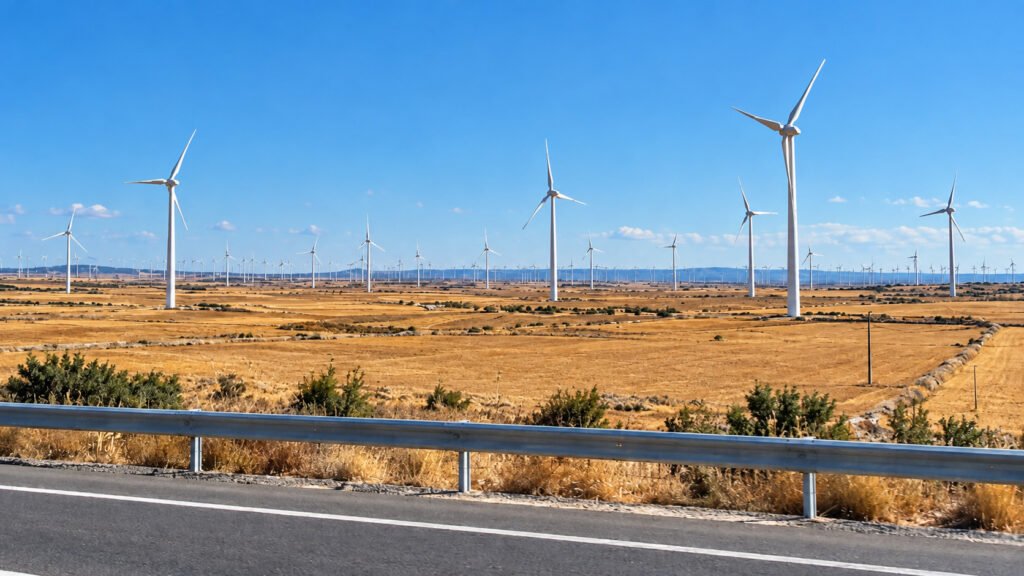
The other thing that dominated the landscape was wind turbines.
Not a few wind turbines.
Thousands of them.
Or at least that was how it appeared from the road.
They marched across the plains in enormous rows, disappearing into the heat haze and continuing right to the horizon.
Against the dry golden landscape they looked strangely futuristic.
White towers standing across an otherwise empty plain.
And then more.
And more.
And still more.
By late afternoon we were heading towards our destination for the night.
Puebla de Sanabria.
There was no particularly complicated reason for choosing it.
It appeared to be roughly where we wanted to stop.
It looked interesting.
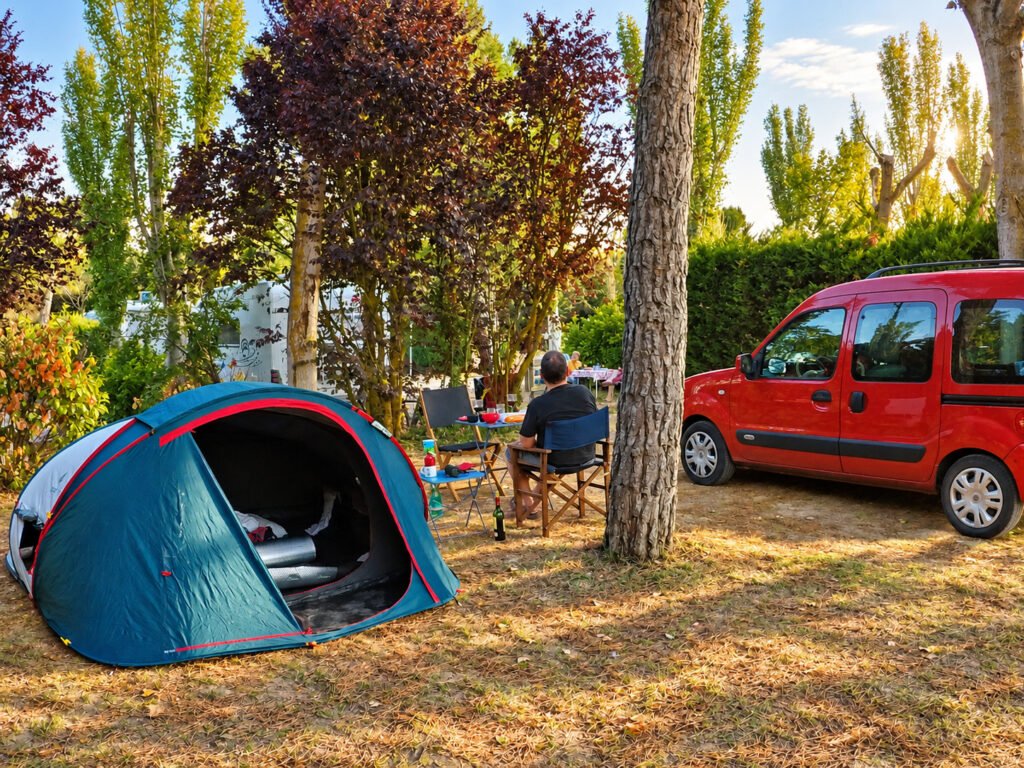
And, most importantly, it had a campsite with trees.
Shade had become a major factor in our travel planning.
Puebla de Sanabria turned out to be considerably more interesting than our rather casual choice of overnight stop suggested.
The old town sits high above the surrounding countryside near the meeting of the Tera and Castro rivers, a position that made it strategically important for centuries.
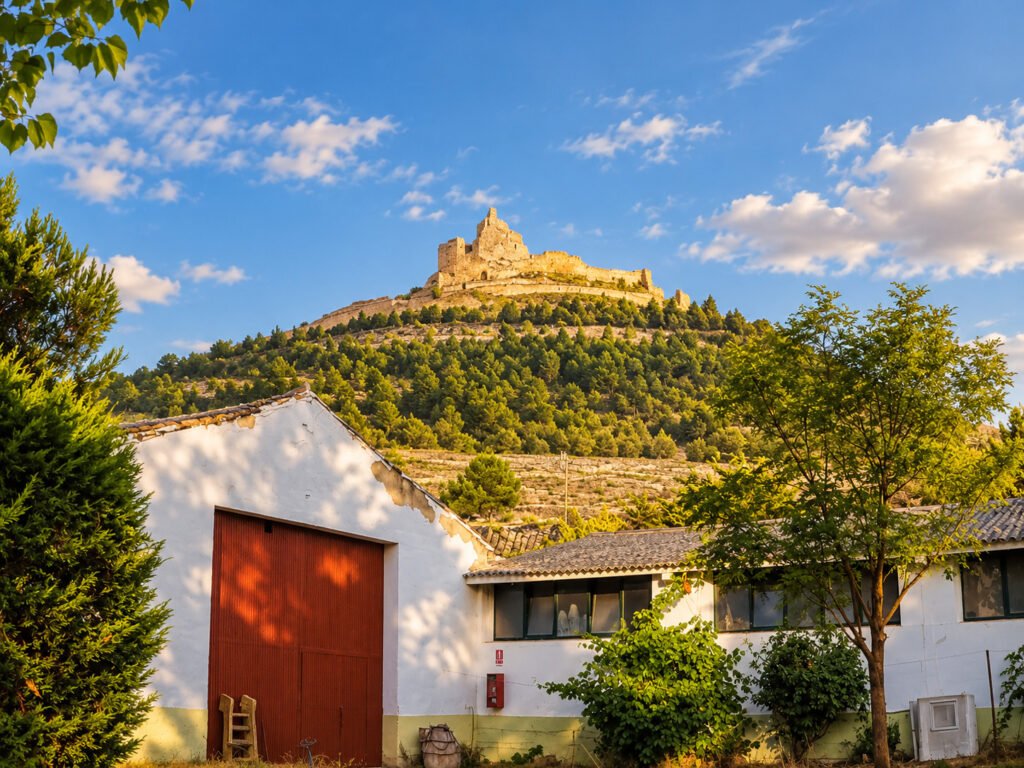
Much of the old fortified town still survives, with steep streets, stone houses, sections of medieval walls and a rather magnificent castle sitting above it all.
The castle dates from the fifteenth century and was built by the powerful Counts of Benavente.
It dominates the hilltop.
Which, as it turned out, was particularly convenient for us.
We arrived late in the afternoon, found the campsite and chose a shady spot beneath the trees.
Then came the familiar business of setting up our little tent.
After six months of hotels, trains and apartments, we were back to crawling around on the ground attaching bits of fabric to poles.
Travel glamour comes in many forms.
Once the tent was standing and everything appeared reasonably secure, there was one obvious next step.
A cold beer.
The campsite had a little bar.
Perfect.
We wandered over and discovered that quite a few of the other people staying there were travelling the Camino.
Some were walking.
Others were cycling.
After watching people trudging along beside the road all day, sitting under a tree drinking cold beer seemed to us to be the considerably more sensible option.
Eventually we headed back to our campsite and made a simple dinner.
Nothing elaborate.
Camping rarely encourages elaborate.
But it didn’t really matter.
Our site looked straight up towards the castle perched high above the town.
As evening settled over the campsite, the light softened and the old stone walls on the hill began to glow.
We sat outside the tent with dinner and watched the sun slowly disappear behind it.
After a day of mountains, tunnels, pilgrims, dusty plains, endless wind turbines and hundreds of kilometres of road, it was a rather lovely way to finish.
Tomorrow there would be another country.
Next stop: Bragança, Portugal.
We had started the morning beside a mountain river in France and ended it beneath a medieval castle in Spain. In between were the Pyrenees, pilgrims, hot dusty plains and more wind turbines than I had previously imagined could exist in one place. Our fairly random choice of Puebla de Sanabria had turned out rather well. Tomorrow we would cross another border. Portugal was waiting.