
Chengdu & Huanglongxi – Sichuan Adventures
Spicy Food, Ancient Streets and a Swiss Army Knife
We landed at Chengdu Tianfu Airport at about 3pm on a Monday afternoon, feeling reasonably pleased with ourselves. Having visited China before, we knew what to expect on arrival and were able to skip the fingerprint registration process, as our details were already in the system. We sailed through immigration, and by the time we reached baggage collection, our bags were already going around on the carousel. It was all remarkably efficient.
Our first stop after leaving customs was the China Telecom shop to buy a local SIM card. We had learned from previous visits that the most reliable way to ensure all those absolutely essential Chinese apps work properly is to have a Chinese phone number and a local data connection. China operates in something of a digital world of its own. Google, WhatsApp, Facebook and many other Western apps are blocked on ordinary Chinese internet connections, while everyday activities such as paying for a coffee, booking transport or navigating your way around a city rely heavily on Chinese apps. A local SIM doesn’t solve the problem of accessing Western websites, but it does provide a reliable connection for everything you need to function in China. And believe me, functioning in China without the right apps can be an interesting experience.
A very helpful young woman in the Telecom shop organised our SIM card, installed it and made sure everything was working before sending us on our way. Feeling suitably connected to the Chinese digital universe, we headed towards the airport railway station to catch the metro into Chengdu. And that was where my first little adventure began.
In China, all railway stations, including the metro, have airport-style baggage screening. Bags go through an X-ray machine, and passengers pass through security before entering the station. We put our bags on the conveyor belt and waited for them to emerge on the other side. Except mine didn’t. A security guard pulled my bag off the belt, pointed at the screen and began speaking to me in rapid-fire Chinese while making a series of rather enthusiastic hand gestures. One gesture looked suspiciously like a cutting motion, although with Chinese sign language I was rapidly discovering that interpretation was largely a matter of guesswork.
Then it dawned on me. My Swiss Army knife. Bloody hell! I knew it was in my bag somewhere, but unfortunately, knowing it was there and knowing exactly where it was were two entirely different things. The security guard continued gesturing, apparently under the impression that if he repeated himself loudly enough, I would suddenly become fluent in Mandarin. AP, meanwhile, was standing beside me, muttering through gritted teeth, “Open your bag.”
A perfectly reasonable suggestion, except that my bag was packed to the absolute limit of its capacity. I had visions of opening it and watching the contents explode across the station floor like one of those spring-loaded snakes in a can that used to frighten small children. I continued to dither, the security guard continued gesturing and AP continued muttering. Eventually, realising that the situation wasn’t going to resolve itself, I bent down and unzipped the bag. Sure enough, out came the packing cubes, one after another, tumbling onto the floor.
By this stage, I was kneeling in the middle of a busy Chinese railway station, surrounded by my belongings, with a security guard looking on and hundreds of passengers streaming past. Not quite the glamorous arrival in China I’d envisaged. Then, in a moment of inspiration, I remembered that I had packed the knife with my socks. I rummaged through the relevant packing cube and triumphantly produced my Swiss Army knife, holding it aloft like a trophy. The security guard took it, examined it carefully, turned it over in his hand and then, much to my relief, handed it back with a nod. Apparently, it was acceptable.
All that fuss for nothing. Well, not quite nothing, because I now had to repack my entire bag on the station floor. This involved a considerable amount of stuffing, squashing, muttering and some language that probably didn’t require translation. Eventually, with the zip straining under the pressure, everything was back where it belonged. I stood up, shouldered my bag and made a firm mental note to keep the knife somewhere easily accessible in future. Although perhaps keeping sharp objects readily accessible at railway security checkpoints wasn’t necessarily the best lesson to take from the experience.
The Chinese railway system, however, continued to impress us. The stations are enormous, the trains are clean, modern, fast and extraordinarily efficient, and fares are remarkably inexpensive. Our journey from the airport into central Chengdu cost just 12 yuan each, roughly AUD $2. Everything was spotless. There was no graffiti, no rubbish scattered around and none of the rough sleeping we have become accustomed to seeing around many major railway stations in Western Europe. It was quite a contrast.
The train whisked us into Chengdu in about an hour, and from the station it was only a couple of hundred metres to our accommodation. By the time we finally reached our room, we’d been travelling for more than 26 hours, from our little village in Cornwall all the way to Chengdu in southwestern China. We were hot, tired and ready to stop moving. To make matters worse, I’d managed to develop a cold along the way. So much for arriving fresh and ready for adventure. We found somewhere nearby for an early dinner and then collapsed into bed.
Chengdu is the capital of Sichuan Province and one of China’s largest cities, with a metropolitan population running into the tens of millions. It has a history stretching back more than 2,000 years and is famous for its pandas, tea culture and, of course, its food. Sichuan cuisine is celebrated throughout China, particularly for its liberal use of chilli and Sichuan peppercorns, which produce that distinctive tingling, slightly numbing sensation in the mouth. The combination is known as málà, meaning numbing and spicy. We were about to become very well acquainted with it.
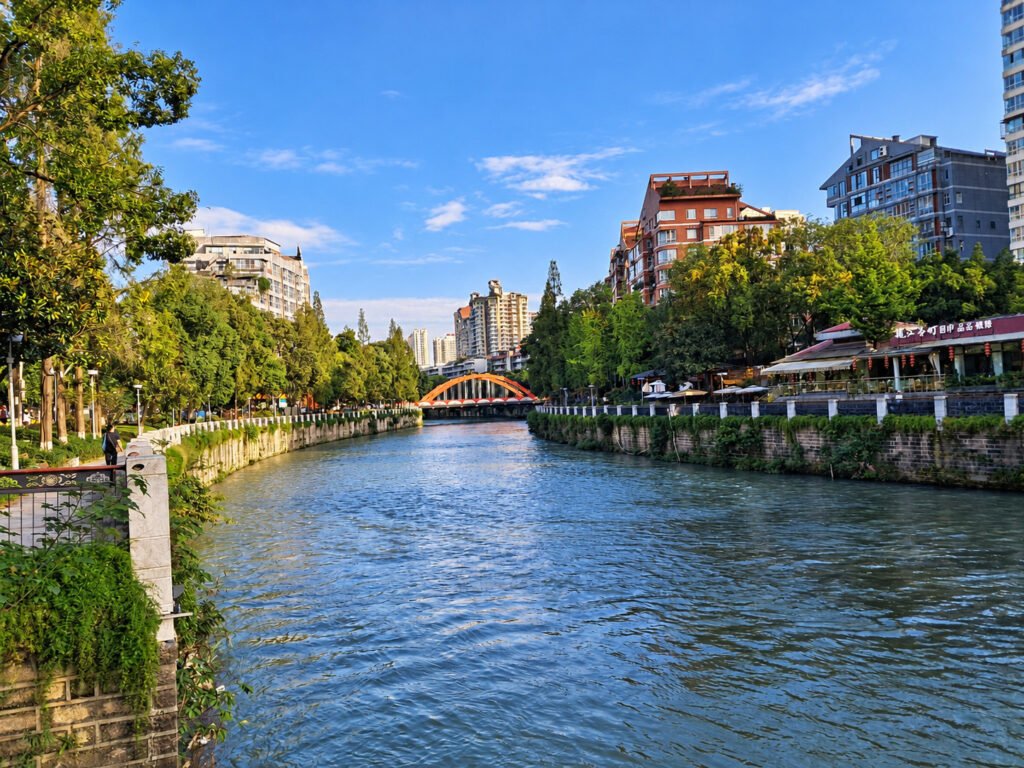
The next couple of days were fairly quiet while we recovered from the journey and I attempted to shake off my cold. We found a reasonable coffee shop, enjoyed cups of tea beside the nearby river and explored the many restaurants around our hotel. The food was excellent. Sichuan cooking is full of bold flavours, fragrant spices, chilli oil, garlic, ginger and those wonderful peppercorns that make your lips tingle. Some dishes were fiery, others surprisingly subtle, but almost everything we ate was delicious. We also enjoyed wandering along the river in the evenings, when the temperature became more pleasant and the city took on a relaxed atmosphere. Despite its enormous size, Chengdu felt surprisingly easy to navigate. The metro was efficient, the streets were clean and there were plenty of pleasant areas to walk.
One day, we decided to visit People’s Park, a large public park in the centre of the city. What we hadn’t fully appreciated was that our visit coincided with China’s National Day celebrations. October 1 marks the anniversary of the founding of the People’s Republic of China, proclaimed by Mao Zedong in Beijing on October 1, 1949. The occasion is one of China’s most important national holidays and forms part of what is known as Golden Week, when millions of Chinese people take holidays, visit family and travel around the country. Judging by the crowds in People’s Park, a considerable proportion of them had decided to spend the day in Chengdu.
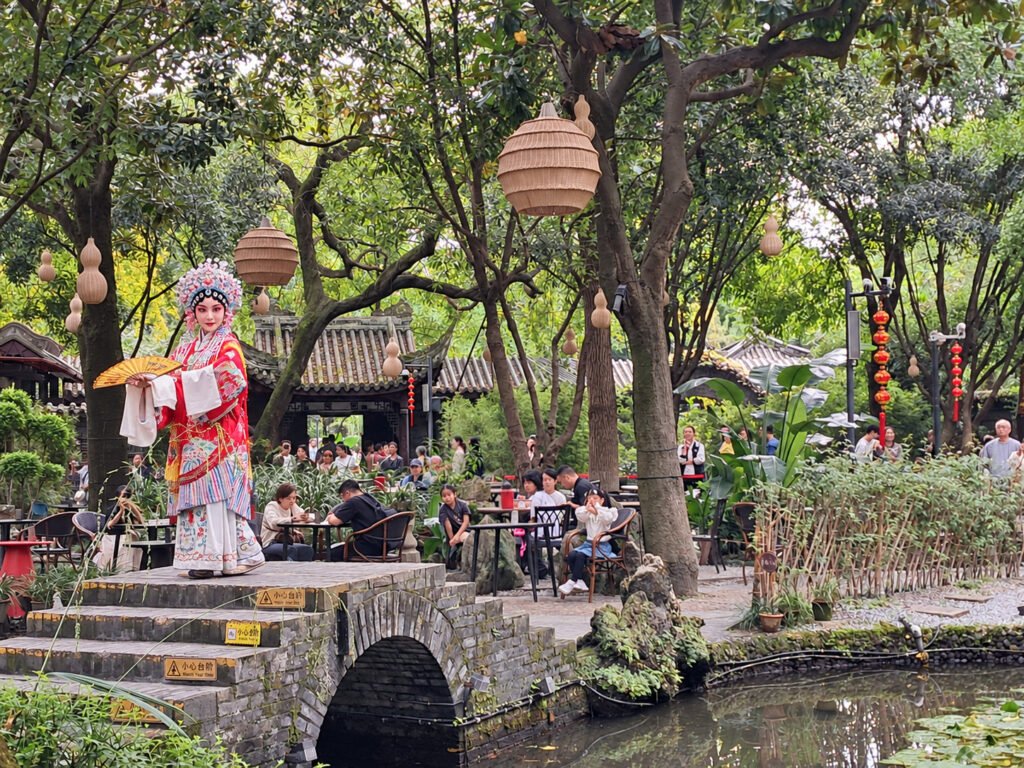
The park itself is lovely, with beautiful gardens, ornamental ponds, streams, traditional pavilions and shaded pathways. It was established in 1911 and is one of Chengdu’s oldest public parks. It is also home to traditional teahouses, where locals gather to drink tea, chat, play games and generally watch the world go by. Under normal circumstances, I imagine it would be a wonderful place to spend a leisurely afternoon. Unfortunately, half of Chengdu appeared to have had the same idea. The paths were packed, families were everywhere, and there was a general atmosphere of holiday excitement. We wandered around for a while, admiring the gardens and watching the crowds, before deciding to make our way back towards the hotel on foot.
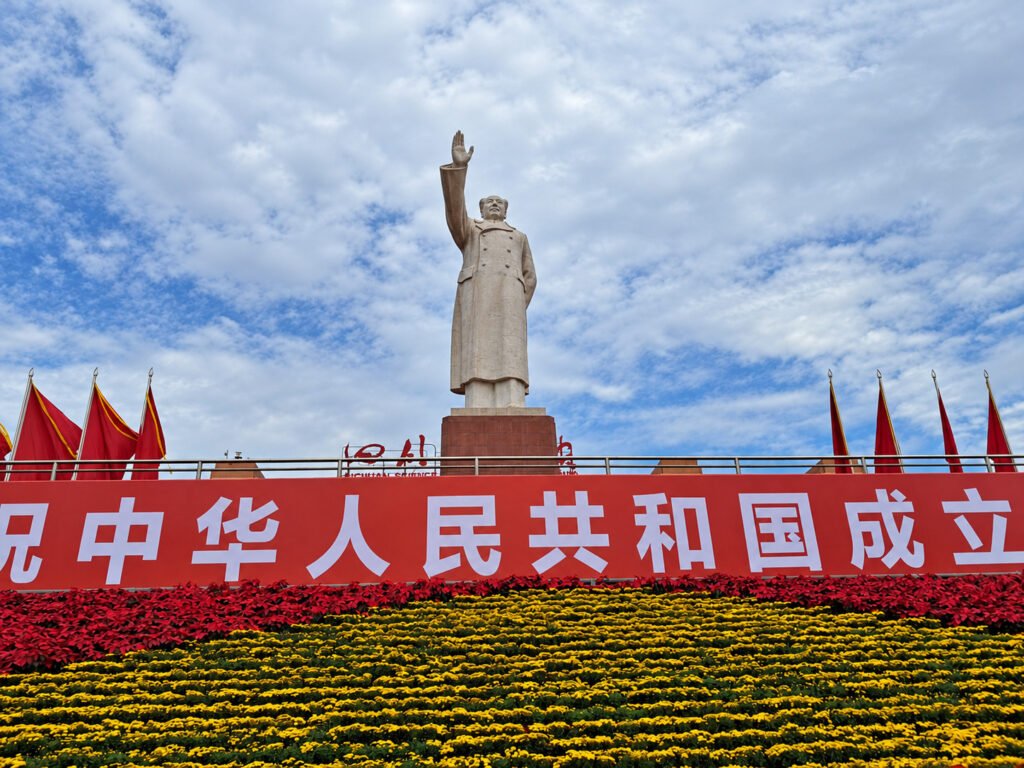
Our route took us past an enormous statue of Mao Zedong, standing with one arm outstretched, apparently pointing the nation towards a glorious future. The statue is around 30 metres high and dominates one side of Tianfu Square, the vast public square at the heart of Chengdu. For some reason, it reminded me of the equally enormous statues of Lenin we’d seen during our travels in Russia. There is something about communist monuments that seems to demand considerable height, a stern expression and an arm pointing decisively into the distance. Subtlety was clearly not a major consideration.
Tianfu Square itself was busy being prepared for the National Day celebrations, with decorations, displays and various arrangements underway. It was an impressive space, but by this stage we’d had enough crowds for one day. We found the nearest metro station and headed back to the relative peace of our hotel.
One of the things I’d particularly hoped to do in Chengdu was visit the Chengdu Research Base of Giant Panda Breeding. After all, Chengdu is famous for its pandas, and it seemed a shame to come all this way without seeing them. That was until I started investigating tickets. The visitor numbers were staggering. The information I found indicated that tens of thousands of people could visit in a single day, with enormous numbers allocated to both morning and afternoon sessions. The idea of seeing pandas was certainly appealing, but the idea of seeing pandas while surrounded by what could potentially be 30,000 other people was considerably less so. I pictured thousands of tourists crowding around enclosures, cameras held high, all competing for a glimpse of a panda that would probably be fast asleep anyway. We decided to give it a miss. I’m sure the pandas were terribly disappointed.
Chengdu had been a pleasant introduction to this part of China. We’d eaten some excellent food, enjoyed our riverside walks and found the city remarkably clean and easy to get around. But after a few days, we were ready to move on. Our next destination was Huanglongxi, an ancient town south of Chengdu that we’d decided deserved rather more than the usual day trip.
Huanglongxi has a history stretching back more than 1,700 years, with its origins associated with the Han dynasty and the turbulent Three Kingdoms period of Chinese history. Located near the meeting of two rivers, it developed as an important river settlement and trading centre, with boats transporting goods along the waterways connecting the surrounding region. During the Three Kingdoms period, when China was divided between rival states, the area had strategic importance because of its position south of Chengdu, then the capital of the Shu kingdom. Over the centuries, Huanglongxi developed into a prosperous market town, with temples, merchants’ houses, cobbled streets and riverside wharves.
Much of its historic character has been preserved or restored, particularly buildings from the Ming and Qing dynasties. Today, it is a popular destination for Chinese tourists, attracted by its traditional architecture, picturesque waterways, street food and the chance to experience a little of old China. It sounded exactly like our sort of place. Getting there, however, required a certain amount of faith in Chinese public transport.
We caught the metro from central Chengdu to the very end of the line, a journey of about an hour, and then went looking for the S18 bus, which we believed would take us to Huanglongxi. Or at least somewhere reasonably close to it. We found the bus, climbed aboard and I confidently presented my Alipay app to the payment machine. A confidence that, as it turned out, was entirely undeserved. A large red X appeared on the screen. Declined. I tried again. Another large red X. Meanwhile, the driver was waving his arms and speaking to me in Chinese, and an increasingly impatient queue of passengers was forming behind us.
I looked around for AP, who had the cash, but he’d vanished into the depths of the crowded bus. Excellent. There I was, blocking the entrance, waving my phone at a machine that clearly had no intention of accepting it, while the driver continued gesturing and the queue behind me grew longer. Then, quite suddenly, a man reached over and took my phone. He tapped a few things, examined the screen, shook his head and handed it back. Then he used his own app to pay for both of us. Just like that. No fuss, no drama.
When I eventually caught up with AP and explained what had happened, he tried to give the man some cash, but the man refused. He simply smiled and waved us away. It was an extraordinarily kind gesture, and one of those lovely little encounters that remind us why we enjoy travelling independently. I later discovered that to use Alipay on local buses, you sometimes need to activate a separate transport card for the particular city or region. This sounded straightforward enough. It wasn’t. The system was, and to a large extent remains, a complete mystery to me. Fortunately, the kindness of strangers is considerably easier to understand.
The bus was absolutely packed, largely with women returning from the market carrying baskets laden with fresh vegetables. I found myself wedged beside an elderly lady with a large basket of cabbages, while attempting to follow our progress on Amap so we’d know where to get off. I showed her the map on my phone and pointed to Huanglongxi, which apparently established us as firm friends. For the remainder of the journey, she chatted away to me in Chinese, periodically pointing at the map and then gesturing towards something outside the window. I nodded, smiled and occasionally made what I hoped were appropriate noises of agreement.
I suspect she was giving me a running commentary on the places we were passing, although she could just as easily have been asking what on earth two Westerners were doing on a local bus in the backblocks of China and whether we’d completely lost our minds. She may not have been entirely wrong. Either way, she seemed delighted to have someone to talk to, and I was equally delighted to have someone apparently keeping an eye on our destination. Eventually, we arrived at the bus terminal in Huanglongxi. I said goodbye to my new friend and her cabbages, retrieved my backpack and prepared for the next stage of the adventure.
AP was already studying his GPS. “Right,” he announced. “Only 1.8 kilometres. Come on.” And with that, he set off uphill. I followed, as usual. By the time we reached the old town, we’d had quite enough walking with backpacks, but there was still the small matter of finding our guesthouse. We entered the narrow, crowded streets, surrounded by traditional buildings, shops, food stalls and a bewildering network of little lanes. And then the GPS promptly lost its mind.
We turned left, then right, then back again. Nothing seemed to match what was on the screen, and we wandered around looking increasingly like two people who had absolutely no idea where they were going. Which, to be fair, was precisely the situation. Then, out of nowhere, a young woman appeared in front of us and greeted us with a cheerful “Hi!” In English. Beautiful, wonderful English.
It turned out she had emigrated to New Zealand with her mother many years earlier and was back in the area visiting her father. She quickly realised we were lost and asked where we were trying to go. We showed her the guesthouse details, and she immediately took control. After several rapid conversations in Chinese with nearby locals, she announced that she knew where we needed to be and set off to take us there. Her father followed along behind, periodically encouraging me to hurry up, while a small gaggle of children joined the procession. Before long, we had acquired quite an entourage. I felt rather like the Pied Piper of Hamelin, although in this version the piper was a helpful Chinese woman and the two bewildered foreigners were the ones being led around.
Eventually, we arrived at the guesthouse. We thanked our rescuer and her accompanying procession, then checked in. Our accommodation was a simple, family-run guesthouse that looked as though it might have seen more prosperous days. The building was a little tired, the furnishings fairly basic and there was nothing particularly luxurious about it. But it was comfortable, very inexpensive and in an excellent location. More importantly, the owners were lovely. They were kind, helpful and welcoming, and we quickly settled in.
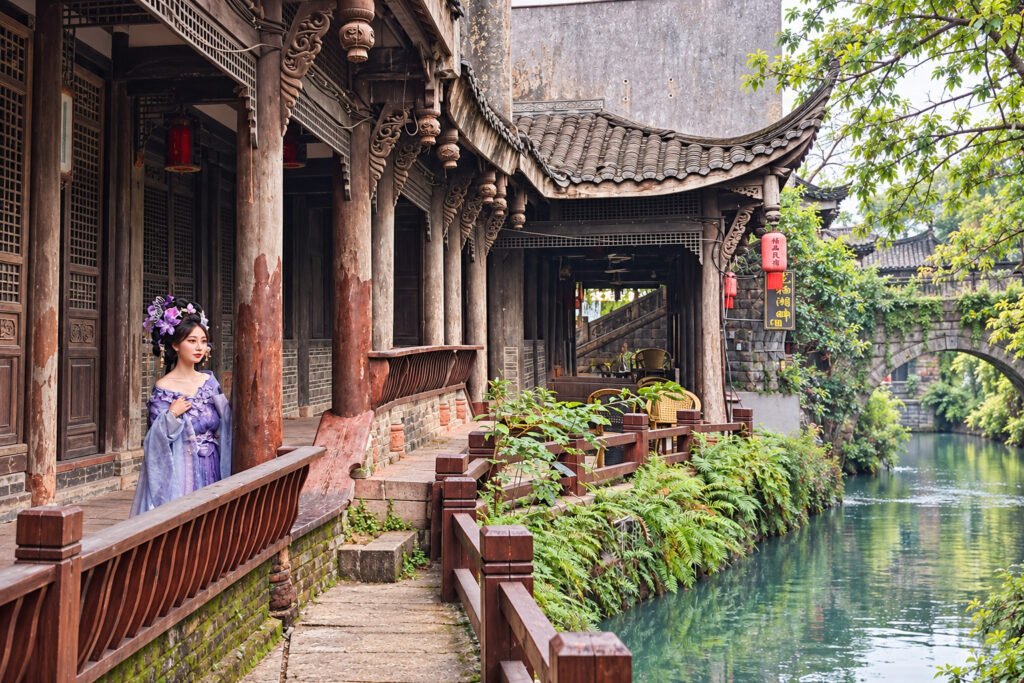
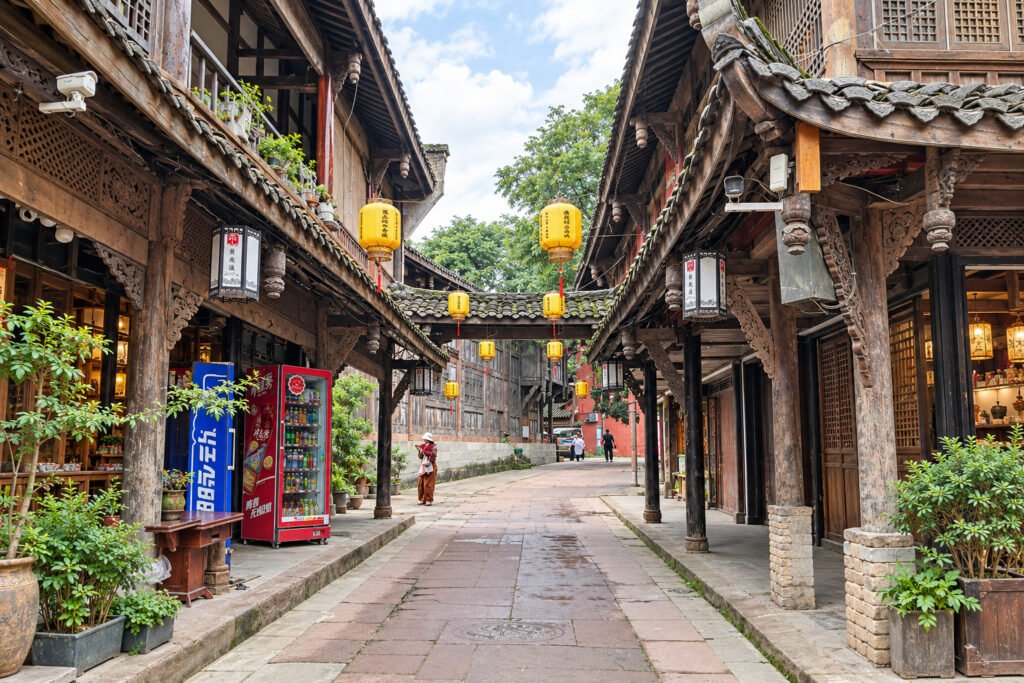
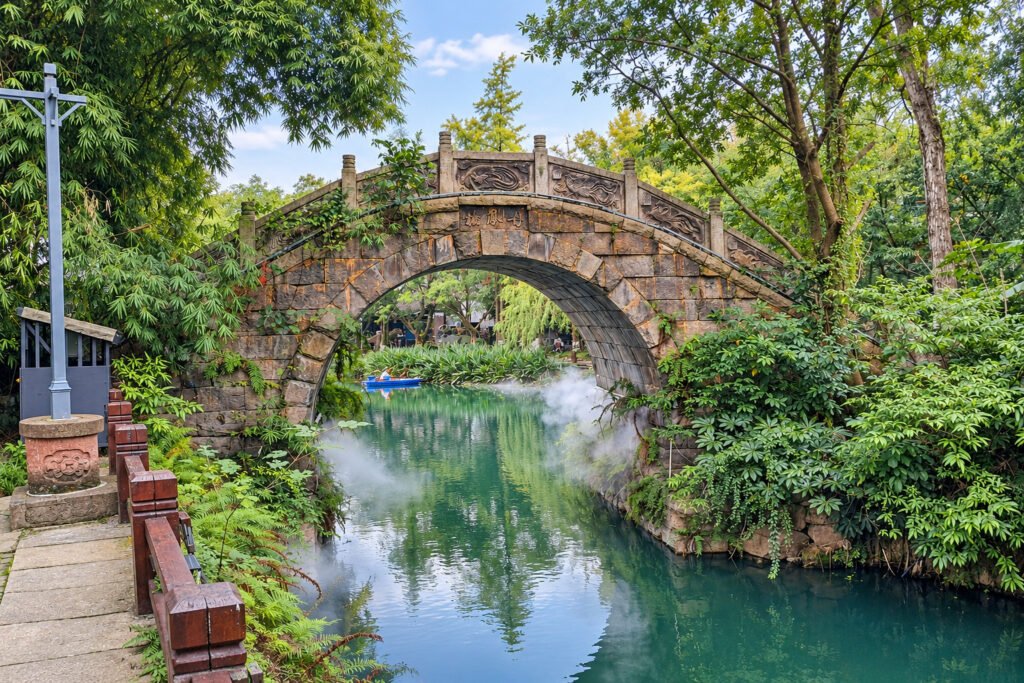
Huanglongxi itself was delightful. The main historic street was lined with traditional timber buildings, their tiled roofs and wooden balconies overlooking a shallow stream that flowed right through the centre of town. There were small stone bridges, ancient-looking courtyards, temples and narrow lanes leading off in all directions. Beyond the old streets, the rivers added another dimension to the town, with broad waterfront areas, stone steps, bridges and places to sit and watch the world go by. The combination of traditional architecture, waterways and the surrounding countryside made it a very attractive place.
It was clearly popular with tourists. Chinese tourists, that is. During our six days there, we didn’t see another Westerner. Not one. English was also virtually nonexistent. Not a word on signs, menus or in the shops, and very little spoken by anyone we encountered. Fortunately, this doesn’t particularly bother us. After years of spending extended periods in countries where we don’t speak the language, we’ve become quite comfortable with having absolutely no idea what’s going on around us. You learn to observe, improvise and accept that occasionally you’re going to get something completely wrong.
The Chinese writing system adds another level of complexity, of course, because unlike many European languages, you can’t even make an educated guess at what a word might mean. Chinese characters remain entirely mysterious to us. But we’ve found that most restaurants have photographs of their dishes, and when all else fails, pointing is a remarkably effective form of communication. Occasionally, you end up with something unexpected. That’s part of the fun.
We quickly established a pleasant daily routine. Coffee in the morning, followed by a walk around the town, then usually a bowl of noodles for lunch. Later in the afternoon, we’d head out again to explore another part of Huanglongxi or wander along the river before finding somewhere for dinner. The food was generally excellent, although being in Sichuan meant that chilli and Sichuan pepper featured rather prominently in almost everything. There were stir-fries, noodle dishes, vegetables and various combinations of meat and spices, often covered in a rich, fragrant, reddish sauce. Delicious, although after several days we began to notice that quite a few dishes tasted remarkably similar. There are only so many variations of chilli, garlic, oil and Sichuan pepper before your taste buds start wondering whether they’ve eaten the same meal three nights running.
One particularly memorable discovery was a restaurant specialising in Huanglongxi’s famous Yi Gen Mian, or One Long Noodle. And when they say one long noodle, they mean exactly that. The dish consists of a single continuous strand of dough, which is stretched and pulled into an extraordinarily long noodle before being cooked and served in a bowl of spicy broth. The preparation is as much entertainment as cooking.
The noodle maker takes a long strand of dough and swings it through the air, stretching, looping and tossing it with remarkable skill, often accompanied by music and dramatic movements. The noodle flies around in great sweeping arcs before being fed into the cooking pot, all without breaking. It looks rather like someone performing a complicated dance with an exceptionally long piece of elastic. The skill involved is extraordinary. The noodle itself is traditionally associated with longevity, the unbroken strand symbolising a long and uninterrupted life. We ate there several times, partly because the noodles were delicious and partly because watching them being made was such good entertainment. It was certainly one of the more unusual meals of our travels.
Huanglongxi was an interesting town to observe, particularly the contrast between the busy tourist areas and the quieter streets behind them. During the day, the main historic street was absolutely packed. Visitors filled the narrow lanes, stopping to buy snacks, take photographs, browse the shops and admire the traditional buildings. The shallow stream running through the centre was particularly popular, creating a picturesque setting for photographs and a lively atmosphere. Food vendors were everywhere, selling noodles, skewers, sweets and all manner of local specialities. There was a constant stream of people moving through the town.
But by about seven in the evening, almost everyone had vanished. It was quite extraordinary. One minute, the streets were heaving with people; a few hours later, they were practically deserted. Shops closed, food stalls packed up and the town became wonderfully peaceful. This was one of the advantages of staying in Huanglongxi rather than visiting for a few hours on a day trip. We got to experience the town when the crowds had gone, wandering through the quiet streets and along the river in the evening. In many ways, I preferred it then.
There was also another, rather curious side to Huanglongxi. While the main tourist streets were busy and beautifully maintained, we only had to venture one street back to find an entirely different scene. There were quiet lanes, empty buildings and what appeared to be abandoned hotels and guesthouses. Some looked as though they hadn’t welcomed a guest in years. Windows were dark, entrances closed and buildings that had clearly once been intended for tourists stood empty. It made us wonder whether there had been an expectation of a much larger tourism boom than had actually materialised.
Perhaps businesses had expanded too quickly, or perhaps the town simply attracted far more day visitors than overnight guests. Whatever the reason, the contrast was striking. On the main street, thousands of people wandered between shops and restaurants, while just a short distance away, entire buildings sat empty. It was a reminder that tourism doesn’t always distribute its benefits evenly, even in places that appear to be thriving.
We spent six days in Huanglongxi and, by the end of our stay, I think we’d explored just about every square inch of the place. We wandered along the river, poked our noses into little lanes, visited quiet corners away from the tourist crowds and became familiar with the daily rhythm of the town. It was a lovely place to slow down for a few days. Nothing particularly dramatic happened, apart from our arrival involving a failed bus payment, a cabbage-carrying travelling companion and a small procession of locals escorting us to our accommodation. Which, come to think of it, was probably quite enough excitement for one visit.
Eventually, however, it was time to return to Chengdu. This time, rather than repeat the bus adventure, we decided to take a taxi to the metro station. The fare was about AUD $10. Money extremely well spent, in my opinion. No mysterious Alipay transport cards, no crowded buses, no elderly ladies with baskets of cabbages and no long walks carrying backpacks. Just a comfortable ride to the station. Sometimes the simplest solution is also the best.
We caught the metro back into Chengdu and made our way to a hotel near Chengdu South Railway Station, ready for our train journey the following morning. The hotel was superb. Beautifully appointed, comfortable and exactly the sort of place where you could happily spend several days doing very little. Naturally, the moment we walked into our room, I wished I’d booked us in for four nights rather than one. Typical. Never mind. That evening, we found a nearby restaurant serving delicious Chinese barbecue and enjoyed an excellent meal before heading back to the hotel for an early night. We had a long train journey ahead of us the following morning.
Our time in Sichuan had been a fascinating introduction to this part of China. Chengdu had impressed us with its enormous infrastructure, efficient transport, excellent food and remarkably clean streets, while Huanglongxi had offered something quite different. Ancient buildings, quiet riverside evenings, delicious noodles, a somewhat mysterious local bus system and wonderful encounters with people who went out of their way to help two foreigners who clearly didn’t know what they were doing.
And that’s often what stays with me most about travelling. Not necessarily the famous attractions or the places everyone tells you to visit, but the unexpected moments and the people you meet along the way. The stranger who paid our bus fare without a second thought. The elderly lady who chatted happily to me for an entire journey despite neither of us understanding a word the other was saying. And the young woman who abandoned whatever she was doing to personally deliver us to our guesthouse, complete with an entourage. Small acts of kindness that made a lasting impression.
And, of course, I’d managed to survive my first confrontation with Chinese railway security, although my packing skills had been rather publicly exposed as somewhat less than professional.
The following morning, we’d be boarding a train for Lijiang, high in the mountains of Yunnan Province. Another long journey, another new place and, no doubt, another opportunity for something to go slightly wrong. After all, that’s half the fun of travelling. Or so I keep telling myself.
Next stop, Lijiang, high in the mountains of Yunnan Province.