
Lijiang – Ancient Streets, Snow-Capped Mountains and a Very Good Coffee
We decided to take a taxi the very short distance from our accommodation to Chengdu South Railway Station, at the enormous expense of about $4. As it turned out, this was an excellent decision. While the station was only a short distance away as the crow flies, the crow clearly hadn’t taken into account the extraordinary number of motorways, railway lines, fences and other obstacles standing between us and our destination. Our taxi spent an inordinate amount of time driving in circles, doubling back and navigating a complicated network of roads. Had we attempted to walk, we might still be trying to get there.
Chengdu South Railway Station is enormous, although by this stage of our travels we were beginning to realise that the Chinese do everything, and I mean everything, on a grand scale. The railway system is no exception. China’s high-speed rail network is simply incredible. The stations are enormous, the trains modern, comfortable and efficient, and the whole system moves an astonishing number of people around the country every day.
Buying a ticket is remarkably straightforward. We use Trip.com, where you book online and your ticket is linked directly to your passport. Chinese citizens use their national identity cards, while foreign visitors use their passports. No paper tickets and no frantic searching through emails for booking confirmations. Your passport is your ticket. Well, almost.
Entering a Chinese railway station is rather like entering an airport. First, you present your passport, then you and your luggage go through security screening before entering the enormous departure hall. Chengdu South has departure areas on two levels, and after finding our departure gate upstairs, we settled down to wait. Eventually, our train was called, and we joined the large crowd making its way towards the boarding gates. There was a certain amount of shuffling, a little pushing and the general sense that several hundred people had simultaneously decided they needed to be somewhere else.
We eventually reached the automatic gates and confidently presented our passports to the scanners. Denied. Tried again. Denied. Oh dear. Were we in the wrong queue? Had we misunderstood something? Were we about to miss our train? I stood there for a moment, rather inconveniently holding up the queue, while the crowd continued to move around me.
Fortunately, a friendly gentleman behind us tapped me on the shoulder and pointed towards another queue, where an attendant was checking documents. What we hadn’t realised was that foreign passports needed to be checked manually by a member of staff rather than through the automatic gates used by Chinese passengers. A minor detail that would have been useful to know about five minutes earlier. We moved across to the correct queue, had our passports checked and were waved through.
From there, we were swept along with everyone else towards the platform, found our carriage and settled into our seats for the nine-and-a-half-hour journey to Lijiang. Watching the whole process, you could be forgiven for thinking it was complete chaos. Hundreds of people moving in different directions, enormous queues and a general air of organised confusion. Yet somehow it worked perfectly. From the time boarding was announced to the train pulling out of the station was only about twenty minutes. Quite remarkable. And, of course, we departed on time.
The journey took us through an ever-changing landscape of agricultural land, small towns, villages and mountains. What struck me was just how much of the countryside was cultivated. There were enormous farming areas, endless rows of polytunnels and fields stretching into the distance, but it was the tiny gardens that fascinated me most. Every available piece of ground seemed to have been put to use, with small vegetable plots appearing beside railway tracks, along riverbanks, squeezed between buildings and tucked into the most unlikely corners.
We frequently spotted people wearing traditional conical hats, tending their crops by hand with simple tools. While China might be racing ahead with high-speed trains, enormous cities and extraordinary infrastructure, there are still countless people working the land in much the same way their ancestors did. It was an interesting contrast, particularly when viewed from a train travelling at speeds that would have been unimaginable to those earlier generations.
As we travelled further west into Yunnan, the landscape became increasingly mountainous and the railway began disappearing into tunnels. Sometimes we seemed to spend more time underground than above it. Building railways through this sort of country is an extraordinary engineering achievement, and China appears to have tackled the problem with its usual approach to infrastructure: if there’s a mountain in the way, build a tunnel through it. Preferably a very long one.
Finally, after nine and a half hours, we arrived in Lijiang, where a smiling driver organised by our guesthouse was waiting to collect us. After the excitement of negotiating the railway station, it was rather nice to see someone who knew exactly where we were supposed to be going.
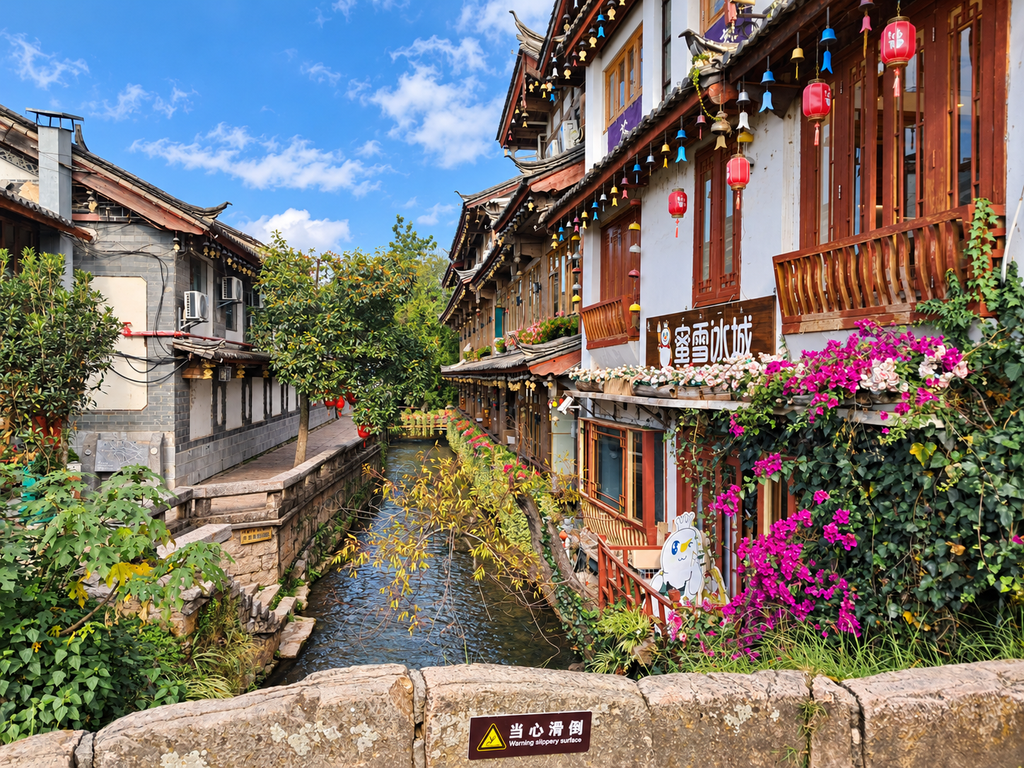
Lijiang sits in northwestern Yunnan Province, at an altitude of approximately 2,400 metres, surrounded by mountains and dominated by the magnificent Jade Dragon Snow Mountain. The old town is a maze of narrow cobbled streets, traditional timber houses, canals and little stone bridges, with water flowing through an intricate network of channels that has served the town for centuries. Its history is closely associated with the Naxi people, one of China’s ethnic minorities, whose distinctive culture, traditions and architectural style remain an important part of Lijiang’s identity.
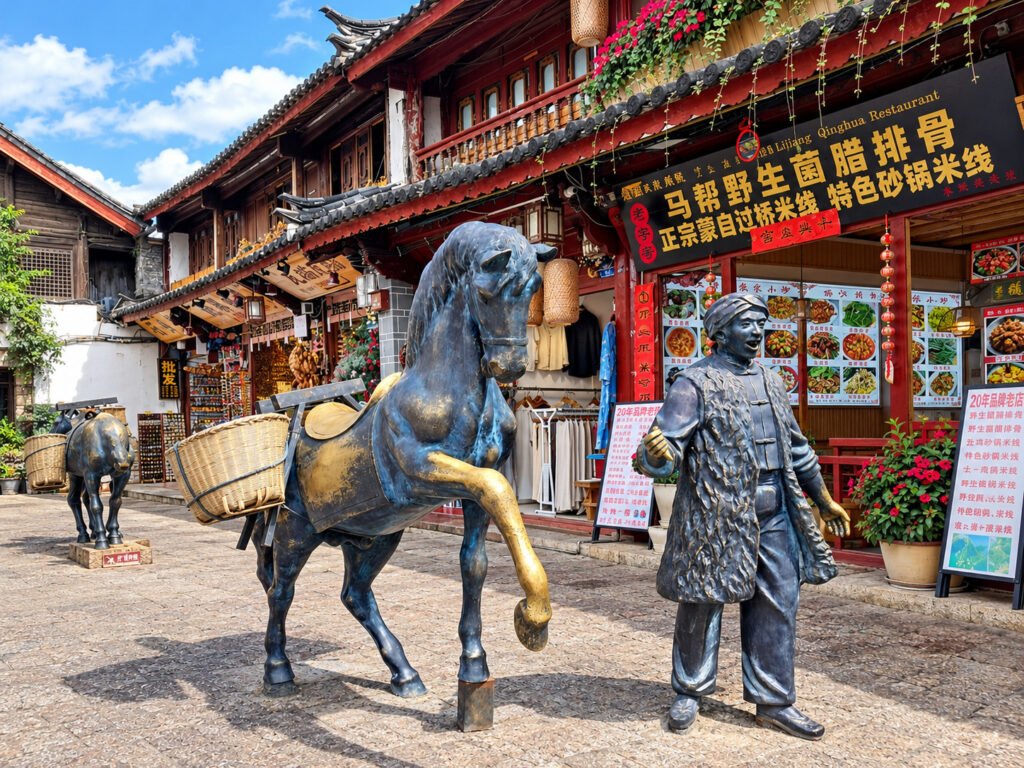
For centuries, Lijiang was a major trading centre along the ancient Tea Horse Road, a network of trading routes connecting southwestern China with Tibet and beyond. Caravans of horses and mules made their way through the mountains carrying tea, salt and other goods, exchanging them for horses, medicinal products and commodities from the Tibetan plateau. It wasn’t an easy journey. The routes crossed some of the most difficult mountain country imaginable, and traders faced treacherous passes, unpredictable weather and considerable danger. Travelling around China by comfortable high-speed train certainly puts the difficulties of those earlier journeys into perspective.
Lijiang prospered as a meeting place for traders and travellers from different regions and cultures, and much of the character of the old town developed during this period. The town also survived a devastating earthquake in February 1996, measuring approximately 7.0 in magnitude, which caused widespread destruction and loss of life throughout the region. Interestingly, many of the traditional timber-framed Naxi buildings proved more resilient than newer structures, although the old town suffered considerable damage.
The subsequent restoration helped draw international attention to Lijiang’s historical importance, and in 1997 its old town was inscribed on the UNESCO World Heritage List. Today, Lijiang is one of China’s most popular tourist destinations. And as we were soon to discover, the Chinese certainly enjoy visiting it. Preferably all at once.
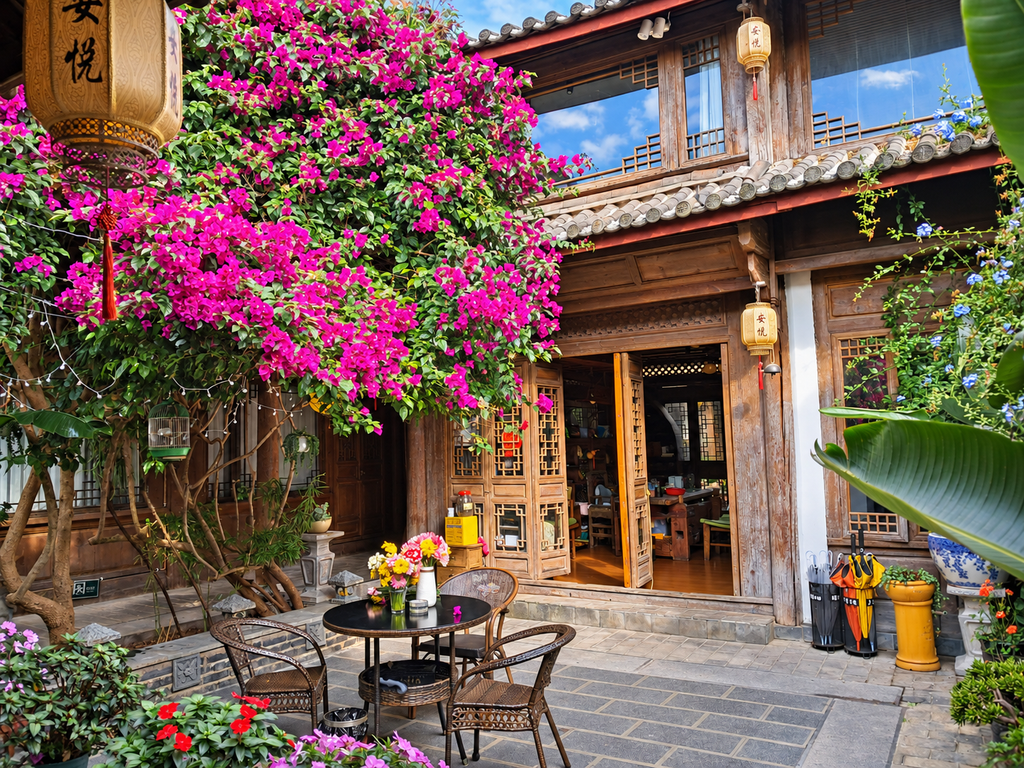
Our home for the week was The Big Tree Guesthouse, tucked away in the heart of the old town, and what a treasure it turned out to be. The guesthouse occupies a beautiful old Chinese house, built in the traditional style with rooms arranged around central courtyards. Large, comfortable lounge areas provided lovely places for guests to relax, and the building had that wonderful sense of age and character that is impossible to reproduce in a modern hotel.
Our room had enormous old wooden beams, rustic furniture and plenty of character. It was exactly the sort of place we love staying in. The guesthouse was owned and run by the wonderful Joye and his team, who made us feel immediately welcome. We settled in very happily and looked forward to spending the next week exploring Lijiang.
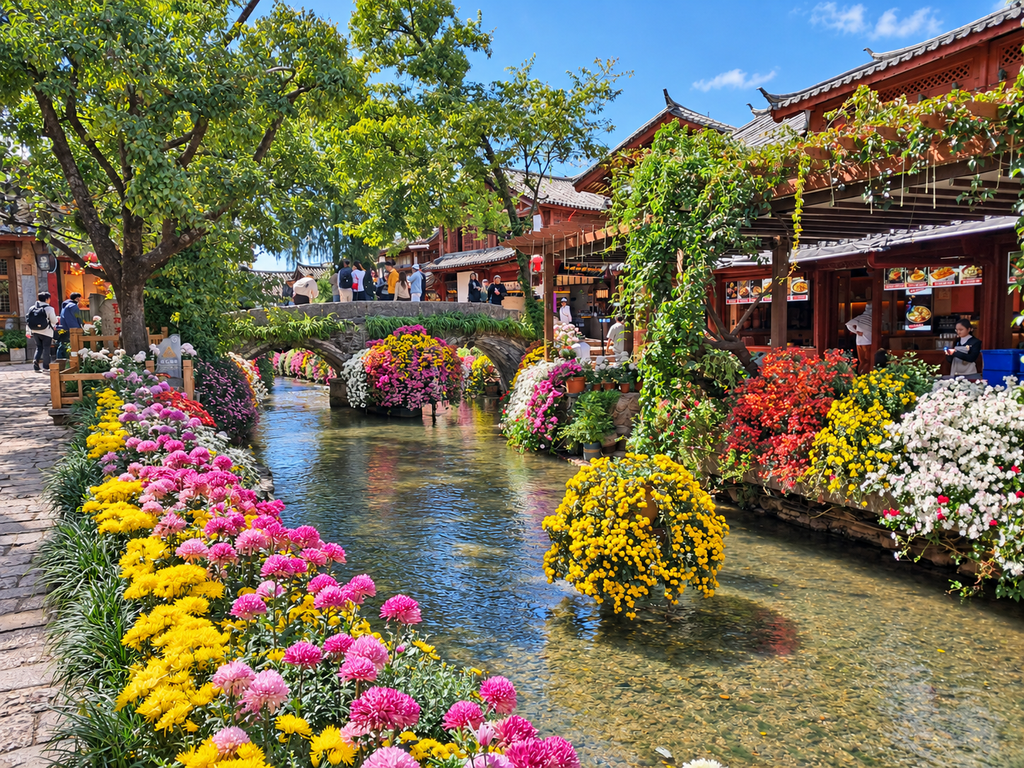
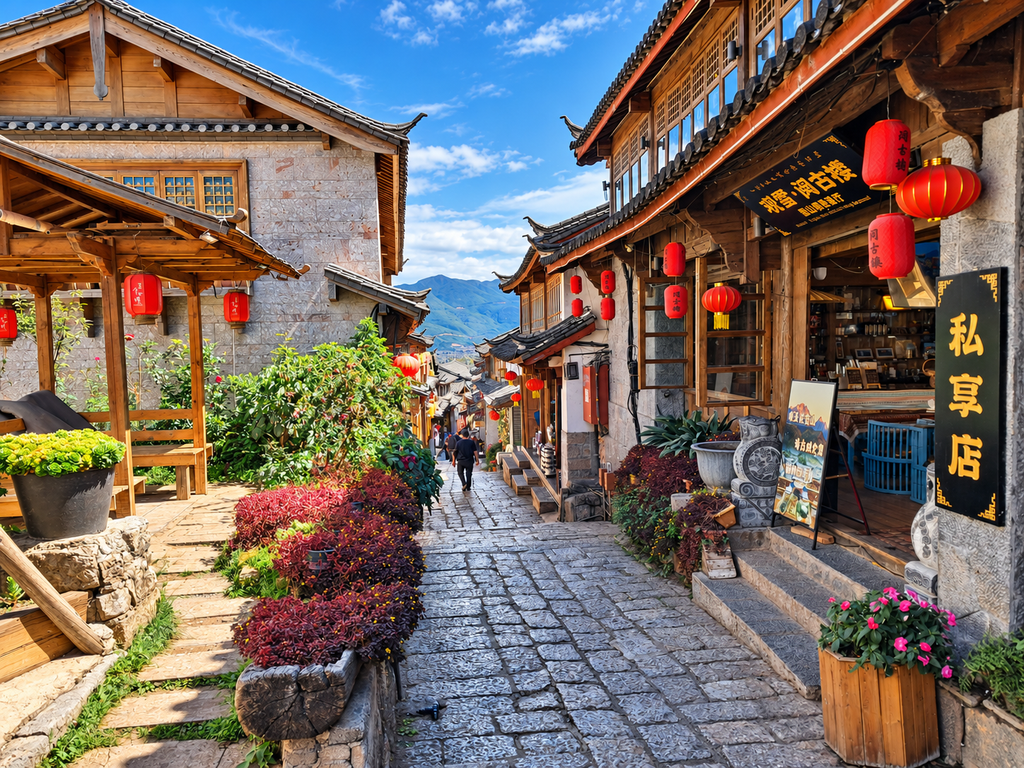
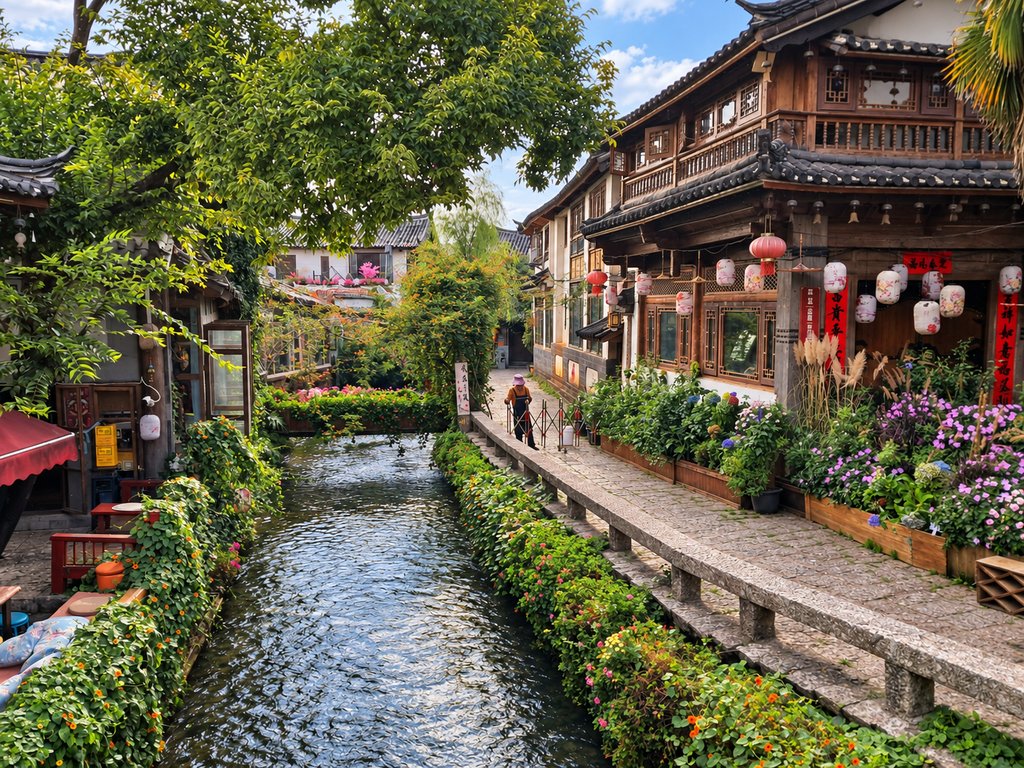
One of the pleasures of Lijiang is simply wandering around its winding streets. The old town is a labyrinth of narrow cobbled lanes, stone bridges, canals and beautifully preserved traditional buildings. Streets twist and turn in seemingly random directions, occasionally opening into small squares or courtyards before disappearing into another maze of alleyways. It is a place where getting your bearings takes a little time, although that hardly matters when there is something interesting around practically every corner.
The buildings are particularly interesting, with their dark timber frames, tiled roofs, carved doorways and decorative details reflecting the architectural traditions of the Naxi people. Water runs everywhere, flowing through canals and channels beside the streets, under little bridges and past shops and houses. The water comes from springs fed by the mountains to the north and has been an essential part of the town’s design and daily life for centuries.
We spent hours wandering through the streets, occasionally emerging somewhere familiar before turning into another interesting lane. There was always something to see: small shops selling local crafts, food stalls preparing all manner of unfamiliar dishes, traditional buildings converted into restaurants and cafés, and endless little alleyways tempting us to explore further. It is the sort of place where you can set out for a short walk and return considerably later than intended.
Of course, not everything in Lijiang is ancient or particularly authentic anymore. Tourism is big business here, and the old town has its fair share of souvenir shops, commercial attractions and businesses catering to the enormous numbers of visitors. But look beyond the crowds and the tourist trade, and there is still a great deal to appreciate. The trick, we discovered, was choosing when to appreciate it.
Early in the morning, the streets were relatively quiet, shopkeepers were beginning to open their businesses and there was a much more relaxed atmosphere. By mid-afternoon, however, the old town was absolutely packed. The narrow streets filled with visitors, tour groups, photographers and people determined to photograph themselves in front of practically everything. We soon developed a routine of doing most of our exploring in the mornings and leaving the busiest parts of the day to the crowds. They appeared to be enjoying themselves enormously, so we were quite happy to let them get on with it.
One of the most interesting places we visited was Mu’s Residence, also known as Mu Mansion. For centuries, the Mu family ruled Lijiang as hereditary local chieftains, governing the region under the authority of successive Chinese dynasties. Their residence was the political and administrative centre of Lijiang, and the complex is often described as a miniature version of Beijing’s Forbidden City.
Much of what visitors see today is a reconstruction, following the destruction and deterioration of earlier buildings, particularly after the 1996 earthquake. Nevertheless, it is an impressive complex. Grand halls, ornate timber buildings, beautifully decorated roofs, courtyards and gardens are arranged across the hillside, with the architecture combining traditional Naxi elements and more formal Chinese imperial styles.
The buildings become increasingly elevated as you move through the complex, and the higher terraces provide wonderful views across the old town. It was fascinating to imagine the wealth and influence this family once commanded, ruling a remote mountain region that was nevertheless an important trading centre. They certainly knew how to choose a location for a house.
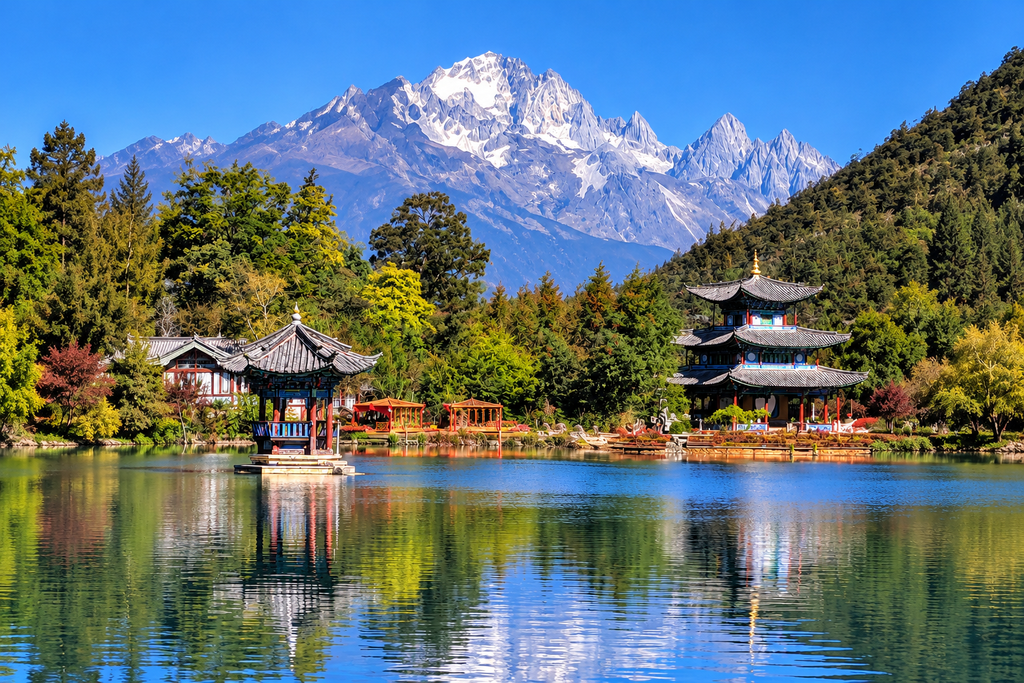
Another highlight was Black Dragon Pool Park, located just north of the old town. The park is centred around a beautiful pool, with traditional pavilions, bridges and gardens set against the dramatic backdrop of Jade Dragon Snow Mountain. The pool dates back to the eighteenth century and is fed by natural springs, which also supply water to Lijiang’s network of canals.
On a clear day, the mountain is reflected in the still water, creating one of the most famous views in Yunnan. It really is an extraordinary setting. The traditional buildings, water, trees and distant snow-covered peaks combine to create a scene that looks almost too perfect to be real. It is also a lovely place to escape the crowds and enjoy a quieter side of Lijiang.
Another day, we climbed Lion Hill, which rises above the old town. The hill is home to Wangu Tower, a striking five-storey wooden pavilion built in the traditional style, and offers panoramic views across Lijiang’s rooftops towards the surrounding mountains. But while the views were certainly worth the climb, we discovered something almost as important.
Excellent coffee.
We found a café with a wonderful outlook over the old town and settled in to enjoy both the coffee and the scenery. There is something particularly satisfying about sitting comfortably with a good coffee, looking down over a town you’ve just spent hours walking around. Especially when you’ve had to climb a hill to get there. I consider a decent coffee entirely reasonable compensation for the effort.
Back in the centre of the old town, we visited the famous Big Water Wheel, one of Lijiang’s most recognisable landmarks. Situated near the northern entrance, the large wooden water wheels are a reminder of how important water has always been to the town. They have become something of a symbol of Lijiang and, naturally, are extremely popular with visitors wanting photographs.
We also spent time in Sifang Street, or Square Street, the historic centre of the old town. For centuries, this square was the centre of Lijiang’s trading activities, where merchants travelling along the Tea Horse Road gathered to exchange goods. Today, the traders and pack animals have been replaced by shops, restaurants, tourists and cameras, but the square remains one of the busiest and most atmospheric parts of the town. It is easy to imagine the bustle of earlier times, although I suspect the merchants of the Tea Horse Road were slightly less concerned about getting the perfect photograph.
One of my favourite places was the local food market. I have always enjoyed visiting markets when we travel. They offer a wonderful glimpse into everyday life and often tell you far more about a place than its major tourist attractions. The market was filled with an extraordinary variety of fresh fruit and vegetables, much of it beautifully displayed and some of it unfamiliar to us.
There were piles of leafy greens, colourful vegetables, fresh herbs, mushrooms and all manner of produce. Everything looked incredibly fresh, and it was fascinating to see what was grown locally and how much variety was available. Markets like this are also a reminder that beyond the historic buildings and tourist attractions, Lijiang is a real town where people shop, cook, work and go about their daily lives. Although I suspect the people doing their weekly shopping would have preferred fewer tourists photographing the vegetables.
Now, anyone who knows us will appreciate that finding a good coffee is a fairly important part of our travels. We are, after all, Australian, and Australians take their coffee seriously. Very seriously. We have travelled through plenty of places where the local interpretation of coffee bears only a passing resemblance to what we are accustomed to drinking, so finding somewhere that serves a decent cup is always cause for celebration.
We discovered an absolutely wonderful coffee shop and bakery in the old town, serving coffee and cakes that would have held their own in any decent café in Melbourne or Sydney. This was not something we had necessarily expected to find in the mountains of southwestern China, but there it was. Excellent coffee, beautiful cakes and a very pleasant place to sit and watch the world go by.
Naturally, it didn’t take long for us to become regulars. Most mornings would find us there, enjoying our coffee and something delicious before heading off to explore. It’s important to establish a routine when travelling, particularly when that routine involves cake.
And as with everywhere we go, we soon found ourselves a favourite restaurant. We have a habit of doing this. We arrive somewhere new, try a few places, discover one we particularly like and then return repeatedly. Some people might consider this a lack of imagination. We prefer to think of it as rewarding excellence.
The food was fabulous, and we ate there most evenings, occasionally washing dinner down with a local Dali beer. We ate extremely well during our week in Lijiang. In fact, between the restaurant, the bakery and all the walking, I suspect we were maintaining a fairly delicate balance between exercise and cake consumption. Whether the balance was quite as even as I like to think is another matter.
One of the more curious things we noticed in Lijiang, and subsequently in other historic towns across China, was the enormous popularity of dressing up in historical costumes for photographs. And I don’t mean a handful of tourists putting on a traditional hat for a quick picture. This is a serious business. There are shops everywhere offering elaborate costumes, professional makeup, hairstyling and photography packages.
People emerge wearing beautiful flowing robes, ornate headdresses, intricate jewellery and all manner of traditional-style clothing. Some outfits are inspired by the dress of China’s historic dynasties, while others reflect local ethnic traditions. The whole experience can involve hours of preparation, followed by an extensive professional photo session, and the results are taken very seriously indeed.
We saw people posing on bridges, in doorways, beside canals, in gardens and on staircases. Photographers crouched, directed, adjusted clothing and arranged poses while their subjects adopted expressions ranging from mysterious contemplation to full imperial grandeur. Sometimes it was difficult to walk down a street without inadvertently wandering into someone’s photo shoot. I began to feel that simply walking along minding my own business was becoming something of an inconvenience to the local photographic industry.
We found it all quite fascinating. It is a huge industry, particularly in China’s historic towns, where the traditional architecture provides the perfect backdrop. There’s even a name for the trend: lüpai, which roughly translates as travel photography, although the term is now closely associated with these elaborate destination portrait sessions.
It is an interesting way of experiencing a historic place, even if it occasionally turns the entire town into one enormous photographic studio. Of course, I imagine the Chinese find Western tourists just as entertaining. We wander around with cameras photographing old doors, unusual buildings and plates of food, while they dress up and become part of the scenery. Each to their own.
One of the great attractions of Lijiang is its location, with some of Yunnan’s most spectacular mountain scenery within reach of the town. Jade Dragon Snow Mountain dominates the northern skyline, its jagged, snow-covered peaks rising to more than 5,500 metres. The mountain is sacred to the Naxi people and is one of the region’s most famous natural landmarks.
Visitors can travel by cable car to high-altitude viewing areas, explore the surrounding mountain scenery or visit Blue Moon Valley, known for its striking turquoise lakes beneath the mountains. Further afield is the extraordinary Tiger Leaping Gorge, one of the deepest gorges in the world, where the Jinsha River, part of the upper Yangtze, forces its way between towering mountains.
The gorge is famous for its dramatic scenery and challenging hiking routes, with trails winding high above the river and views across enormous mountain walls. There are also smaller traditional villages in the surrounding countryside, including Baisha and Shuhe, where elements of the region’s Naxi heritage can be explored away from the busiest parts of Lijiang. It is certainly a wonderful base for anyone wanting to explore this corner of Yunnan.
For us, however, much of the pleasure of our week came from simply spending time in the old town. We fell into an easy routine of morning walks, good coffee, exploring historic buildings, wandering through markets and finishing the day with excellent food. Sometimes travel doesn’t need to involve climbing a mountain, visiting every attraction or covering enormous distances. Sometimes it’s enough just to enjoy being somewhere different, and Lijiang was a particularly enjoyable place to do exactly that.
Our days passed surprisingly quickly, and before long it was time to pack our bags and say goodbye to Joye and his team at The Big Tree Guesthouse. We had thoroughly enjoyed our week in Lijiang. Despite the crowds and the inevitable commercialisation that comes with being such a popular destination, the old town had plenty of character, fascinating history and a wonderful setting.
Not to mention some excellent coffee.
Our next destination was Shangri-La, just a couple of hours away by train and almost 900 metres higher in the mountains. A town with a name that promised an almost mythical Himalayan paradise.
What could possibly go wrong?