
Shangri-La – A Little Less Paradise, A Lot More Altitude
Our Adventures in China’s Tibetan Highlands
We boarded the late-morning train from Lijiang bound for Shangri-La, a journey of just a couple of hours into the mountains of northwestern Yunnan. I was particularly excited about this part of our travels. I mean, who wouldn’t want to visit somewhere called Shangri-La? The name alone conjures up images of a mystical Himalayan paradise, tucked away from the rest of the world, where life moves at a gentler pace and everyone lives in perfect harmony. And really, how many people can say they’ve actually been to Shangri-La?
Of course, there’s a bit of a story behind the name. Shangri-La was originally known as Zhongdian, or Gyalthang in Tibetan, and sits at around 3,300 metres above sea level in the Diqing Tibetan Autonomous Prefecture, part of China’s Yunnan Province. The region has deep Tibetan cultural roots and was once an important trading centre along the ancient Tea Horse Road, which connected China with Tibet.
The name Shangri-La comes from James Hilton’s 1933 novel Lost Horizon, in which he imagined a remote Himalayan valley where people lived extraordinarily long, peaceful lives, largely untouched by the troubles of the outside world. In 2001, the Chinese authorities renamed Zhongdian as Shangri-La, recognising the considerable tourism potential of a place with such an irresistible name. A clever piece of marketing, really. Why visit Zhongdian when you can tell everyone you’ve been to Shangri-La?
Back on the train, I had been looking forward to watching the scenery unfold as we climbed higher into the mountains. And what scenery it was. When we could see it. The railway is an extraordinary feat of engineering, cutting its way through some seriously mountainous country. Unfortunately, much of the journey seemed to be spent underground. We would emerge from a tunnel just long enough to catch a spectacular glimpse of towering mountains, steep gorges and rivers winding along impossibly far below, before plunging straight back into darkness.
Mountain. Gorge. River. Tunnel. Repeat for two hours. It was rather like watching a spectacular travel documentary with someone repeatedly turning off the television. Still, you couldn’t help being impressed by the engineering involved in building a railway through this landscape, particularly at such an altitude.
On arrival, we caught a taxi towards our accommodation, Yi’s Hostel, in the old town. Our driver deposited us about 500 metres from the door, leaving us to make our way through the narrow streets with our luggage. This provided our first introduction to Shangri-La’s somewhat relaxed approach to road rules. Cars, motorbikes and pedestrians all appeared to have equal rights to the same piece of road, preferably at the same time and travelling in completely different directions. One-way streets seemed more of a suggestion than a regulation, and everyone appeared perfectly comfortable with the arrangement. Absolute chaos, although somehow it all worked.
My first impression of Shangri-La was that it felt like a frontier town. There was something rugged and slightly remote about it, a sense of being somewhere at the edge of things. The traditional Tibetan buildings, narrow streets and surrounding mountains all added to the atmosphere. My second impression was that it was cold. Very cold. We’d left the relatively mild temperatures of Lijiang behind, and I was already grateful for the thermals and jumpers I’d complained about carrying all the way from France.
As we wandered through the old town, known as Dukezong, we began to notice something rather disappointing. Dukezong has a history stretching back more than a thousand years, but much of that history appeared to be disappearing. Old buildings were being demolished and replaced with modern constructions, sometimes incorporating an original window frame or a piece of carved timber. Apparently, a few remnants of the old building were enough to give the new one a suitably traditional appearance. We weren’t entirely convinced.
The town had already suffered a devastating fire in January 2014, which destroyed much of its historic Tibetan architecture. You might imagine that after such a loss there would be considerable effort to preserve what remained. Unfortunately, that wasn’t what we were seeing. Building regulations seemed rather relaxed, assuming there were any being enforced at all. It was a great shame because Shangri-La was slowly losing the very thing that made it special. Once these wonderful old buildings are gone, they’re gone. Sticking an old window frame into a modern building doesn’t quite have the same effect.
Fortunately, our guesthouse was a very different story. Yi’s Hostel was a lovely original Tibetan building, around a hundred years old and, according to our hosts, the sixth-oldest surviving building in town. It was wonderful to see a building that had retained its traditional character, with beautiful timberwork and all the architectural details that made these old Tibetan houses so interesting. We were warmly welcomed by our delightful hosts and shown to our room.
And it was at that moment I realised I might have a problem. I’d picked up a cold back in Cornwall, which had been followed by a rather spectacular allergic reaction to cats at our guesthouse in Lijiang. I’d made the unfortunate mistake of sitting on a couch that the resident cats apparently regarded as their personal bed. Between the cold and the allergies, I’d developed what seemed to be a rather nasty respiratory infection.
Our room in Shangri-La was beautiful in a traditional sort of way. Wood-lined walls, heavy curtains, thick carpets and enough blankets piled on the bed to survive a Himalayan winter. Perfect for keeping out the cold. Absolutely disastrous for someone with allergies who was already having trouble breathing. Add an altitude of 3,300 metres and things were not looking particularly promising. Still, we were in Shangri-La, and I wasn’t quite ready to surrender.
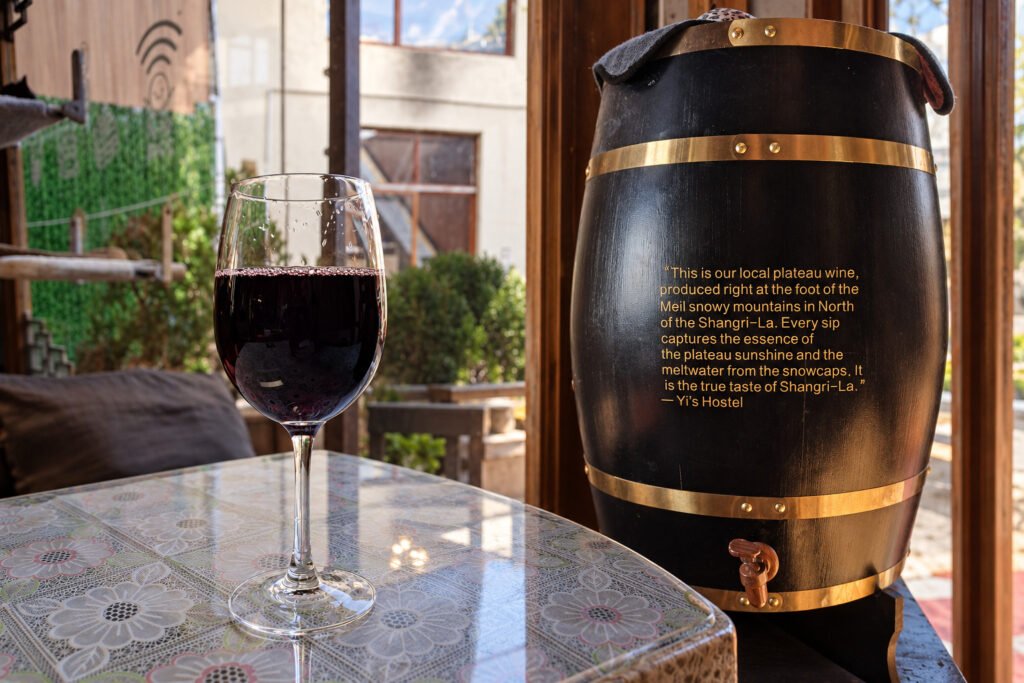
That evening we ate at the hostel, where the food was delicious, and sampled some local wine that our host kept in a large vat. Now, I have to admit, our expectations weren’t terribly high. Wine served from a vat in a Tibetan guesthouse wasn’t something we’d necessarily associated with fine drinking. How wrong we were. It was excellent. In fact, it was so good that we immediately developed a considerably greater interest in the local wine industry.
There is actually a fascinating history behind winemaking in this part of China. French Catholic missionaries brought European grape varieties and winemaking techniques to the Tibetan borderlands during the late nineteenth and early twentieth centuries, initially to produce sacramental wine. Local communities subsequently adopted and adapted the practice, and winemaking eventually became an established part of the region’s agricultural traditions. More than a century later, here we were, drinking remarkably good Tibetan wine in the mountains of China. Life can be rather surprising. And did I mention the wine was very, very good?
Unfortunately, the next morning wasn’t nearly as enjoyable. I woke feeling quite ill, and it was obvious that the combination of my respiratory problems, the room and the altitude wasn’t doing me any favours. I had medication with me and began taking it, but we decided that staying in Shangri-La for our originally planned visit simply wasn’t sensible. It was Saturday, and we arranged to leave on Monday. Not quite the Shangri-La experience I’d imagined.
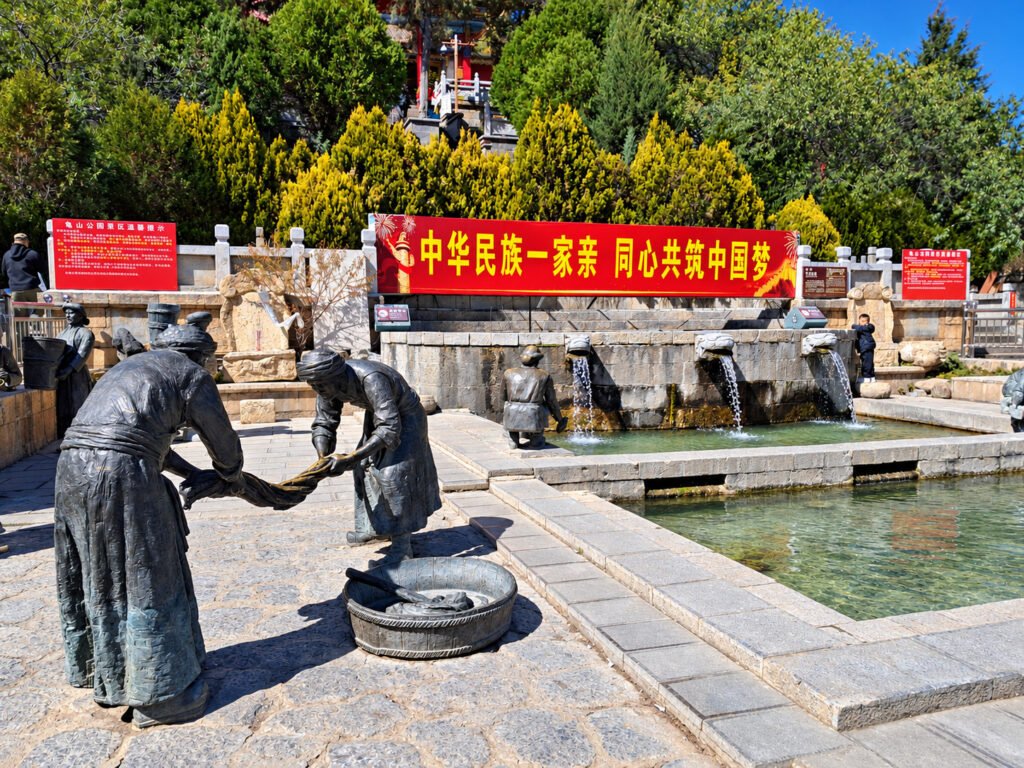
Saturday was therefore a fairly quiet affair. I managed a short walk around the old town, including a brief look at Moonlight Square and nearby Guishan Park, also known as Turtle Hill Park. Rising above the square is Dafo Temple, or Big Buddha Temple, alongside its enormous golden Tibetan prayer wheel. The prayer wheel is so large that it takes several people working together to turn it, and it dominates the skyline above the old town. It was an interesting glimpse of Shangri-La, but I wasn’t up to much more exploring.
The remainder of the day was devoted to the highly underrated travel activity of sleeping. I would have preferred to be wandering through the old streets, exploring the town and finding somewhere interesting to eat, but apparently my lungs had other ideas. For once, they were going to win the argument.
By Sunday morning I was feeling somewhat better, although I was still quite pleased with our decision to leave the following day. After a good breakfast, AP suggested we take a walk up to Baiji Si, a small Tibetan temple on a hill overlooking Shangri-La. It was only about two kilometres away. That sounded perfectly reasonable.
Our host showed us a shortcut, which turned out to be less of a shortcut and more of a goat track. From there, we climbed a very steep road, followed by what felt like at least a hundred steps, and then another steep track leading towards the summit. Under normal circumstances it would have been a decent walk. At 3,300 metres, with a respiratory infection, it was beginning to feel like a particularly ill-advised expedition. I stopped repeatedly to catch my breath, while AP continued to demonstrate the sort of enthusiasm for climbing hills that I find difficult to understand even when I’m perfectly healthy.
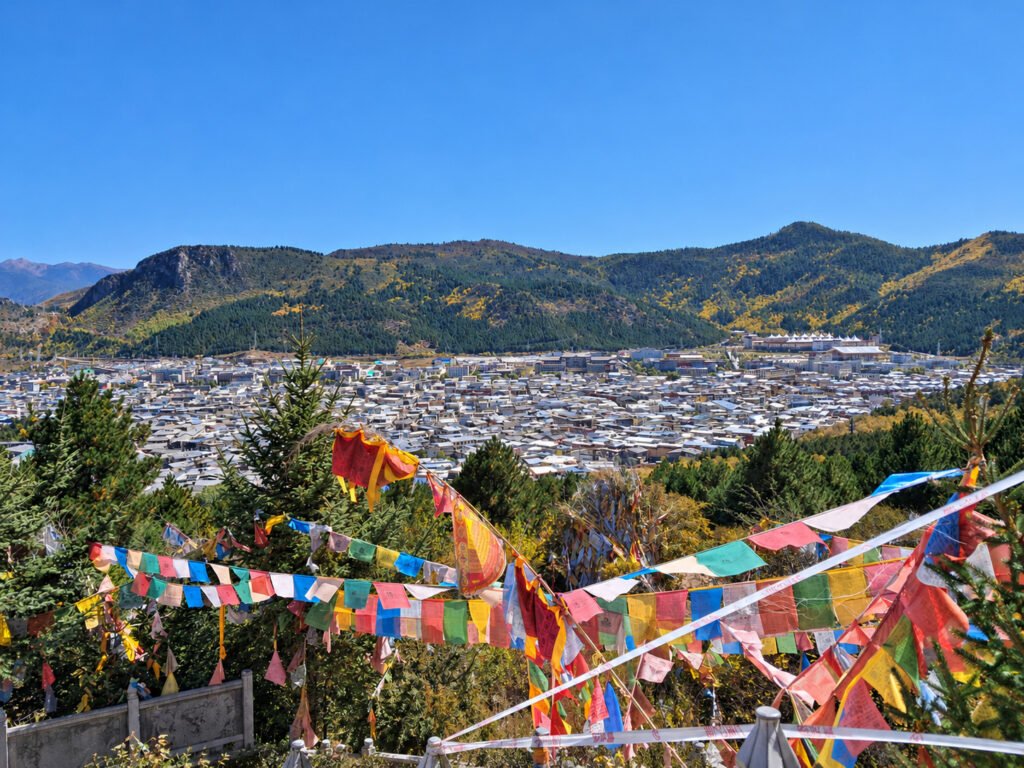
Eventually, we reached the top. Baiji Si, sometimes called the Temple of a Hundred Chickens, is a small and relatively little-visited Tibetan temple perched above the town. Locals come here to pray, and the surrounding hillside is decorated with colourful Tibetan prayer flags. The temple itself was a little tired and looked as though it could do with some tender loving care. But perhaps that was part of its charm. It certainly wasn’t a polished tourist attraction.
And those views really were magnificent. From the top, Shangri-La spread out below us, its rooftops clustered together against a backdrop of mountains and wide-open skies. Prayer flags fluttered across the hillside, adding wonderful splashes of colour to the landscape. It was the sort of view that reminded me why we make the effort to get to these places, even when the effort involves considerably more climbing than anticipated. I was pleased we’d made it to the top. I was even more pleased to be heading downhill.
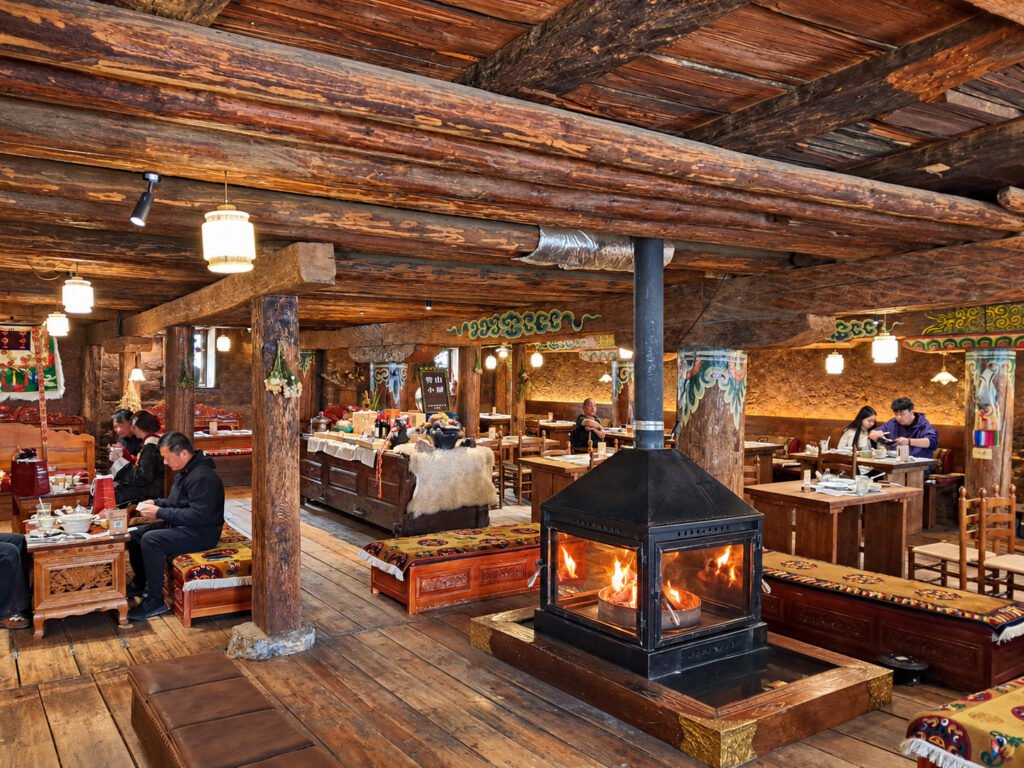
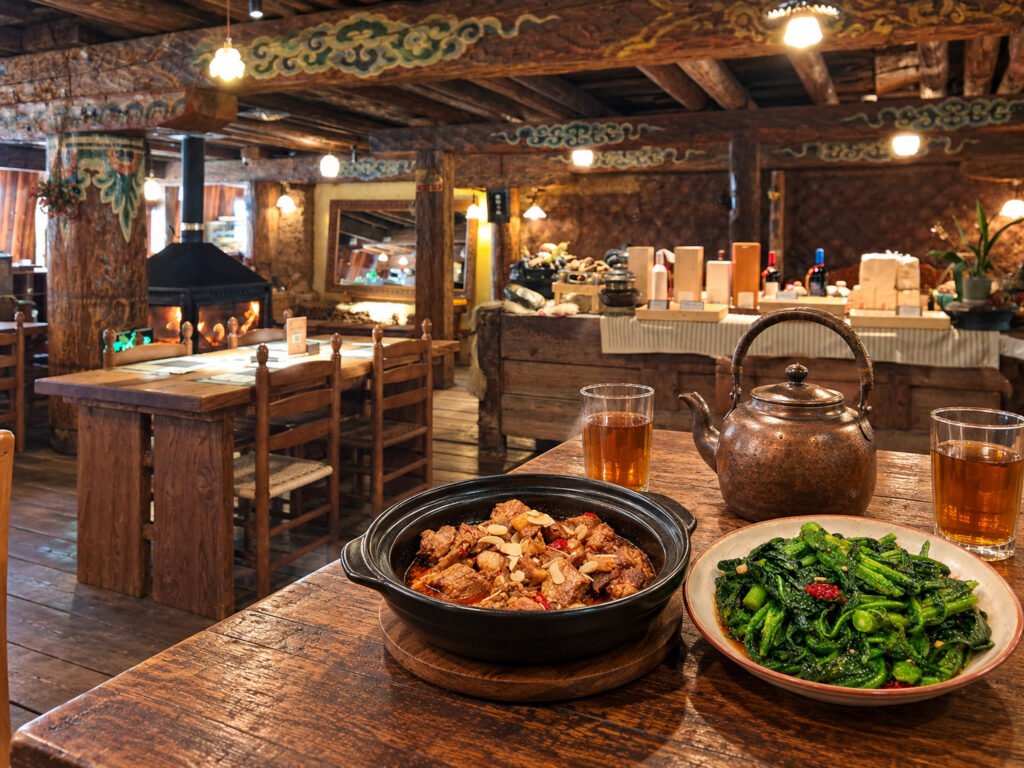
Before we’d set off that morning, our host had pointed out one of the town’s oldest buildings, now operating as a restaurant called Bina’s Old House. After our mountain expedition, we decided we’d earned a decent lunch. And what a find it turned out to be. Bina’s Old House is a beautifully restored traditional Tibetan residence dating back well over a century. Once home to a prominent local Tibetan family, the building retains much of its original architectural character, with substantial timber pillars and richly detailed interiors.
Today it operates as an upmarket restaurant and bakery, and the restoration is absolutely superb. The food was excellent, the service wonderful and the setting quite extraordinary. After spending the morning hauling myself up a mountain, sitting down to a lovely meal in such beautiful surroundings seemed a particularly civilised way to recover. It was undoubtedly one of the highlights of our short stay in Shangri-La.
After lunch, we wandered upstairs to admire more of the building. The restoration continued throughout, with beautiful timberwork and traditional architectural details. It was particularly pleasing to see an old building preserved so beautifully after witnessing what was happening to others around town. Bina’s Old House was proof that traditional Tibetan architecture could be retained while giving a building a new purpose. If only more people were taking the same approach.
There was just one small obstacle to appreciating it all. The photographers. Or, more accurately, the seemingly endless parade of Chinese visitors dressed in elaborate traditional-style costumes, posing for photographs. This wasn’t something confined to Bina’s Old House. Everywhere we went in Shangri-La, people were dressed in flowing robes, ornate headdresses and all manner of historical costumes, carefully arranging themselves for the perfect photograph.
Doorways, staircases, courtyards, streets. Nothing was safe. You could barely walk anywhere without finding yourself in the middle of someone’s photographic production. We found it all rather amusing, and a little odd. Although, to be fair, I imagine the Chinese find plenty of things about Western tourists equally peculiar. We wander around in hiking boots, photographing buildings and getting terribly excited about old doorways. They dress up and become part of the scenery. Perhaps they’re having more fun.
By Sunday evening the temperature had dropped below freezing, and we settled in around the fire at the hostel for our final dinner. AP enjoyed one last glass of the excellent high-altitude Tibetan wine while we watched other guests come and go. Shangri-La attracts plenty of walkers and trekkers, drawn by the surrounding mountains and the many hiking routes in the region. Some of the walks are relatively gentle, while others involve serious climbs and considerable altitude. After our little excursion that morning, I had a newfound respect for anyone who voluntarily chose to spend several days climbing mountains around Shangri-La.
Guests drifted in throughout the evening, some returning from a day’s hiking, others heading out or simply stopping for a meal or a drink. We chatted with a few of them as we sat around the fire, enjoying the warmth and the easy atmosphere of the guesthouse. It was a lovely way to spend our final evening, even if our visit hadn’t quite gone to plan.
The following morning, we were up early for the journey to Chengdu. I was feeling better, but I knew that recovering properly while staying at that altitude, in those conditions, was going to be difficult. As disappointed as I was to cut our visit short, I was happy to be moving on. Our lovely host drove us to the station, and we boarded the train for the six-hour journey to Chengdu.
As we left Shangri-La behind, I couldn’t help feeling that we’d only scratched the surface of this fascinating part of China. There was so much more to see, particularly beyond the town itself, but sometimes travel requires a little common sense. Something we don’t always have in abundance.
I’d arrived in Shangri-La expecting a mythical paradise. Instead, I’d found a fascinating Tibetan frontier town, spectacular mountain scenery, excellent food, surprisingly good wine and an altitude that left me struggling to breathe. I’d also seen some wonderful old Tibetan buildings, along with the rather sad sight of others being demolished and replaced with modern constructions. I hoped that places like Yi’s Hostel and Bina’s Old House would survive, because without buildings like these, Shangri-La risks losing much of the character that makes it worth visiting.
Perhaps James Hilton’s Shangri-La was a little more restful. Still, I can now say I’ve been to Shangri-La. And that’s something.
Next stop, Chengdu. A little less altitude and, with any luck, a lot more oxygen.