Hue: Imperial Cities, Misty Streets & Bun Bo Hue
Emperors, French food, ancient walls and a very good bowl of noodles
Given this was a relatively short trip, and in the interests of saving time, we flew to Hue.
Overland travel is nearly always our preferred way of getting around. You see more, you get a better sense of the country and, quite often, the journey itself becomes half the story. But sometimes there simply aren’t enough days in the holiday to spend one of them sitting on a bus.
So we flew.
We landed in Hue on a cool, misty February afternoon.
Now, you could be forgiven for thinking that Vietnam, being in Southeast Asia, would be hot all the time.
It isn’t.
Well, certainly not in central Vietnam in February.
Hue sits fairly close to the coast and has a much cooler, wetter winter than the south. The sky was grey, there was mist hanging around the hills and the temperature had us digging through our bags for layers we hadn’t expected to need quite so soon.
Our hotel was tucked down a small road within easy walking distance of the centre, and once we’d dumped the bags we headed straight back out.
I liked Hue almost immediately.
It felt very different from Saigon.
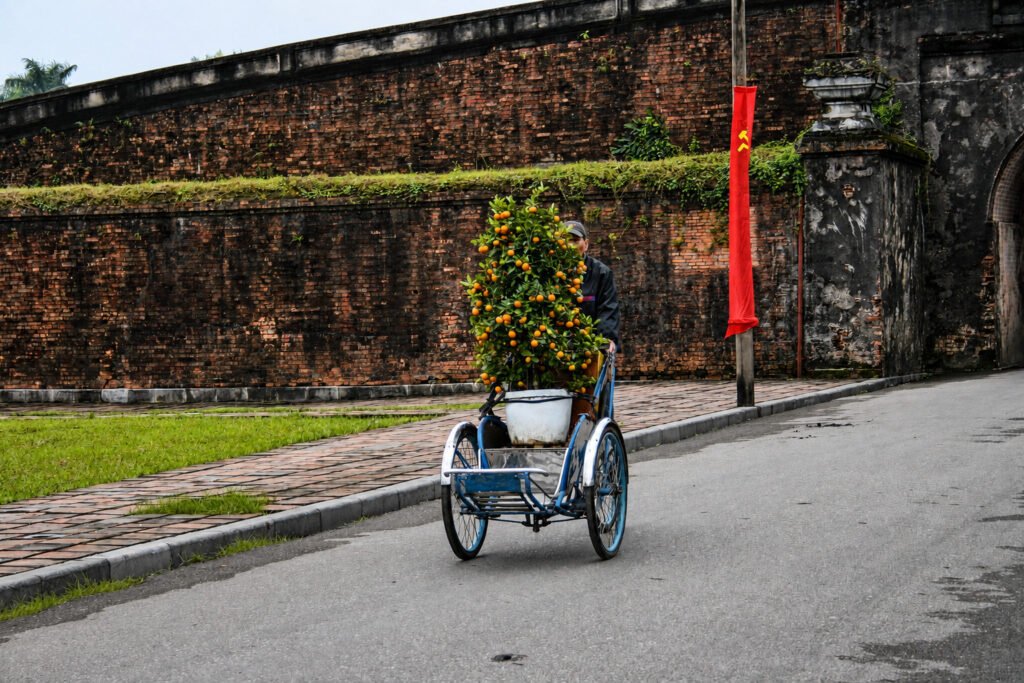
Saigon had been all movement, noise, traffic and motorbikes coming at you from every conceivable direction. Hue was quieter and slower, with wide streets, old walls, trees and the Perfume River cutting through the city.
It also had history everywhere.
Hue had been the imperial capital of Vietnam under the Nguyen dynasty from the early nineteenth century until 1945, when the last emperor, Bao Dai, abdicated. For more than a century this was where the emperors lived, ruled and built palaces, temples and tombs on a scale that suggested modesty was not particularly high on the imperial list of priorities.
Then came the French.
Vietnam’s relationship with France is complicated, to put it mildly.
Calling Vietnam simply a French colony isn’t quite accurate in every part of the country, although in practical terms French colonial rule certainly shaped much of modern Vietnam. From the late nineteenth century, Vietnam formed part of French Indochina. The south, Cochinchina, was administered directly as a colony, while central Vietnam, including Hue, became the French protectorate of Annam. The Nguyen emperors remained in Hue, but increasingly their power existed under French control.
So the emperor was still there.
The French were also there.
And everyone presumably understood who was actually making the important decisions.
The French left behind railways, government buildings, villas, cafés, Catholic churches, baguettes and a culinary influence that Vietnam took and very sensibly made its own.
Hue later found itself at the centre of another much darker chapter.
During the American War, the city became the scene of one of the bloodiest battles of the conflict. In early 1968, during the Tet Offensive, North Vietnamese and Viet Cong forces took control of much of Hue and held it for several weeks. The battle to retake the city involved intense street fighting and heavy bombardment, and large parts of the old imperial city were badly damaged.
Thousands of soldiers and civilians were killed.
Standing in modern Hue, with its traffic, cafés and people going about their day, it was difficult to reconcile the quiet city around us with what had happened there only a few decades earlier.
That first evening, however, history gave way to dinner.
While wandering around looking for somewhere to eat, we stumbled across a small French restaurant.
Perfect.
Now, you may think travelling all the way to Vietnam and eating French food is slightly ridiculous.
I don’t.
For one thing, Vietnam had been under French rule for decades, so French influence is woven into the country’s food and architecture whether anyone likes the history behind it or not.
And secondly, there are still quite a few French people living in Vietnam.
This particular restaurant was owned by a Frenchman and the food was excellent. Proper French food too, not something vaguely European with a few decorative parsley leaves and an optimistic name.
We ate extremely well.
So well, in fact, that the restaurant immediately went onto the very short list marked: places we should probably come back to before leaving.
The following morning we headed for the Imperial City.
You don’t really stumble across the Imperial City.
It announces itself.
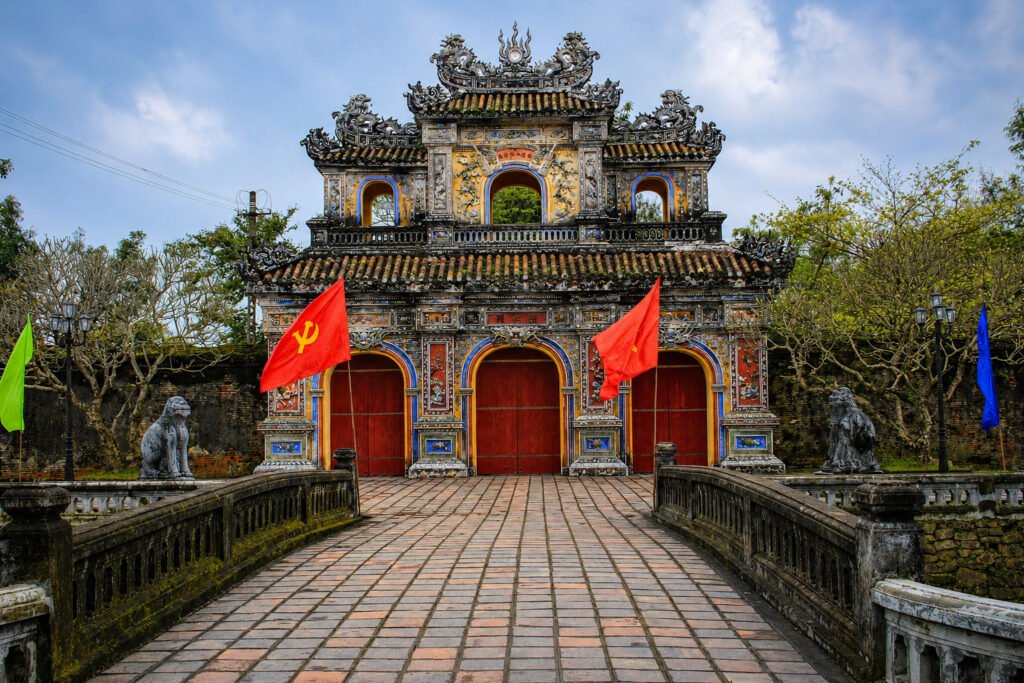
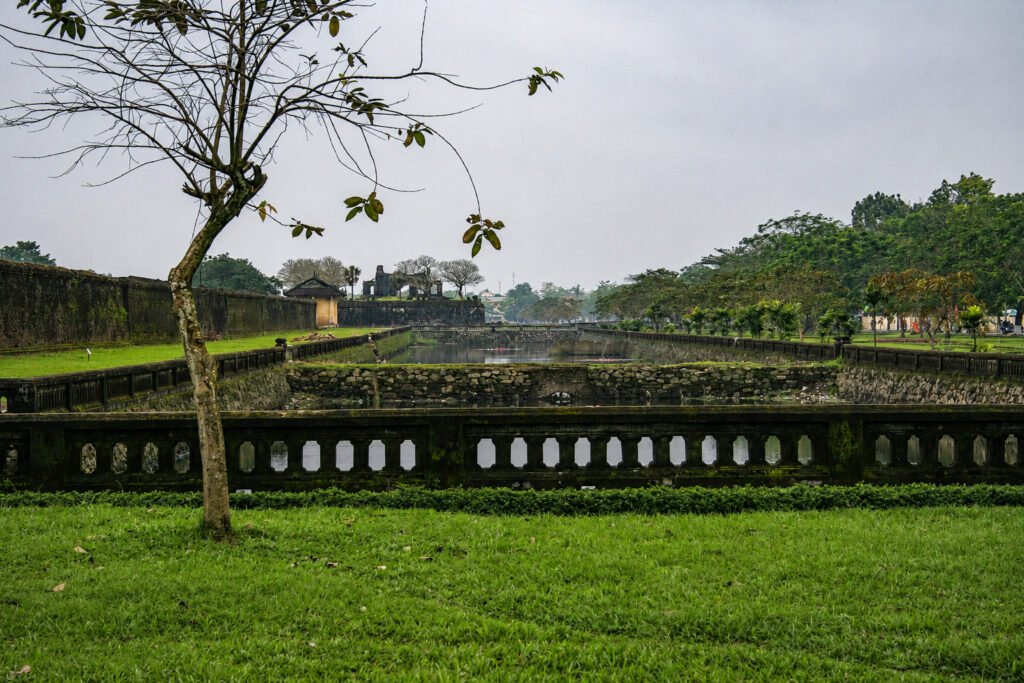
The old citadel occupies a huge area on the northern side of the Perfume River, surrounded by thick walls and a broad moat. Within those walls was the centre of imperial Vietnam: palaces, temples, ceremonial halls, gardens, administrative buildings and, right at its heart, the Forbidden Purple City, where the emperor and his household lived.
The whole complex was modelled in part on Beijing’s Forbidden City, although with a distinctly Vietnamese character.
We entered through one of the great gates and immediately realised this wasn’t going to be a quick wander around.
The place is enormous.
Long courtyards lead to elaborate gateways, ceremonial halls and pavilions, many decorated in deep reds, golds and blues. Dragons curl across rooflines, carved stone animals guard entrances and every now and then another courtyard opens up and you realise there is still considerably more to see.
It must have been extraordinary at its peak.
The Forbidden Purple City was the most private part of the complex and, as the name rather strongly suggests, ordinary people were not invited in. This was the world of the emperor, his family, concubines, servants and eunuchs.
Much of it was badly damaged during the wars of the twentieth century, particularly during the Battle of Hue, and large areas were destroyed.
That damage is still part of the story of the place.
Some buildings have been beautifully restored while elsewhere you find foundations, fragments of walls and open spaces where something once stood. Rather than spoiling the experience, I found it made the history feel more real. Hue’s Imperial City isn’t some perfectly preserved film set. It has survived emperors, colonial rule and war, although not always intact.
We wandered for hours.
There were gates within gates, courtyards beyond courtyards and enough ornate roof decoration to keep A.P.’s camera occupied indefinitely.
Impressive doesn’t really cover it.
Later we wandered along the Perfume River, which runs through the centre of Hue.
The name apparently comes from the scent of flowers that once fell into the water from orchards upstream, although on the day we were there I can’t say I noticed anything particularly perfumed about it.
Still, it is a lovely river.
Broad and slow-moving, it gives Hue much of its character. Dragon boats moved along the water, bridges crossed between the old and newer parts of the city and life carried on along the banks.
We eventually found our way to Dong Ba Market.
Markets had already become one of my favourite parts of Vietnam and Dong Ba didn’t disappoint.
It was huge.
Inside and around the market were stalls selling vegetables, herbs, fish, meat, clothing, household goods, spices, noodles, dried goods and things I couldn’t identify even after staring at them for several minutes.
There was very little of the neat presentation you get in a supermarket.
Produce was piled high in baskets, vendors sat amongst their goods and people squeezed past carrying bags, boxes and occasionally quantities of food that seemed physically impossible for one person to transport.
It was busy, messy and completely absorbing.
We spent far longer there than intended.
From the city we also made our way out to the Thien Mu Pagoda, sitting above the Perfume River a few kilometres from central Hue.
The seven-storey pagoda is one of the symbols of the city, rising above the river behind a set of stone steps. It dates back to the early seventeenth century and has been rebuilt and expanded several times since.
The setting was beautiful.
Gardens and temple buildings stretched behind the tower and the river lay below. Despite the visitors, there was a calmness about the place that was very different from the markets and streets in town.
Hue also turned out to be an excellent place to eat.
Not that this was becoming a problem anywhere in Vietnam.
One dish we had to try was bun bo Hue, the city’s famous noodle soup.
It is richer and spicier than pho, made with a deeply flavoured beef broth, thick round rice noodles, slices of beef and plenty of herbs. Depending on where you eat it, there may also be pork, chilli, lemongrass and other additions floating around in the bowl.
It is not subtle.
It is also delicious.
After one bowl I completely understood why Hue puts its own name on it.
We ate plenty of other Vietnamese food as well, usually in small local places where the furniture was basic, the menu required a little interpretation and the food was invariably excellent.
And then, on our final night, we went back to the French restaurant.
Of course we did.
We had found something good.
There was no reason to complicate matters.
All too soon our few days in Hue were over.
Next stop was Hoi An.
This time we weren’t flying.
We were taking the train south, along a section of railway we had been told was one of the most spectacular in Vietnam.
Mountains.
Coastline.
Sea views.
Apparently the lot.
It sounded promising.
Let’s see.