
Saigon: Markets, Motorbikes & the Art of Crossing the Road
Street food, colonial landmarks and our introduction to Vietnam
It was time for another adventure.
This time we decided to stay a little closer to home and head into our own region. We only had about three weeks, which wasn’t nearly long enough to see a country the size and shape of Vietnam properly, but three weeks was considerably better than no weeks at all.
Vietnam it was.
We flew straight into Saigon, or Ho Chi Minh City as it is officially known, although almost everyone we met seemed perfectly happy to call it Saigon. It is Vietnam’s biggest city, sprawling across the south of the country and home to millions of people, a significant percentage of whom appeared to own a motorbike.
Our first impression was noise.
Motorbikes, horns, buses, people, street vendors, music, construction and traffic all seemed to be happening at once.
Our second impression was that we loved it.
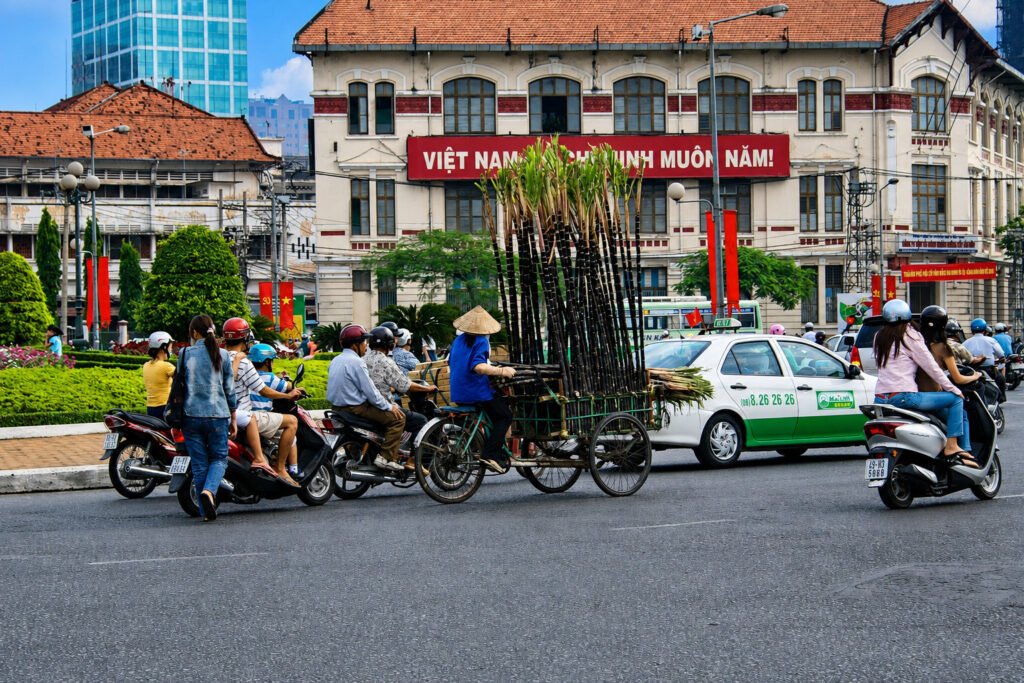
Saigon has that slightly chaotic energy that immediately makes you feel as though you have arrived somewhere completely different. The streets were packed from early morning until late at night, pavements doubled as parking areas, restaurants, shops and occasionally extensions of people’s living rooms, and motorbikes flowed around everything like water.
We spent the first couple of days simply finding our feet and wandering.
This is usually our preferred way of arriving somewhere new. Rather than immediately racing through a list of sights, we tend to walk, get lost, stop for coffee, work out how the transport works and generally watch the city going about its business.
There was plenty to watch.
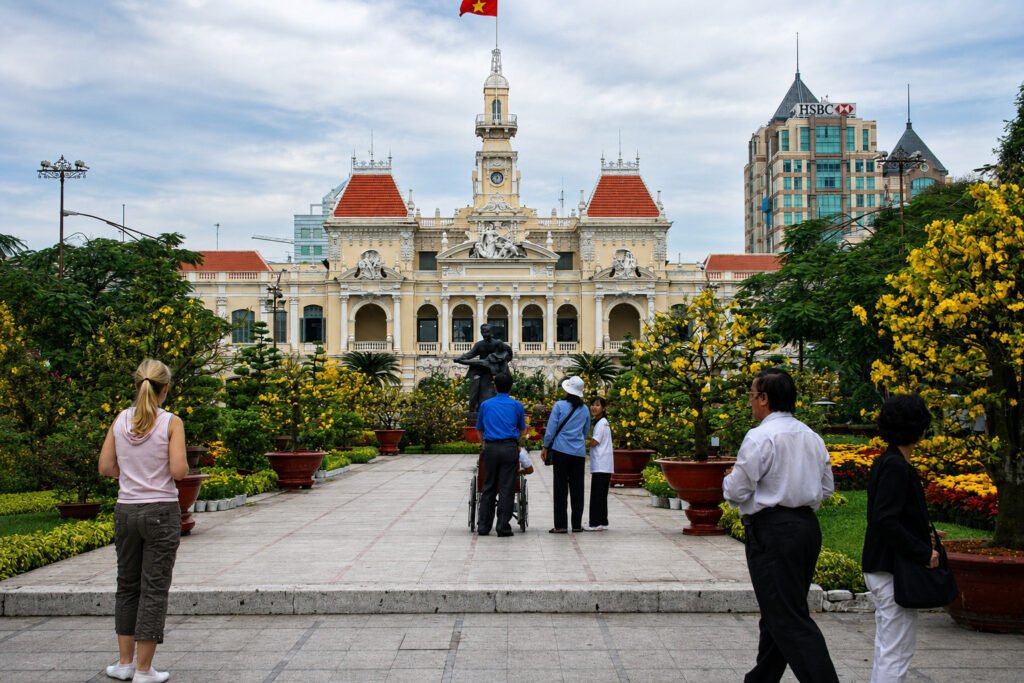
Saigon still has a surprising amount of French colonial architecture scattered amongst the modern towers, shops and endless rows of narrow buildings. The old Central Post Office was one of the grandest examples, a huge yellow building with arched windows and a cavernous interior that felt more like an old European railway station than somewhere you went to post a letter.
Across the road stood Notre-Dame Cathedral, built from red brick in the late nineteenth century, its twin towers rising above one of the busiest parts of the city.
Around it, naturally, were motorbikes.
Motorbikes parked on the pavement.
Motorbikes moving through the intersection.
Motorbikes coming from directions that did not appear to be recognised by conventional traffic laws.
By then we were beginning to understand that crossing the road in Saigon required a completely different approach from anything we were used to.
Waiting for a gap was pointless.
There was no gap.
If you waited for the traffic to stop, there was a very real possibility you would still be standing on the same corner several days later.
The trick, we discovered, was to step into the road and walk steadily.
Do not run.
Do not suddenly stop.
And absolutely do not change direction halfway across.
The motorbikes simply flowed around you.
At least that was the theory.
It took a little while before I was prepared to test it.
Our best method was to find a local who looked as though they were heading in roughly the same direction and attach ourselves to them.
Not literally, obviously.
Although there were moments when I considered it.
We would wait until a suitably confident-looking person stepped off the kerb and then follow closely behind, matching their speed and trying not to think too much about the hundred motorbikes coming towards us.
This technique became particularly useful around Ben Thanh Market.
The market itself is one of Saigon’s best-known landmarks, housed in a huge covered building packed with stalls selling just about everything imaginable — fruit and vegetables, meat, spices, coffee, clothing, bags, souvenirs, household goods and enough food stalls to keep you occupied for a week.
It was busy, hot, noisy and great fun.
But the real challenge was getting there.
In front of the market was one of the craziest traffic areas I had ever seen. Traffic poured around the large roundabout in a seemingly endless stream of motorbikes, buses, taxis and cars, all merging and separating with very little obvious concern for lane markings.
We stood on the edge watching it for a while.
Surely there had to be a pedestrian crossing somewhere.
There probably was.
Finding it was another matter.
Eventually a woman carrying several shopping bags stepped confidently into the traffic.
Excellent.
We had found our guide.
We followed her.
Closely.
She crossed the road without the slightest hesitation while motorbikes passed in front of her, behind her and occasionally in spaces I would not have thought large enough to contain a motorbike.
We stuck to her like glue.
She probably had no idea that she had acquired two Australian tourists, but she got us safely to the other side.
Top tip for Saigon: if in doubt, find a local crossing the road and follow them.
They know what they’re doing.
Once inside the market we wandered for ages, looking at the food stalls, trying things we didn’t recognise and attempting to avoid buying things we had absolutely no need for.
Vietnamese markets have a wonderful habit of drawing you in. One minute you are looking at vegetables and the next you are negotiating over a bag, drinking iced coffee and wondering whether you have enough room in your luggage for something you hadn’t known existed ten minutes earlier.
We also visited the Reunification Palace, one of the most interesting buildings in the city.
The palace had been the home and workplace of the president of South Vietnam and became one of the defining locations of the end of the American War when tanks entered its grounds in April 1975.
Inside, much of it felt frozen in another era.
There were huge reception rooms, meeting rooms, offices, old telephones, maps and furnishings that looked as though everyone had simply walked out one afternoon and never returned.
Downstairs, the atmosphere changed completely.
The basement contained communication rooms, bunkers and narrow corridors filled with old radio equipment and military maps.
Given A.P.’s background, this naturally took considerably longer to inspect than the decorative rooms upstairs.
I have learned over the years that when travelling with someone who has spent much of his working life around broadcasting and communications equipment, an old radio room is never simply an old radio room.
Every switch apparently has a story.
We also visited the War Remnants Museum.
It was not an easy place to visit, nor should it be.
The displays covered the American War from the Vietnamese perspective, with photographs, military equipment and personal stories showing the enormous human cost of the conflict.
Some of the photographic exhibitions were confronting and stayed with us long after we left.
Outside were tanks, aircraft and other military equipment, but it was the photographs inside that had the greatest impact.
Afterwards we walked for a while without saying much.
That was another side of Saigon.
The city was energetic, noisy and increasingly modern, but the recent past was never very far away.
Then, usually within a few streets, we would find ourselves back amongst cafés, shops, market stalls and motorbikes and the city would carry on around us.
Food quickly became a major part of our days.
Some of the best meals came from places we would never have found if we had been looking for anything polished or obvious.
Tiny restaurants were hidden down even tinier lanes, sometimes with just a few plastic stools and tables squeezed into whatever space was available.
We would walk down an alley barely wide enough for two motorbikes to pass and suddenly find a little restaurant full of people eating bowls of noodles, grilled meat, herbs and things bubbling away in large pots.
Those were usually the places we wanted.
Menus were sometimes limited, English was often even more limited and ordering could involve pointing at somebody else’s dinner.
It generally worked.
We ate bowls of pho, plates of grilled pork, fresh herbs, rice dishes, noodles and wonderfully crisp bánh mì filled with meat, pâté, pickled vegetables and chilli.
There were spring rolls that bore little resemblance to anything sold under that name back home, bowls of soup fragrant with herbs and lime, and endless glasses of strong Vietnamese coffee.
The coffee deserved a category of its own.
Vietnamese coffee is strong enough to restart machinery.
It drips slowly through a small metal filter into a glass, often over a generous layer of condensed milk, producing something halfway between a coffee and dessert.
I became very fond of it.
Possibly too fond.
We spent a lot of time simply wandering through different neighbourhoods, slipping down side streets and watching daily life unfold around us.
A woman would be cooking over a small charcoal stove on the pavement while somebody repaired a motorbike beside her. A few metres away someone else would be cutting hair, washing dishes or selling fruit from baskets hanging from either end of a pole.
Entire businesses appeared to operate from spaces no larger than a cupboard.
And somehow it all worked.
The traffic continued to look completely impossible but after a few days we stopped flinching every time we crossed a road.
Mostly.
We learned that the horn wasn’t necessarily an expression of anger. Often it simply meant, I’m here.
Which, given the number of vehicles sharing the road, was probably useful information.
By the time we were ready to leave Saigon we had settled into its rhythm surprisingly quickly.
We loved the food, the markets, the little lanes and the sheer energy of the place.
It was huge, noisy, crowded and occasionally completely bewildering.
It was also fascinating.
There was something happening everywhere you looked.
Saigon had a slight insanity about it, but it was a very likeable sort of insanity.
And after a few days of learning how to cross the road without being flattened, drinking far too much coffee and eating some of the best food we’d had in ages, it was time to move on and see what the rest of Vietnam had in store.
It was time to go to Hue